Why BNP leader Tarique Rahman’s return to Bangladesh matters ahead of vote
 26 December 2025
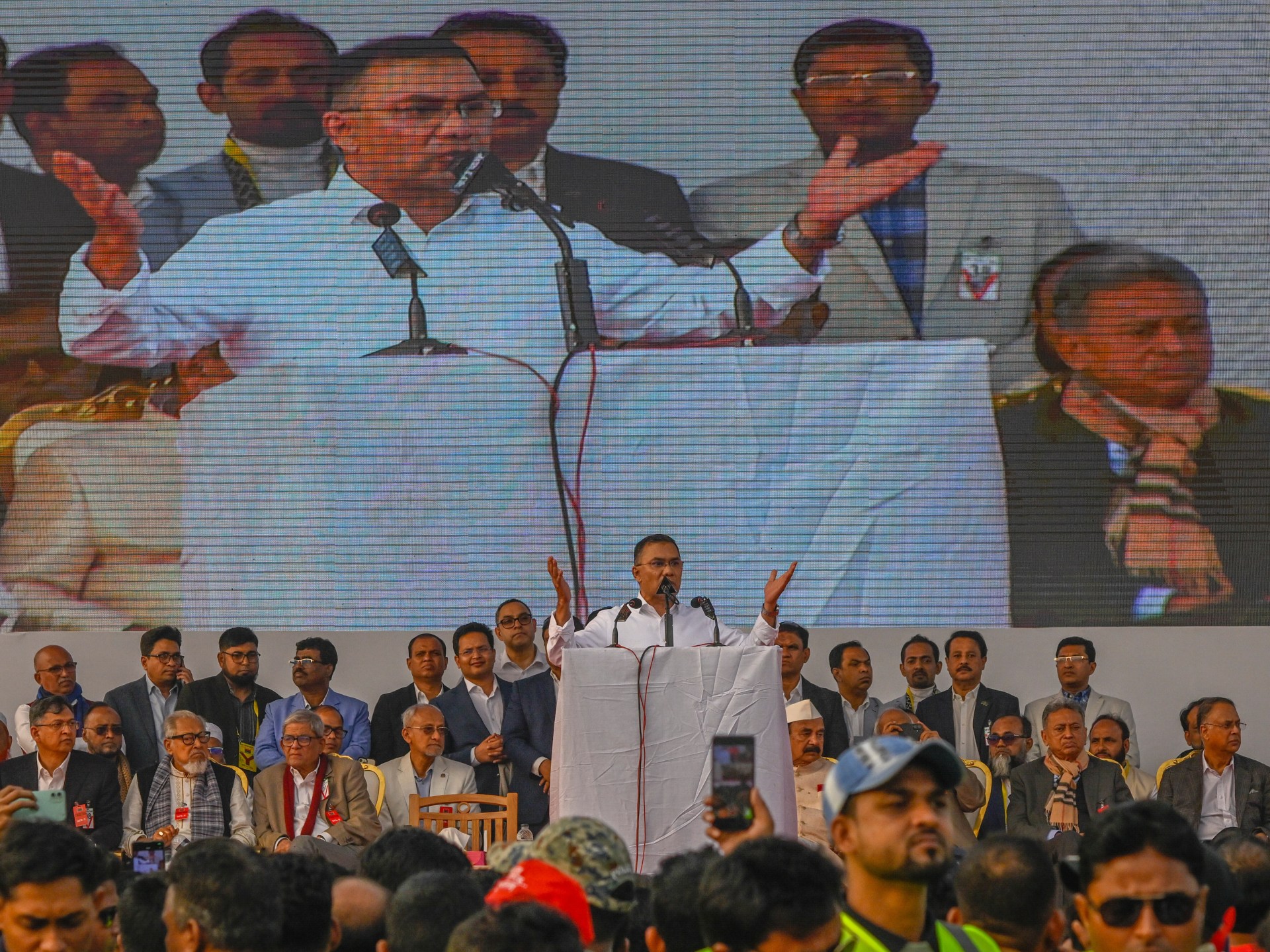

Dhaka, Bangladesh — Standing amid a sea of people on the outskirts of Dhaka, Tarique Rahman, the acting chairman of the Bangladesh Nationalist Party (BNP), declared that he had “a plan for the people and for the country”.
It’s a plan that has been 17 years in the making. On Thursday, the son of the critically ill BNP chairperson and former Prime Minister Khaleda Zia landed in Dhaka, returning from Britain, where he had lived in exile since 2008. Tens of thousands of supporters gathered at a rally to welcome him home.
“We want peace,” Rahman said. “We have people from the hills and the plains in this country – Muslims, Hindus, Buddhists and Christians. We want to build a safe Bangladesh, where every woman, man and child can leave home safely and return safely.”
His return comes at a time of heightened political uncertainty and tension in Bangladesh, following the assassination of prominent youth leader Osman Hadi and with a national election scheduled for February 2026. The BNP has long been widely seen as the frontrunner in the polls, with Rahman viewed as a leading contender for the prime ministership.
But the escalating violence in the country following Hadi’s assassination — the offices of the country’s two leading newspapers were set on fire, and a Hindu man was lynched — and deepening political tensions had led to fears that the election might be derailed.
Analysts say that Tarique Rahman’s return and his speech are likely to help calm the country’s political waters and reinforce the momentum for Bangladesh to hold its election as planned.
Advertisement
“His arrival has opened a new window of opportunity. I think this will reduce the uncertainty about election and create a sense of stability that the country is looking for,” said Asif Mohammad Shahan, professor of development studies at the University of Dhaka.
None of this was guaranteed even a few days ago.

Uncertainty to stability
With his mother, Khaleda Zia, critically ill, Rahman, whose father Ziaur Rahman was president from 1977 until his assassination in 1981, had long been expected to play a decisive role in shaping the BNP’s prospects at the upcoming elections. Until recently, however, his return from exile had remained uncertain.
Rahman himself had demurred on committing to return. His arrival now clears that uncertainty but opens up a new question, said Shahan: Can Rahman truly lead?
“If he takes a firm stance against extremism, assures the people that he understands their concerns and will work for a stable political future, promises to bring about normalcy and shows that he is ready to govern while establishing a firm control over party apparatus, the political situation will improve significantly,” Shahan said.
But if Rahman fails to deliver a clear message, “things will deteriorate,” Shahan said.
Mubashar Hasan, an adjunct researcher at the Humanitarian and Development Research Initiative (HADRI) at Western Sydney University, said the public fervour visible on Thursday over Rahman’s return suggested that he might benefit from support beyond the traditional BNP voter base.
“People’s interest and reaction to his return is not limited to the BNP alone, but includes people from all walks of life,” Hasan said, adding that many in Bangladesh will likely see the party as a stabilising force amid the chaos of the past 16 months, since the ouster of former PM Sheikh Hasina following massive student-led protests. The interim government of Nobel laureate Muhammad Yunus, which assumed office after Hasina fled to India in August 2024, has faced increasing criticism over its failures to ensure law and order, and to deliver on broader promised reforms.
The enormous rally by supporters to greet Rahman also showed the BNP’s organisational and political strength, Hasan said.
But there’s another factor, too, that could work in Rahman’s favour, said Hasan: On the streets of Bangladesh, many believe that Khaleda Zia’s son was treated unjustly and forced to leave the country. Under a military-backed caretaker government that was in power between 2006 and 2009, Rahman faced a range of charges. He was subsequently convicted, in absentia, in some of those cases.

The return of the son
After the BNP last lost power in 2006, the political tide had flowed against Rahman.
Advertisement
He faced a series of convictions, from murder to corruption, while stories of his alleged misdeeds ran prolifically in the Bangladeshi media during the years of Sheikh Hasina’s government.
However, he nevertheless succeeded in keeping a strong hold over his party and maintained its unity. The 2024 uprising gave him a second chance. All the cases against him were dropped over the last year and a half, and convictions were stayed, paving the way for his return.
“Tarique Rahman’s defining trait as a politician will be his focus on policy. He is known as a policy buff within his inner circle and in today’s speech in front of millions of supporters, he stated repeatedly that he has a plan,” said US-based Bangladeshi geopolitical columnist Shafquat Rabbee.
One key aspect of his plan that will be watched closely across South Asia is his approach to India.

‘Adult in the room’
Traditionally, India has had a mostly cold relationship with the BNP, maintaining functional ties whenever the Bangladeshi party was in power, but far too often making it clear that it preferred Hasina and her Awami League as its partner.
The BNP’s decades-old alliance with the Jamaat-e-Islami, the country’s largest Islamist group, didn’t help ties with India. The Jamaat had opposed Bangladesh’s independence from Pakistan and has historically favoured closer relations with Islamabad.
But in recent months, even as anti-Hasina sentiment in Bangladesh has led to intense anti-India rhetoric from several political groups in the country, the BNP has maintained a comparatively restrained posture.
It has also broken up with the Jamaat, and has tried to position itself as a centrist party, seemingly eager to occupy the political space vacated by the Awami League, which has been banned from participating in the February election.
Although Tarique Rahman has adopted a “Bangladesh First” slogan, political observers believe he is unlikely to be a firebrand anti-Indian politician.
“The baseline assumption for India with Tarique back in Bangladesh will be that the Indians will finally have an adult in the room with serious political muscle to negotiate with,” Rabbee said.
Recent political surveys in Bangladesh show the BNP and the Jamaat are running close ahead of the election, with a significant number of voters still undecided.
There too, Rahman’s return should help the BNP, said analysts.
“His presence will definitely energise the party base and encourage undecided voters to break for the BNP,” Shahan of the University of Dhaka said. “If he performs, we may very well see a ‘wave’ election where the BNP can win in a landslide.”
For that to happen, though, Rahman will need to show that “he can connect with people, reassure them, and provide a clear pathway for reform and democratic transition,” Shahan said.
Related News
Worker at France’s Elysee Palace to face trial over alleged theft
Polish jets intercept Russian reconnaissance plane spotted near airspace
‘We have to have it’: Trump renews push for Greenland as Denmark protests