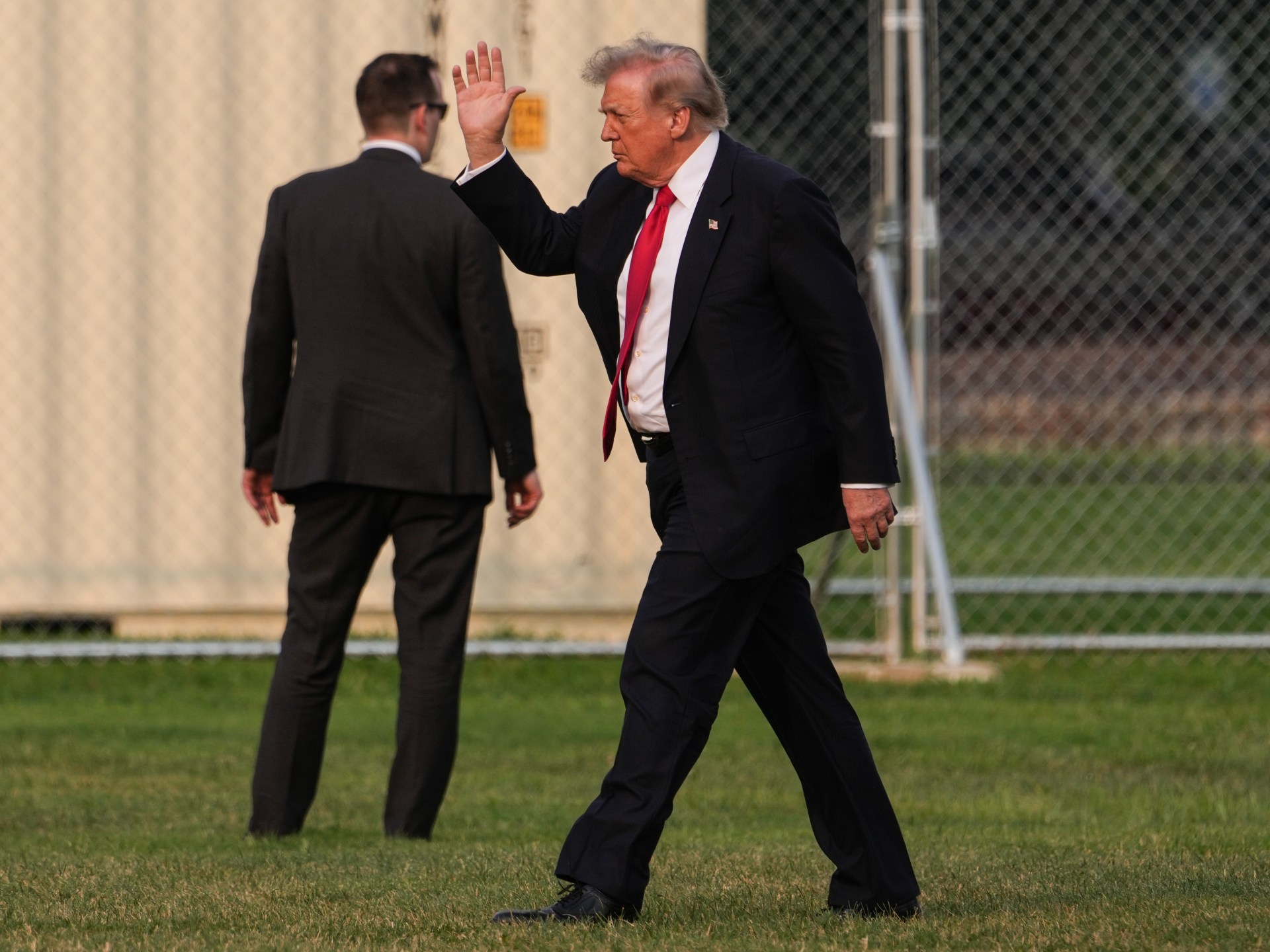

United States President Donald Trump has pledged a major escalation against Iran after the latest Iranian attacks on US military sites in the Middle East.
Trump made the threat in an expletive-laden interview with Fox News reporter Trey Yingst on Wednesday.
- list 1 of 3Iran missiles target US forces in Jordan after a five-day pause in war
- list 2 of 3Trump promises to hit Iran hard after missile attacks on US forces
- list 3 of 3Iran and Oman swap proposals to manage Strait of Hormuz: What we know
end of list
Quoting Trump, Yingst said the president promised to “beat the f****** s*** out of them”.
“We’ll be hitting them hard,” Yingst quoted the president as saying. “They’re going to get a beating.”
The comments come a day after Iran said it attacked US forces at a military base in Jordan, the latest salvo in a five-month-long conflict.
Trump’s remarks threaten to once again derail the latest detente after the US paused its strikes for several days starting on Saturday following 13 days of consecutive attacks.
A ceasefire reached last month as part of a memorandum of understanding (MoU) between Washington and Tehran dissolved in early July.
On Tuesday, Iran’s Islamic Revolutionary Guard Corps (IRGC) said it targeted an airbase and US Central Command (CENTCOM) centre in Jordan.
The IRGC warned of further attacks in a statement. “As long as threats against the Islamic Republic of Iran continue and illegal and vicious actions by American forces against our interests continue, the resistance will continue,” it said.
CENTCOM, meanwhile, described the attack as an “attempted surprise attack on US forces based in the Middle East”.
All the missiles were intercepted, and “US forces remain vigilant and at a high state of readiness”, CENTCOM added.
The attack comes after three US soldiers were killed at an airbase in Jordan on July 17. Experts have said the killings underscored Iran’s ability to inflict deadly damage on military installations where American soldiers are deployed as US officials have warned of a diminishing supply of air defence interceptors.
Advertisement
Despite the US’s military superiority, critics have warned that Iran maintains the ability to conduct a grinding asymmetrical war. At least 18 American soldiers have been killed since the war began in February.
The latest Iranian attacks were launched just hours after Trump met Israeli Prime Minister Benjamin Netanyahu at the White House on Tuesday.
Netanyahu has long been perceived as influencing Trump to take a more aggressive approach towards Iran.
Despite launching the war on Iran together on February 28, the US and Israel have diverged on whether and how to continue the conflict.
Israel has pushed for the continuation of the war with the aim of changing Iran’s government.
It has also opposed any agreement that could allow Iran to continue its nuclear programme, which Tehran for years has maintained is only for civilian purposes.
The Trump administration, meanwhile, has repeatedly sought ceasefires that would allow it to frame the conflict as a strategic victory. Trump himself has alternated between calls for diplomacy and threats of escalation throughout the war.
In April, he infamously pledged that a “whole civilisation will die tonight”, just hours before announcing an agreement to pause the fighting.
More recently, Trump has floated seizing Iran’s Kharg Island, an important port for Iranian oil products, but that prospect would all but assure US troops on the ground.
He also threatened to strike Iran’s Pickaxe Mountain nuclear site as well as civilian infrastructure, including bridges and power plants. International law experts and human rights groups have said such attacks would constitute war crimes.
Public opinion polls have shown low US support for the war. Even members of Trump’s Make America Great Again (MAGA) movement have questioned whether any benefits outweigh the costs, including rising fuel prices precipitated by the closure of the Strait of Hormuz.
On Tuesday, Netanyahu, who faces elections in October, described his meeting with Trump as “excellent”.
He said the conversation was full of “partnership, mutual support and a shared understanding of our common goal to ensure Iran never acquires nuclear weapons, along with other objectives”.
The White House offered a more staid response with a spokesperson saying in a post on the social media platform X that the meeting was “positive and productive”.
Related News
Trump targets Spain, NATO backs Ukraine: Is the alliance still united?

VIDEO: Messi, Rodri speak to media ahead of Argentina-Spain World Cup final
Venezuela gov’t and opposition to hold talks aimed at path to elections