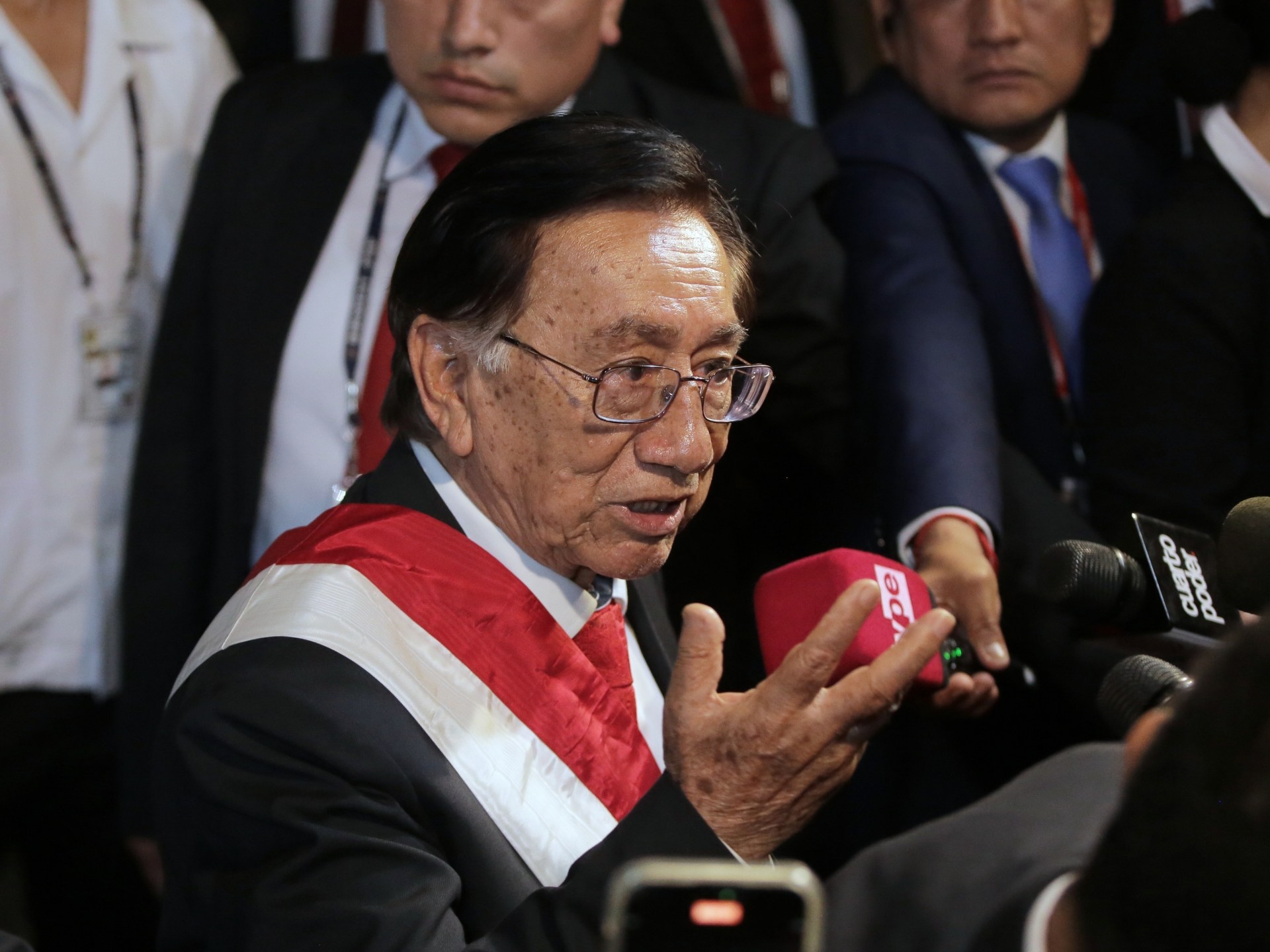

Two cabinet-level ministers in Peru have resigned after interim President Jose María Balcazar announced he would defer a decision to purchase F-16 fighter jets from the United States company Lockheed Martin.
Defense Minister Carlos Diaz and Foreign Minister Hugo de Zela cited their opposition to move in their resignation letters on Wednesday.
- list 1 of 3Pressure mounts on Peru’s election authorities amid presidential race delay
- list 2 of 3Peru’s election chief steps down amid frustration over long vote count
- list 3 of 3Peru’s election chief steps down amid chaotic general election
end of list
“A strategic decision has been taken in the area of national security with which I have a fundamental disagreement,” Diaz wrote.
The fighter jets have long been a source of controversy in Peru, where critics have questioned whether the purchase is a sign of deference to US President Donald Trump.
Last week, the left-wing Balcazar — Peru’s ninth president in a decade — announced he would leave the decision about whether to invest $3.5bn in the purchase to country’s next elected leader.
Balcazar himself had only been in office since February, selected by Congress to replace the latest in a string of impeached presidents.
Last week, he abruptly cancelled a signing ceremony for the F-16 deal, which would have seen an initial batch of 12 new planes added to Peru’s aging air force. The country aims to acquire 24 jets overall.
Balcazar explained he was not pulling out of the deal, but that he felt the next presidential administration should be involved in making such a hefty financial commitment.
“For us to commit such a large sum of money to the incoming government would be a poor practice for a transitional government,” Balcazar said at the time.
“We remain firm in respecting all agreements that may have been reached at the level of the armed forces, or in this case with the relevant ministry of the air force, to carry out the corresponding negotiations.”
Advertisement
His decision, however, was met with pushback, both domestically and from the US. The US ambassador to Peru, Bernie Navarro, responded on April 17 with a warning posted on social media.
“If you deal with the U.S. in bad faith and undermine U.S. interests, rest assured, I, on behalf of
[President] Trump and his administration, will use every available tool to protect and promote the prosperity and security of the United States and our region,” Navarro wrote.
Critics of the deal, however, have argued that Peru has received more competitive offers from French and Swedish aircraft makers like Dassault Aviation and Saab AB, respectively.
But Navarro on Wednesday denied that the US had been outcompeted. In a statement, he wrote that the “bid was made at a high level of competitiveness” and called the airplane feet “the most technically advanced fighter jets ever built”.
He also denounced the delay as an unreasonable stoppage on a deal he characterised as already signed.
“In planning the delivery of a product of this calibre, there is no such thing as an inconsequential delay,” he wrote.
“Every delay results in significant costs. The same package cannot be available in a couple of months, or even weeks.”
The decision to spend the $3.5bn on 24 fighter jets was struck in 2024 under former President Dina Boluarte. The purchase was to be financed by $2bn in domestic borrowing in 2025 and $1.5bn in 2026.
In September, the US Defence Department approved a potential sale of F-16s to Peru.
But Boluarte was removed from office in October, and her successor, Jose Jeri, lasted just four months in office before he too was impeached.
The instability in Peru’s presidency comes at a time when the Trump administration is seeking greater influence over Latin America, as part of what the US president has called his “Donroe Doctrine”.
Already, the Trump administration has pushed Peru to distance itself from Chinese investment. In February, for instance, it publicly protested against Chinese ownership in the Pacific port of Chancay.
“Peru could be powerless to oversee Chancay, one of its largest ports, which is under the jurisdiction of predatory Chinese owners,” the Trump administration wrote in social media post.
“We support Peru’s sovereign right to oversee critical infrastructure in its own territory. Let this be a cautionary tale for the region and the world: cheap Chinese money costs sovereignty.”
Just this week, one of Trump’s allies, Representative Maria Elvira Salazar, warned that the Chinese-owned port was a danger to the US.
Advertisement
“That’s a direct threat in our hemisphere, right in the country of Peru,” she told a congressional committee. “For that reason, the new Peruvian government, which will be elected next June, must take it back.”
She added that, if the Peruvian government responded accordingly, “the United States will help them under the Trump administration”.
The country, however, is enmeshed in a messy presidential race replete with vote-counting delays and accusations of malpractice.
Election experts have said there is no evidence of voter fraud. But the slow vote count has left the race’s outcome undetermined, more than a week after the ballots were cast on April 12.
Right-wing leader and former First Lady Keiko Fujimori is all but assured of progressing to a runoff in June. But who will join her is uncertain.
Left-wing Congress member Roberto Sanchez is currently in the lead in the race for second place, with 12 percent of the votes tallied, but far-right candidate Rafael Lopez Aliaga, a former mayor, is close behind with 11.9 percent. Lopez Aliaga has been a vocal supporter of the Trump administration.
The final vote count for the first round of the election is expected to be delivered in May.
Traditionally, Peru’s new president should be sworn in on July 28, the country’s independence day.
Related News

Senate vote on arms sale shows ‘massive cracks’ in US support for Israel
Trump’s Labor Secretary Lori Chavez-DeRemer latest to leave administration
Cloud over US-Iran talks: What are the key sticking points?