
United States President Donald Trump has claimed a second round of negotiations with Iran will take place in Pakistan on Tuesday as mediators try to revive negotiations before the end of an ongoing yet fragile two-week ceasefire.
The announcement on Sunday came alongside a sharp escalation in rhetoric. Trump warned that Iran must agree to a deal “one way or another – the nice way or the hard way” and threatened to target key infrastructure if negotiations fail. He also renewed his threat of striking “bridges and power plants”, which experts said could amount to war crimes under international law.
- list 1 of 3Trump says US seized Iranian ship trying to get past blockade near Hormuz
- list 2 of 3Oil prices surge amid mixed signals on US-Iran peace talks
- list 3 of 3To stay or to go? No good options for Lebanon’s displaced
end of list
Iran, however, has so far denied it will participate in the talks, accusing the US of “armed piracy” after US forces struck and seized an Iran-linked tanker on Sunday, further heightening tensions between the longtime adversaries.
What has the US said?
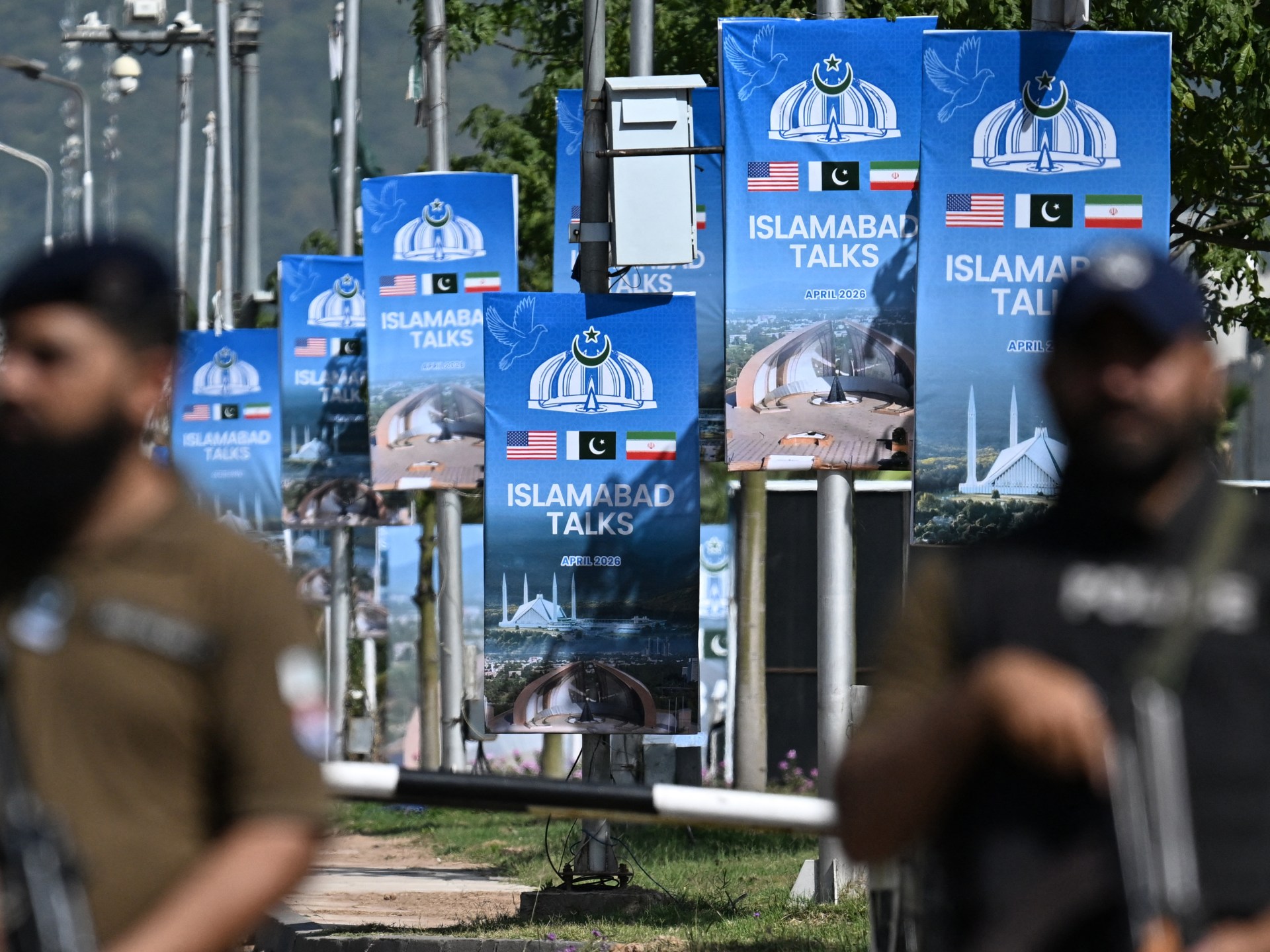
On Sunday, Trump announced that US negotiators would travel to the Pakistani capital, Islamabad, on Monday for talks aimed at ending the US-Israel war on Iran.
In a social media post, the president did not say which officials would be sent to the talks. Last weekend’s first round of talks, at which Vice President JD Vance led the US delegation, ended without a deal.
Trump accused Iran of violating their two-week ceasefire, which is due to expire on Wednesday, by opening fire on Saturday in the Strait of Hormuz. The US president threatened to destroy civilian infrastructure in Iran if it doesn’t accept the terms of the deal being offered by the US.
Advertisement
“We’re offering a very fair and reasonable deal, and I hope they take it because, if they don’t, the United States is going to knock out every single power plant, and every single bridge, in Iran,” Trump wrote on his Truth Social platform.
In a further escalation, Trump said an Iranian-flagged ship called the Touska was “stopped” by US forces in the Gulf of Oman “by blowing a hole in the engine room”. He said it was trying to get past the US naval blockade of Iranian ports.
US forces boarded the ship and took physical control of the vessel.
How has Iran responded?
Iran’s Khatam al-Anbiya military headquarters confirmed the US attack on the Iranian-flagged tanker and said it would “respond soon”.
Then, Iran’s Tasnim News Agency reported that Iranian forces had sent drones in the direction of US military ships.
Ebrahim Azizi, the head of the Iranian parliament’s National Security Committee, told Al Jazeera that Iran’s actions during talks with the US are strictly guided by national interests and security.
When asked if Tehran intends to participate in the talks in Islamabad, he said, “Iran acts based on national interests.”
“We see the current negotiations as a continuation of the battlefield, and we see nothing other than the battlefield in this,” he said. “If it yields achievements that sustain those of the battlefield, then the negotiation arena is also an opportunity for us … but not if the Americans intend to turn this into a field of excessive demands based on their bullying approach.”
What are the key points of friction now?
Since the start of the war on February 28, a number of new sticking points have emerged – alongside old challenges:
Strait of Hormuz
A central dispute is over the Strait of Hormuz, a critical global shipping route linking the Gulf to the Arabian Sea. One-fifth of the world’s oil and liquefied natural gas (LNG) supplies were shipped through the strait before the war began.
Iran insists on sovereignty over the waterway, which lies within the territorial waters of Iran and Oman and does not fall into international waters, and stated that only “nonhostile” ships could pass. It has also floated the idea of levying tolls while Washington demands full freedom of navigation.
After the war began, Iran in effect closed the strait by forbidding transits, attacking ships and reportedly laying sea mines. Shipping traffic has since dropped by 95 percent.
A week ago, the US implemented a blockade of its own. Its Navy has been blocking Iranian ports to pressure Tehran to reopen the vital waterway, adding another obstacle to the talks.
Advertisement
According to Rob Geist Pinfold, a lecturer in international security at King’s College London, Trump’s stance on the strait has shifted during the conflict and remains unclear.
“We’ve had Trump say that he would be open to jointly controlling the Strait of Hormuz with Iran, where both sides collect a toll for shipping,” Geist Pinfold noted, calling this “completely different to the demands of the US on paper but also the demands of the US’s regional allies like the Gulf states and Israel, … who would regard any deal that entrenches Iranian control of the Strait of Hormuz … as a stab in the back”.
“This isn’t just between the US and Iran. It’s about the US having to keep its regional allies on side,” Geist Pinfold told Al Jazeera.

Enriched uranium
Another core issue is Iran’s nuclear programme, particularly its stock of enriched uranium.
The US and Israel are pushing for zero uranium enrichment and have accused Iran of working towards building a nuclear weapon while providing no evidence for their claims.
Iran has insisted its enrichment effort is for civilian purposes only. It is a signatory to the 1970 Treaty on the Non-Proliferation of Nuclear Weapons (NPT).
In 2015, the US was a signatory to the Joint Comprehensive Plan of Action (JCPOA) under then-US President Barack Obama. In that agreement, Iran pledged to limit its uranium enrichment to 3.67 per cent, which is substantially below weapons grade, and to comply with inspections by the International Atomic Energy Agency (IAEA) to insure it wasn’t developing nuclear weapons. In return, international sanctions on Iran were lifted.
However, in 2018, during his first term, Trump withdrew the US from the JCPOA despite the IAEA saying Iran had complied with the agreement up to that point.
In March 2025, Tulsi Gabbard, the US director of national intelligence, testified to Congress that the US “continues to assess that Iran is not building a nuclear weapon”.
A month later, the IAEA estimated that Iran had 440kg (970lb) of 60-percent enriched uranium. While that is also below weapons grade, it is a short jump to achieve the 90-percent purity needed for atomic weapons production.
On Sunday, in strongly worded comments, Iranian President Masoud Pezeshkian said Trump had no justification to ”deprive” Iran of its nuclear rights.
Maryam Jamshidi, a law professor at the University of Colorado in Boulder, said Iran’s position on enrichment is based on Article IV of the NPT, “which recognises that all state parties [to the treaty] have the inalienable right to research, develop and use nuclear energy for peaceful purposes”.
“In demanding that Iran have no enrichment, the United States is denying Iran its rights under this treaty,” she told Al Jazeera.
“In insisting that its right to enrichment be preserved, Iran is expressing a reasonable desire to be treated the same as any other state under international law.”
Lebanon
Two days after the first US-Israeli strikes on Tehran on February 28, in which Supreme Leader Ali Khamanei was killed, the Iran-backed Hezbollah group in Lebanon began firing rockets and drones into northern Israel, and Israel struck back, launching an invasion into southern Lebanon.
Advertisement
Iran is adamant that its ceasefire with the US extends to Lebanon and is demanding Israel end its offensive against its ally Hezbollah and its invasion of Lebanon.
After initially denying the two-week ceasefire included Lebanon, Israel accepted a 10-day truce starting on Thursday night after direct Israel-Lebanon talks. However, that ceasefire is also teetering on collapse amid renewed hostilities.
On Monday, the Israeli military claimed that it struck a loaded launch system in the Kfarkela area of southern Lebanon overnight while Hezbollah claimed responsibility for multiple explosions that it said hit a convoy of eight Israeli armoured vehicles, also in southern Lebanon.
Hezbollah is Tehran’s most powerful ally in the region and a central part of its “axis of resistance”, a network of armed groups across the Middle East aligned with Iran against Israel. The network also includes Yemen’s Houthis and a collection of armed groups in Iraq.
Which of the US demands have changed during the conflict?
Ballistic missiles
Before the US-Israeli war on Iran, Tehran had always insisted negotiations be exclusively focused on Iran’s nuclear programme.
US demands, however, have extended beyond the nuclear file. Before the war, Washington and Israel demanded severe restrictions on Iran’s ballistic missile programme. Iran has said its ability to maintain its missile capabilities is non-negotiable.
On February 25, US Secretary of State Marco Rubio warned that Iran’s refusal to discuss its missile programme was a “big problem”.
Yet, since the two-week ceasefire was announced on April 8 and the Pakistan-brokered negotiations began, the US has not made any mention of Iran’s ballistic missiles, which have been a major feature in Iran’s retaliation against US and Israeli forces.
A change in Iran’s government
The US and Israel have also made no secret of their desire for a change in Iran’s government. Asked two weeks before the war began if he wished for a toppling of the government in Tehran, Trump said: “Seems like that would be the best thing that could happen.”
After the killing of Khamenei and multiple other senior Iranian leaders, Trump claimed the US-Israel war had in effect brought about “regime change”, claiming key leadership layers were “decimated”.
Experts, however, disputed Trump’s assertions, saying the government was very much intact, if not stronger.
Salar Mohandesi, a professor at Bowdoin College in Maine, argued that despite US claims, what is happening in Iran does not meet any serious definition of “regime change”.
“The fundamental structures of the Islamic Republic are intact, and the new leaders are regime loyalists who are arguably more hardline than their assassinated predecessors,” he told Al Jazeera.
Mohandesi said the war has arguably strengthened the Islamic Revolutionary Guard Corps (IRGC), something that is an “acceleration of an existing” trend and does not necessarily amount to regime change, “certainly not in the way Trump means it”.
“Trump’s declaration that he has succeeded in ‘regime change’ is just a rhetorical move to try to claim victory where none exists,” he added.
Ending support for proxy groups
Three days before the war began during his State of the Union address to the US Congress, Trump accused Iran and “its murderous proxies” of spreading “nothing but terrorism and death and hate”.
The US and Israel have long demanded Iran stop supporting its nonstate allies – primarily Hezbollah in Lebanon, the Houthis in Yemen and a number of groups in Iraq.
Advertisement
Tehran to date has refused to enter into any dialogue about limiting its support for these armed groups.
But on Friday, Trump claimed Iran had agreed to almost all of the US demands, including support for its proxies.
A statement by Iran’s Ministry of Foreign Affairs rejected that any such agreement was in place, saying: “The Americans talk excessively and create noise around the situation. Do not be misled!”
Can the divide be bridged?
On Sunday, Iran’s top negotiator and speaker of its parliament, Mohammad Bagher Ghalibaf, acknowledged that while “conclusions” had been reached on some issues, “we are far from a final agreement.”
Analyst Geist Pinfold told Al Jazeera that deep divisions between the US and Iran make a comprehensive deal unlikely in the near term despite some openings created by Trump’s shifting positions.
“The primary complication that would mean a deal is less likely but also one of the potential curveballs that would make a deal more likely is the Trump administration’s equivocations regarding what its red lines actually are,” he said.
“At the moment, the gaps look insurmountable,” Geist Pinfold added, noting that “the best-case scenario would be the extension of the ceasefire rather than the actual deal.”
The US-Iran talks face major structural obstacles despite growing speculation about a negotiated end to the current crisis, according to Bowdoin College’s Mohandesi.
“Donald Trump feels that he needs to somehow convert this disastrous defeat into some sort of win,” he noted, adding: “It’s unclear what that would look like at the negotiating table.”
On the Iranian side, Mohandesi sees little room for compromise on the core strategic issues. “Iran will absolutely not abandon its missile programme. It will not stop supporting its allies in the region, and it will almost certainly not agree to zero enrichment,” he said.
The academic questioned whether even a restoration of maritime traffic would constitute meaningful success for Washington. Even if Trump “were to somehow convince Iran to return the Strait of Hormuz to the pre-war status quo, it’s unclear how that would be a major win since the strait was open before he started the war”, Mohandesi said.
Related News

India’s Assam and Kerala states hold legislative assembly elections
South Africa appoints former apartheid-era negotiator as US ambassador

Israel strikes central Beirut without warning