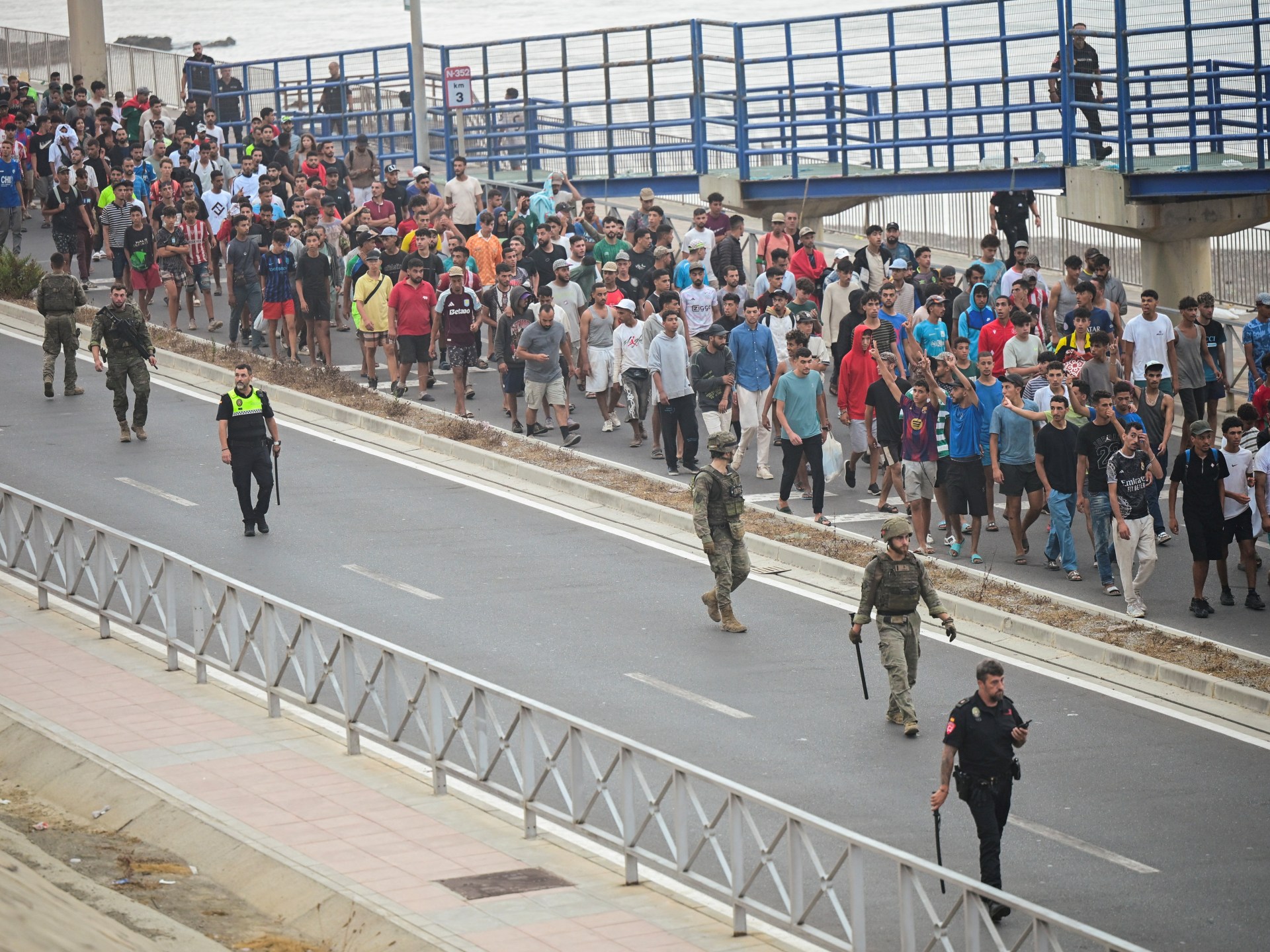

Thousands of migrants entered the Spanish city of Ceuta from neighbouring Morocco on July 31, bringing renewed attention to one of Europe’s most unusual borders.
Although Ceuta lies on the northern coast of Africa and is surrounded by Moroccan territory, it is administered by Spain and forms part of the European Union. Together with nearby Melilla, it forms the EU’s only land border with Africa, making both cities recurring flashpoints for migration and diplomatic tensions between Madrid and Rabat.
The latest crossing has once again highlighted border security and irregular migration, but it has also drawn attention to a broader question: why do these small Spanish territories on the African continent continue to generate recurring political crises between Spain and Morocco?
Understanding the latest tensions requires looking at three connected issues: migration pressures, the cities’ legal status, and Morocco’s long-standing claim over their sovereignty.
Why has the crisis resurfaced now?
The latest crossing reflects continued pressure along one of Europe’s most sensitive migration routes. Because Ceuta and Melilla are Spanish territory, entering either city means entering the European Union.
For some migrants travelling through North Africa, the two cities are among the few places where EU territory can be reached by land, making them recurring focal points during periods of increased migration towards Europe.
The timing of the latest surge has also been linked to a recent ruling by Spain’s Supreme Court on the treatment of migrants attempting to reach Ceuta and Melilla by sea. The court ruled that Spain’s “hot return” procedure, which allows certain immediate returns at the border, could not be applied to migrants intercepted at sea while attempting to swim into the enclaves. The judges found that the procedure applies to people who cross physical border barriers, such as fences, rather than those intercepted at sea.

The ruling did not create an automatic right to remain in Spain or legalise irregular entry. However, it was interpreted by some migrants as making immediate return more difficult if they reached Spanish territory by sea. Spanish and Moroccan officials pointed to the ruling as one factor that may have influenced the latest surge, while migration experts also cited broader migration pressures and misinformation circulating among migrants and smuggling networks.
Advertisement
The episode showed how legal decisions affecting border procedures can quickly influence perceptions on one of Europe’s most heavily monitored frontiers.
Migration cooperation has long been closely linked to the wider relationship between Spain and Morocco. Madrid relies heavily on cooperation with Rabat to manage migration routes, while Morocco’s role in controlling movement towards Europe has made border management an important element of its relationship with both Spain and the EU.
That dynamic became particularly clear in 2021, when thousands of migrants entered Ceuta during a period of heightened tensions after Spain allowed Brahim Ghali, the leader of the Polisario Front, to receive medical treatment in Spain.
The Polisario Front seeks independence for Western Sahara, which Morocco considers part of its territory and which has its final status unresolved under a United Nations-led political process. Rabat viewed Spain’s decision to host Ghali as a diplomatic setback, while Madrid said the decision was based on humanitarian grounds.
Spain accused Morocco of easing border controls during the crisis, while Moroccan officials rejected the suggestion that Morocco should act as Europe’s border guard. The episode demonstrated how migration cooperation can become entangled with broader political disputes between the two countries.
Under the current international legal framework, Ceuta and Melilla are Spanish territories under Spain’s sovereignty. Spain exercises full administrative and governmental authority over the two cities, and they are represented in Spain’s political system and form part of the EU.
They are not listed by the UN as Non-Self-Governing Territories, a category that applies to territories whose people have not yet exercised the right to self-determination through decolonisation. Because Ceuta and Melilla are not on that list, they are not part of a UN decolonisation process.
There has also been no international court ruling or UN decision determining sovereignty over Ceuta and Melilla. The dispute remains a political disagreement between Spain and Morocco rather than a sovereignty dispute currently being adjudicated through an international legal process.
This is one of the key differences between Ceuta and Melilla and Western Sahara. Western Sahara remains on the UN list of Non-Self-Governing Territories and is the subject of a separate UN-backed political process over its future status, while Ceuta and Melilla are treated internationally as territories under Spanish sovereignty.
Advertisement
This is the basis of Madrid’s position that the sovereignty question is settled. Spain argues that the two cities are not colonial possessions but fully integrated parts of the Spanish state, governed under Spanish law and protected as Spanish territory.
Morocco disputes that interpretation, arguing that the cities’ location on the African continent and their historical connection to North Africa mean they should be viewed differently from other Spanish cities.
Why does Morocco continue to claim the two cities?
The dispute is rooted in the long history of the western Mediterranean.
The Strait of Gibraltar has historically connected Europe and Africa rather than separating them. Armies, merchants, cultures and religions moved across it for centuries.
During the medieval period, Muslim dynasties based in present-day Morocco, including the Almoravids and Almohads, ruled large parts of the Iberian Peninsula. Their influence remains visible today in Spain’s architecture, language and cultural heritage.
Later, Portugal and Spain established footholds along the North African coast as European powers expanded their influence overseas.
Portugal captured Ceuta in 1415. After the Iberian Union between Spain and Portugal ended in 1640, Ceuta remained under Spanish rule. Spain has administered the city ever since.
![A view of the border fence separating the Spanish enclave of Melilla from Morocco in North Africa [File: AP Photo]](https://www.aljazeera.com/wp-content/uploads/2022/03/AP19200471997600.jpg?w=770&resize=770%2C515&quality=80)
Melilla has been under Spanish control since 1497.
Spain points to this long history of administration, together with citizenship and constitutional integration, as evidence that the two cities are fully part of Spain.
Morocco views the same history through a different lens, arguing that European-controlled territories on the African mainland remain a historical legacy of European expansion.
Why do the cities matter beyond Spain and Morocco?
The importance of Ceuta and Melilla extends far beyond their size.
For Spain, the cities are sovereign territory and a direct extension of the Spanish state into North Africa.
For the European Union, they represent its only land borders with Africa and are therefore central to debates over migration, border security and cooperation with neighbouring countries.
For Morocco, the cities remain linked to a broader question of territorial sovereignty, even as Rabat maintains close cooperation with Spain on migration, trade and security.
This combination of interests means that developments in Ceuta and Melilla can quickly become issues of regional significance.
Could the dispute be resolved?
There is little indication that either Spain or Morocco is seeking to reopen formal negotiations over sovereignty.
Spain maintains that Ceuta and Melilla are integral parts of the country and that their status is not negotiable.
Morocco continues to maintain its claim, but in recent years has generally prioritised practical cooperation with Spain over direct confrontation on the issue.
As a result, the dispute tends to reappear indirectly during periods of political tension, diplomatic disagreements or increased migration pressure.
Advertisement
What does the latest crossing reveal?
The immediate challenge remains humanitarian: managing migration while protecting the rights and safety of people attempting to reach Europe.
But the events in Ceuta also show why the city repeatedly returns to international headlines. Migration may trigger the immediate crisis, but the response is shaped by border policy, Spain-Morocco relations, legal developments and a sovereignty dispute that continues to influence relations between the two countries.
Ceuta and Melilla remain unusual because they are geographically part of Africa but politically part of Europe. As long as migration pressures and sovereignty disputes persist, they are likely to remain among the Mediterranean’s most sensitive border flashpoints.
Related News
Iran says peace deal voided, fighting ‘existential war’ after US attacks

US judge sides with NAACP over proposed mail-in ballot restrictions

Germany investigates explosive device attached to drone at Leipzig airport