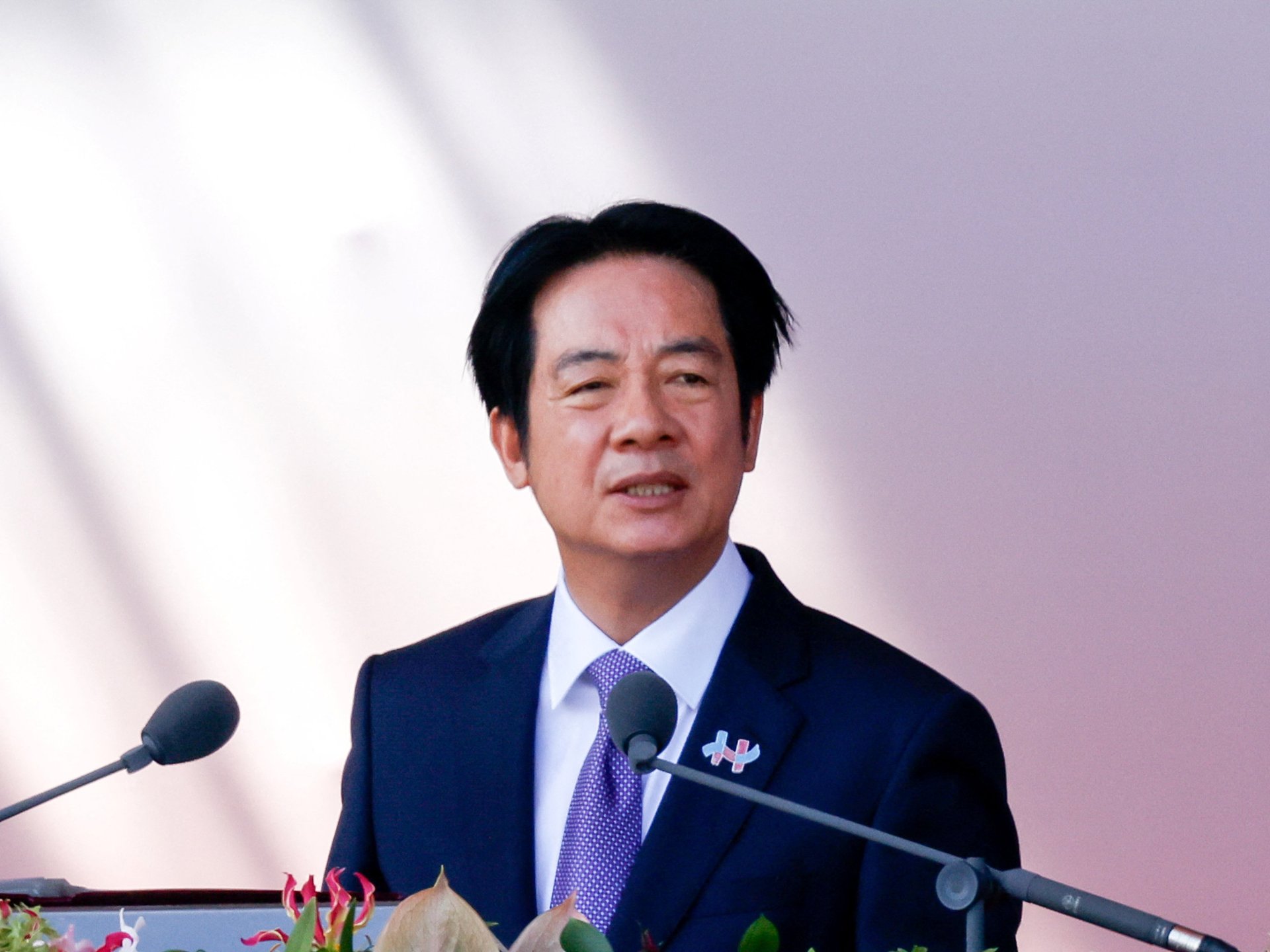

Taiwan’s opposition parties have moved forward with an impeachment campaign to remove President William Lai Ching-te and Premier Cho Jung-tai from office, in what observers say is the latest sign of deepening political polarisation within the self-ruled island.
The Kuomintang (KMT) and Taiwan People’s Party (TPP) began impeachment proceedings on Friday against President Lai and Premier Cho, who they accuse of violating the constitution and the legislative process.
- list 1 of 4Russia-Ukraine war: List of key events, day 1,401
- list 2 of 4Polish jets intercept Russian reconnaissance plane spotted near airspace
- list 3 of 4US releases missile launch video after northwest Nigeria strike
- list 4 of 4North Korea’s Kim Jong Un pushes more missile production as ‘war deterrent’
end of list
Legislators with the KMT, TPP, and two independents had enough seats to initiate proceedings on Friday, but they are still short of the two-thirds majority of lawmakers needed to pass an impeachment vote scheduled for May 19.
Observers say that while the impeachment proceedings are unlikely to clear further hurdles in Taiwan’s Constitutional Court, they offer the opposition a symbolic way to protest their displeasure at Lai’s presidency and Cho’s premiership.
“It’s not possible to have a real impeachment; however, they want to make a record that President Lai would be the first president considered impeached in the history of Taiwan’s democracy,” said Yen-tu Su, an expert in constitutional law and democratic theory at Academia Sinica, Taiwan’s top research institution.
“It’s a way to register their protest. It’s a way to humiliate the president, and also a way to retaliate against the executive branch refusal to promulgate legislation passed by the legislators,” he told Al Jazeera.
Taiwan’s legislature has been largely in deadlock since Lai took office in 2024 amid a divided government.
Advertisement
Though Lai led his centre-left Democratic Progressive Party to an unprecedented third consecutive term in the presidential office last year, his party has since lost its majority in the legislature, and political deadlock has taken hold.

Political parties have been locked in legislative fights over everything from the budget to Taiwan’s relationship with China, and the makeup of the island’s constitutional court – whose work has been frozen for much of the past year due to the infighting.
Lai’s government is still struggling to pass sections of the 2026 budget, while the KMT has also blocked the president’s much-publicised supplemental $40bn bill to boost Taiwan’s defence spending.
For his part, Cho earlier this month vetoed a bill that would have made it easier to allocate tax revenues between Taiwan’s local and central government, arguing that the plan was not feasible.
Brian Hioe, a frequent commentator on Taiwanese politics and a non-resident fellow at the University of Nottingham’s Taiwan Research Hub, told Al Jazeera that he also thought the impeachment campaign was more of a symbolic gesture than a practical move.
“I think it’s just a stunt so that they’ll get attention,” Hioe said.
“But they also just want to paint [Lai] as infringing upon democratic institutions in a way that is beyond the pale,” he said, adding that the impeachment campaign was likely to appeal to core KMT and TPP supporters rather than swing voters.
Academia Sinica’s Su told Al Jazeera that the impeachment fight was a sign of much more profound problems within Taiwan’s political system.
“Taiwan just entered its second period of divided government,” he said.
“We did have a prior experience with a divided government [from 2000 to 2008], but this time things are much uglier, and much more difficult due to partisan polarisation,” he added.
Related News
UNSC condemns Rwanda, M23 rebels for offensive in eastern DR Congo
Belarus frees 123 prisoners including Ales Bialiatski as US lifts sanctions
Egypt says gas deal with Israel is ‘purely commercial’