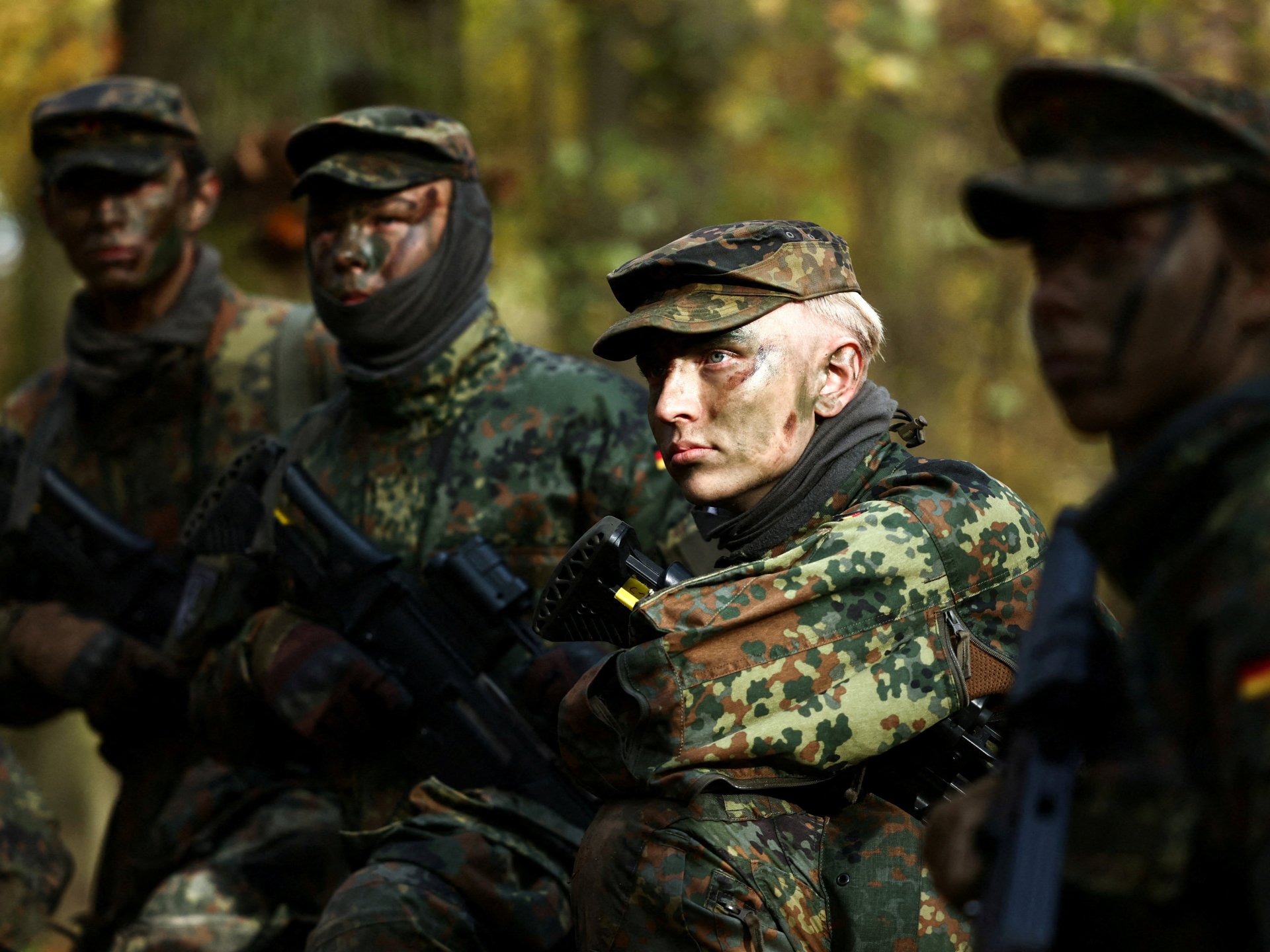

At the beginning of the year, German men aged 18 began to receive a compulsory questionnaire registering their fitness for army service under a law passed last month.
Joining the army is voluntary for now, but the law allows the government to introduce mandatory service to meet its goal of building what it says will be the strongest army in Europe for the first time since World War II.
- list 1 of 4Which countries made the biggest deals with Israel in 2025?
- list 2 of 4UK youth to be offered military ‘gap year’ in bid to boost defence: Report
- list 3 of 4Russia hits Ukraine with Oreshnik hypersonic missile: Why it matters
- list 4 of 4Trump announces new tariffs over Greenland: How have EU allies responded?
end of list
Last November, active duty personnel stood at 184,000 troops, a jump of 2,500 since May, when Chancellor Friedrich Merz first told the parliament that the army, or Bundeswehr, “needs to become Europe’s strongest conventional army”.
“It’s the biggest they’ve had for a very long time, and it’s already the strongest force we’ve had since 2021,” Timo Graf, a senior researcher at the Bundeswehr Centre of Military History and Social Sciences in Potsdam, told Al Jazeera.
The government is tempting voluntary service members on 23-month contracts, with generous salaries and perks. Those contracts can then be extended to indefinite professional service.
“The pay is 2,600 euros ($3,000), and because housing is free, medical insurance is free, they will end up having something like 2,300 euros ($2,700) after taxes and deductions. It’s a lot of money for young people,” said Graf.
Germany has made a NATO commitment to reach 260,000 active duty personnel by 2035, and to double its reservists to 200,000. This would bring it close to the half-million-strong army it had at the end of the Cold War.
The news has discomfited Moscow.
Advertisement
“Germany’s new government is speeding up preparations for a full-scale military confrontation with Russia,” Russia’s ambassador to Germany, Sergey Nechayev, told the German news portal Apolut in an interview last month.
From the German point of view, however, it is Russia’s refusal to withdraw from Ukraine that has fuelled the political will to spend 108 billion euros ($125bn) to rebuild the armed forces this year, equivalent to 2.5 percent of gross domestic product (GDP), and more than twice the 2021 budget of 48 billion euros ($56bn).
“Just in one year, we have gone from 58 percent to 65 percent support of an increase in more defence spending,” said Graf.
By 2030, Germany is to spend 3.5 percent of its GDP on defence.
According to a December survey by Politbarometer, a German election poll and television programme, eight out of 10 Germans are now convinced Russian President Vladimir Putin is not serious about pursuing a peace agreement in the war in Ukraine, and many have begun to believe intelligence officials’ warnings that Russia plans to eventually expand its war to NATO countries.
The year “2029 has been presented as a possible date for Russia to attack NATO, and that has become the reference date for people”, Graf said. “We can see over the last four years of this war that we’ve been sleepwalking, not understanding the gravity of the situation. Europe’s future is at stake here.”
Germans lose faith in Trump’s US
The threat perception from Russia is only one side of the equation. German society has found its loss of faith in the United States over the past year equally transformative.
A poll conducted by the state channel ZDF in June 2025 asked Germans, “Will the USA continue to guarantee Europe’s security as part of NATO?” Seventy-three percent said no. By December, this majority had risen to 84 percent.
Nine out of 10 Germans now see US political influence in Europe as pernicious, evidently fearing the open encouragement of far-right, Russia-friendly parties, as happened in Germany’s federal election in February last year.

US President Donald Trump’s National Security Strategy, published last November, lectured Europe that it faced “civilisational erasure”, because of over-regulation from Brussels and “migration policies that are transforming the continent and creating strife, censorship of free speech and suppression of political opposition, cratering birthrates, and loss of national identities and self-confidence” – nativist positions held by Europe’s far-right.
Advertisement
“They’ve realised… Trump has no interest in helping Germany at all,” said General Ben Hodges, who used to command US forces in Europe. “The National Security Strategy was awful… it was a giant middle finger from Trump to Europe,” he told Al Jazeera.
Germans have such little faith in Washington, that six out of 10 no longer even trust the US nuclear deterrent, and three-quarters would like to see it replaced with an Anglo-French deterrent.
“People who value NATO and those who are pro-EU converge in the idea of a European NATO,” said Graf. “Germans still value NATO as a defence organisation, it’s just that they do not trust the Americans to play their part in NATO, and they do support the idea of a European NATO.”
Graf said Bundeswehr polling showed that support for a European army, always sketchy in Germany, for whose security NATO was expressly built in 1949, jumped in the past year by 10 points to 57 percent.
Will Germany get the job done?
Merz’s pledge is not new.
His predecessor, Social Democrat Olaf Scholz, had also promised to build Europe’s strongest army in 2022, the year Russia launched its full-scale invasion of Ukraine.
But although Scholz got parliament to approve a one-off, $120bn boost in defence spending, the extra money only started trickling down later, in 2024.
Scholz’s government at the time blamed bureaucratic procedures, but some believe there were cultural obstacles as well.
“The Bundeswehr was not perceived positively and, therefore, nobody in their right mind would choose that as a career. So then it would be a more niche thing to do, maybe more for people on the right side of the political spectrum,” Minna Alander, a fellow at the Center for European Policy Analysis specialising in security and defence, told Al Jazeera.
“Well-educated Germans, older Germans, grew up hearing about how terrible Nazi Germany was,” said General Hodges, who now lives in Germany. “And for older Germans who were children during the war, the absolute worst nightmare for them would be a war with Russia, or without the United States.”
But perceptions have changed rapidly since 2022.
Merz came to power condemning both Moscow and Washington, demanding “independence” from the US.
By the time he assumed office, parliament had already approved a suspension of constitutional deficit limits to give him an enormous, permanent increase in defence spending. Last month, parliament approved roughly $60bn in defence procurements.
‘We never rely on European processes’
Analysts believe pro-Kremlin narratives will still seek to exploit whatever latent scepticism exists.
“Sensitivity over conscription is something that Russians are packaging into their propaganda narratives to many societies in Europe,” said Victoria Vdovychenko, a hybrid warfare expert at Cambridge University’s Centre for Geopolitics.
“Germany is one of them, so basically, you’re going to see a spike in news in terms of how bad it is that the Germans are sending in the kids to be killed,” she told Al Jazeera.
She is also wary of the time it will take for money and political will to translate into industrial capacity and force.
Advertisement
Scholz pledged to create a brigade to defend the Suwalki gap, a vulnerable neck of Lithuanian land sandwiched between Belarus and Kaliningrad, a Russian-held territory on the Baltic Sea, but recruiting, training and equipping it is still under way.
“We are not stupid people, so we never rely on European processes, [the notion that] anyone will come as a god to help us,” said Vdovychenko, who is Ukrainian. “We definitely understand, it’s our people who will be always at the forefront.”
Related News
What to know about Trump’s plan on Venezuela?
Denmark PM urges Trump to stop ‘threatening’ Greenland
US to ‘dictate’ decisions to Venezuela, control oil sales ‘indefinitely’