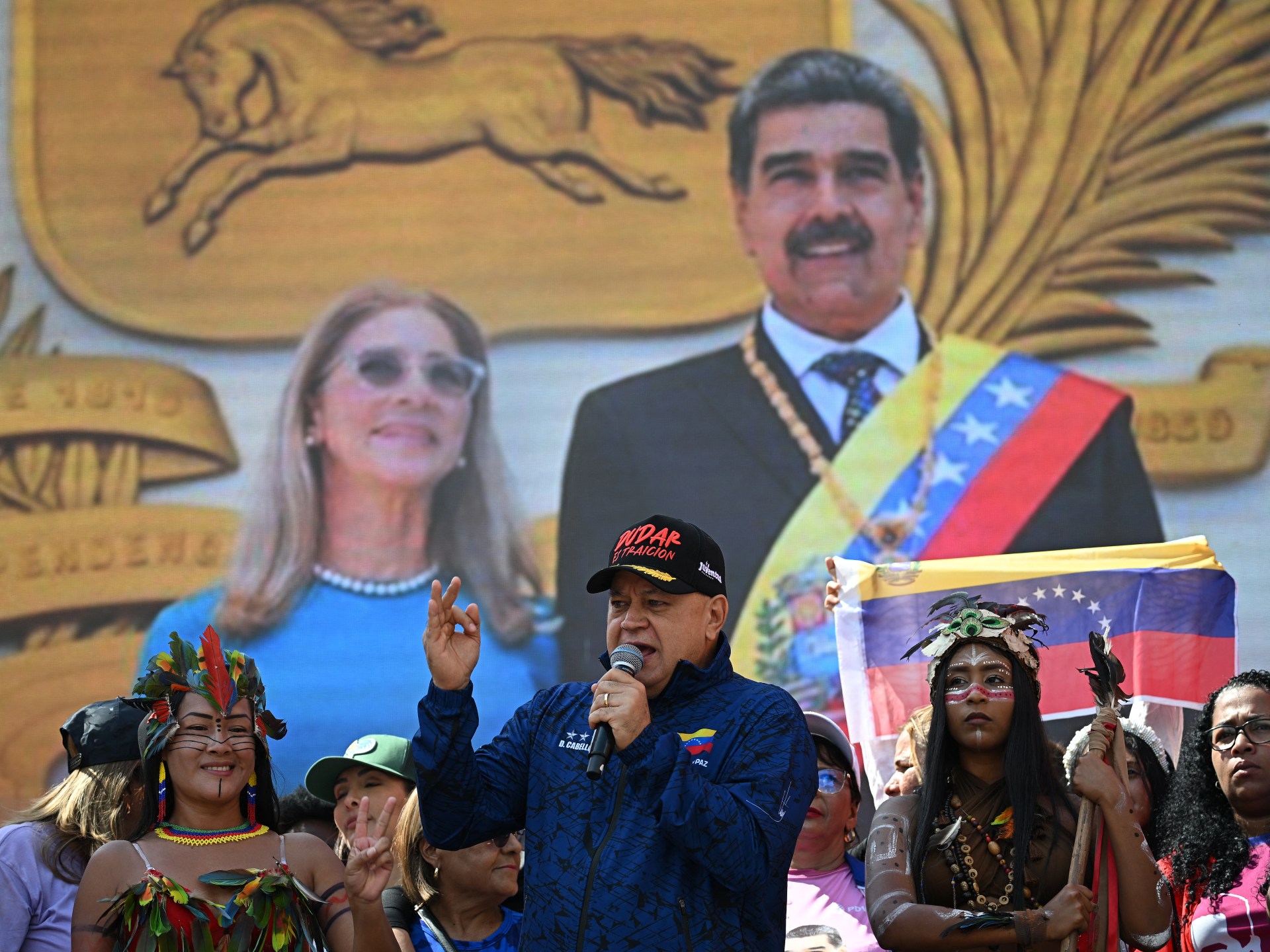

Among the thousands of supporters of Venezuelan President Nicolas Maduro who joined a public protest in Caracas against his weekend abduction by United States soldiers, one man stood out.
Wearing a blue cap emblazoned with the slogan “To doubt is to betray,” Minister of Interior, Justice and Peace Diosdado Cabello marched on Tuesday with the protesters before delivering a speech in front of a giant portrait of Maduro and his wife, Cilia Flores.
- list 1 of 4Trump says Venezuela to hand over up to 50 million barrels of oil to US
- list 2 of 4Trump’s attacks on Venezuela put Mexico on edge
- list 3 of 4Fact-checking Trump on promised US oil company investment in Venezuela
- list 4 of 4How strong are Latin America’s military forces, as they face US threats?
end of list
A longtime ally of Maduro and his predecessor Hugo Chavez, Cabello has emerged as a key figure in the leadership that the ousted president had built. Some analysts described him as in effect the most powerful person in Venezuela today, even though Maduro’s deputy, Delcy Rodriguez, has formally taken over as interim president of the country.
Cabello has been accused of enforcing crackdowns on protests and media coverage that has been critical of Maduro’s government, including by an independent United Nations human rights mission in 2024.
So who is Cabello, and why is he so powerful?

Who is Diosdado Cabello?
Born in El Furrial in Monagas State in northeastern Venezuela, Cabello has a background in engineering, including a graduate degree from Andres Bello University.
He served in various roles under Chavez, who was in power from 1999 until his death in 2013, including his chief of staff and minister of interior and justice, infrastructure and public works.
Advertisement
As a member of the armed forces, Cabello joined Chavez’s attempted coup against President Carlos Andres Perez in February 1992 and spent two years in jail after the coup failed.
After Chavez came to power, Cabello helped set up the pro-Chavez grassroots civil society organisations known as Bolivarian Circles, aiming to empower workers and the poor.
On April 13, 2002, during a two-day coup against Chavez, Cabello took on the duties of the presidency, facing off against Pedro Carmona, the head of the Venezuelan Federation of Chambers of Commerce, whom the coup leaders had appointed president.
Cabello’s first order was to send elite navy forces to rescue Chavez, who was being held prisoner at a base on a Caribbean island.
Chavez was back in office a few hours later.
During the Chavez era, Cabello was criticised for his business interests by the opposition, who called him part of the “Bolibourgeoisie”, or officials who had become wealthy.
He was serving as speaker of the National Assembly when Chavez died in 2013, placing him next in line to serve as interim president, according to the Venezuelan Constitution.
The role instead went to Maduro, who remained in power for more than a decade. Cabello rose up to become security tsar, leading the internal security apparatus and wielding power over armed civilians known as “colectivos”.
Why is Cabello so powerful?
The apparent ease with which US special forces were able to land in Caracas, abduct Maduro and Flores, and get out of Venezuela underscored the wide gulf in military capabilities between the two adversaries.
The US is the strongest military power in history with 1.33 million active soldiers in addition to the most destructive range of bombs, missiles, jets and other weapons ever known to humanity. In contrast, Venezuela has 109,000 active military personnel and 31 military aircraft. The US has 13,043.
If the US were to launch a ground invasion or try to maintain a military foothold in Venezuela, it could still face challenges – in the form of paramilitary forces loyal to Maduro’s United Socialist Party of Venezuela and the army.
Venezuela has 220,000 paramilitary soldiers, more than double its formal military size.
And Cabello, as interior minister, is in charge of these groups.
What are Venezuela’s paramilitary groups?
The bulk of the paramilitary fighters belong to the Bolivarian Militia, a group started by Chavez that his critics described as his private army.
Then there are the colectivos, bands of armed, masked, motorcycle-riding fighters who for years have dominated urban neighbourhoods, enforcing the writ of the governments of Chavez and Maduro.
Advertisement
The colectivos have often also collaborated with the military in a model that Maduro used to refer to as the Civil-Military Union.
Why is Cabello controversial?
According to an independent UN human rights mission, Cabello has ordered crackdowns on people who oppose the Maduro government, including through Operation Tun Tun in 2017, which was named after the sound made when officers knocked on someone’s door before an arrest.
In August 2024 when he was a member of the National Assembly, Cabello warned journalists who published information about the presidential election result that was not in line with Maduro’s government would be arrested as part of Operation Tun Tun, the UN human rights mission found.
The mission’s report also said colectivos operated in coordination with security forces to repress protests, including by firing warning shots “without being prevented from doing so by the security forces, even when they were only metres away”.
Along with Maduro and former Interior Minister Ramon Rodriguez Chacin, Cabello faces drug charges filed by the US Department of Justice over what the US said is Venezuela’s decades-long role in the cocaine trade.
However, Maduro and his allies accused the US of using the drug charges as cover for an “imperialist threat” that they said is targeting Venezuela’s vast oil reserves.
Related News
Flights from Aden airport in Yemen halted amid latest tensions
Venezuela’s abducted leader Nicolas Maduro, wife appear in NYC court
‘Deliberate torment’: Ukrainians left without heating after Russian attacks