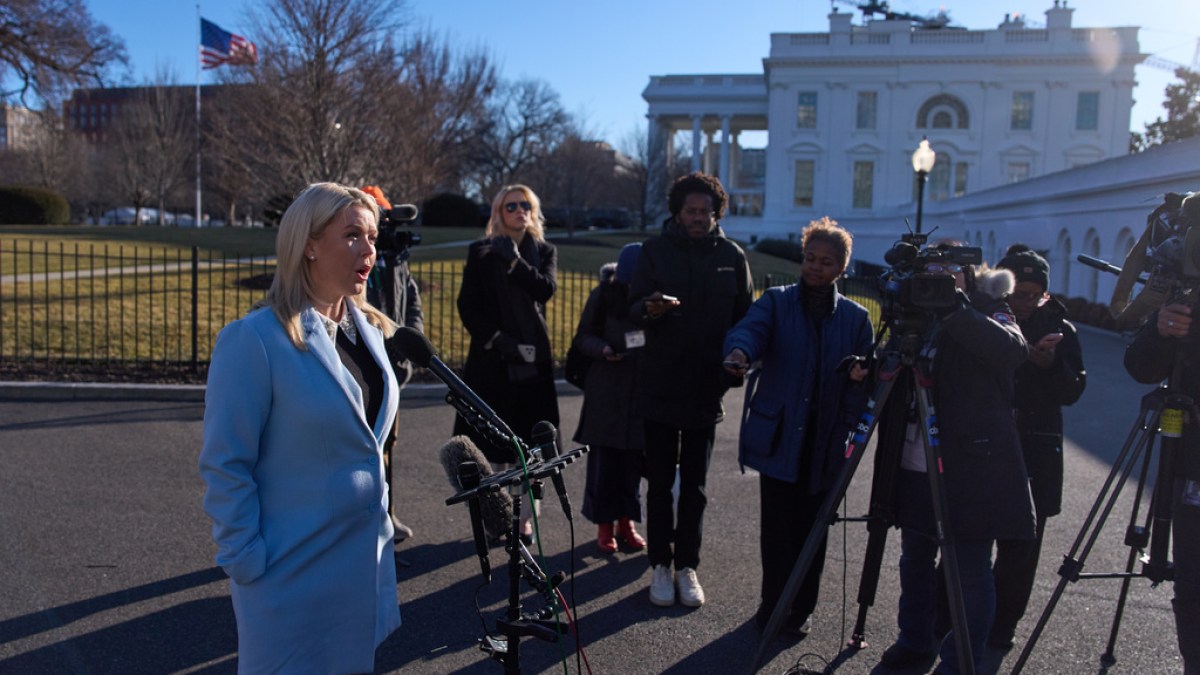

The White House has insisted that last year’s strikes against Iran destroyed the country’s nuclear programme despite a recent claim by a senior US official that Tehran is a week away from having bombmaking material.
Karoline Leavitt, the White House spokesperson, told reporters on Tuesday that the June 2025 attack on Iran’s nuclear facilities, known as Operation Midnight Hammer, was an “overwhelmingly successful mission”.
- list 1 of 3Reports of top US general’s concerns over attack on Iran rebuked by Trump
- list 2 of 3Trump set to deliver second term’s first State of the Union: What to expect
- list 3 of 3Iran army helicopter crashes into market, killing 2 pilots and 2 merchants
end of list
The attack “did, in fact, obliterate Iran’s nuclear facilities“, Leavitt said.
But just this weekend, President Donald Trump’s envoy Steve Witkoff suggested that Iran is close to having enough material to build a nuclear weapon.
“They’re probably a week away from having industrial-grade bomb-making material,” Witkoff told Fox News on Saturday.
Since last June’s strikes, Trump has repeatedly hailed the attack, arguing that it eliminated Iran’s nuclear programme and led to “peace” in the Middle East. Operation Midnight Hammer came towards the end of a 12-day war Israel initiated with Iran that month.
But eight months later, US and Iranian officials are once again holding talks to reach a nuclear deal and avert another war.
On Tuesday, Leavitt said the destruction of Iran’s nuclear programme had been “verified” by Trump and the United Nations’ watchdog, the International Atomic Energy Agency (IAEA).
“That does not mean that Iran may never try again to establish a nuclear programme that could directly threaten the United States and our allies abroad, and that’s what the president wants to ensure can never happen again,” she added.
Advertisement
Last year, after the US attack, IAEA chief Rafael Grossi said Iran could resume uranium enrichment “in a matter of months”.
But the UN agency’s inspectors have not been able to assess Iran’s nuclear sites since the US strikes.
The Pentagon’s public assessment was that the Iranian nuclear programme was set back by one to two years.
There has been no official confirmation of the US claims that Iran has restarted nuclear enrichment after the attack.
After a visit by Israeli Prime Minister Benjamin Netanyahu to the US in December, Trump renewed his threats to attack Iran if it tries to rebuild its nuclear or missile programme.
Tensions have spiralled since then, with the US amassing military assets near Iran.
Still, Tehran and Washington are set to hold the third round of negotiations this year to push for a nuclear deal.
Iran, which denies seeking a nuclear weapon, has said it would agree to minimal uranium enrichment under strict IAEA supervision in exchange for lifting sanctions against its economy.
But Trump has repeatedly stressed that it is seeking zero enrichment.
Enrichment is the process of isolating and concentrating a rare variant, or isotope, of uranium that can produce nuclear fission.
At low levels, enriched uranium can power electric plants. If enriched to approximately 90 percent, it can be used for nuclear weapons.
Before the June 2025 war, Iran was enriching uranium at 60 percent purity.
Tehran had been escalating its nuclear programme since 2018, when Trump, during his first term, nixed a multilateral agreement that capped Iran’s enrichment at 3.67 percent. He instead started piling up sanctions on the Iranian economy, as part of a “maximum pressure” campaign.
The White House on Tuesday suggested the military option against Iran remains on the table.
“President Trump’s first option is always diplomacy. But as he has shown, he is willing to use the lethal force of the United States military if necessary,” Leavitt said.
Related News
Top Iranian security official heads to Oman following nuclear talks with US

Photos: Mexico descends into violence after most wanted drug lord killed
Ex-Prince Andrew’s arrest spurs Epstein accountability calls from UK to US