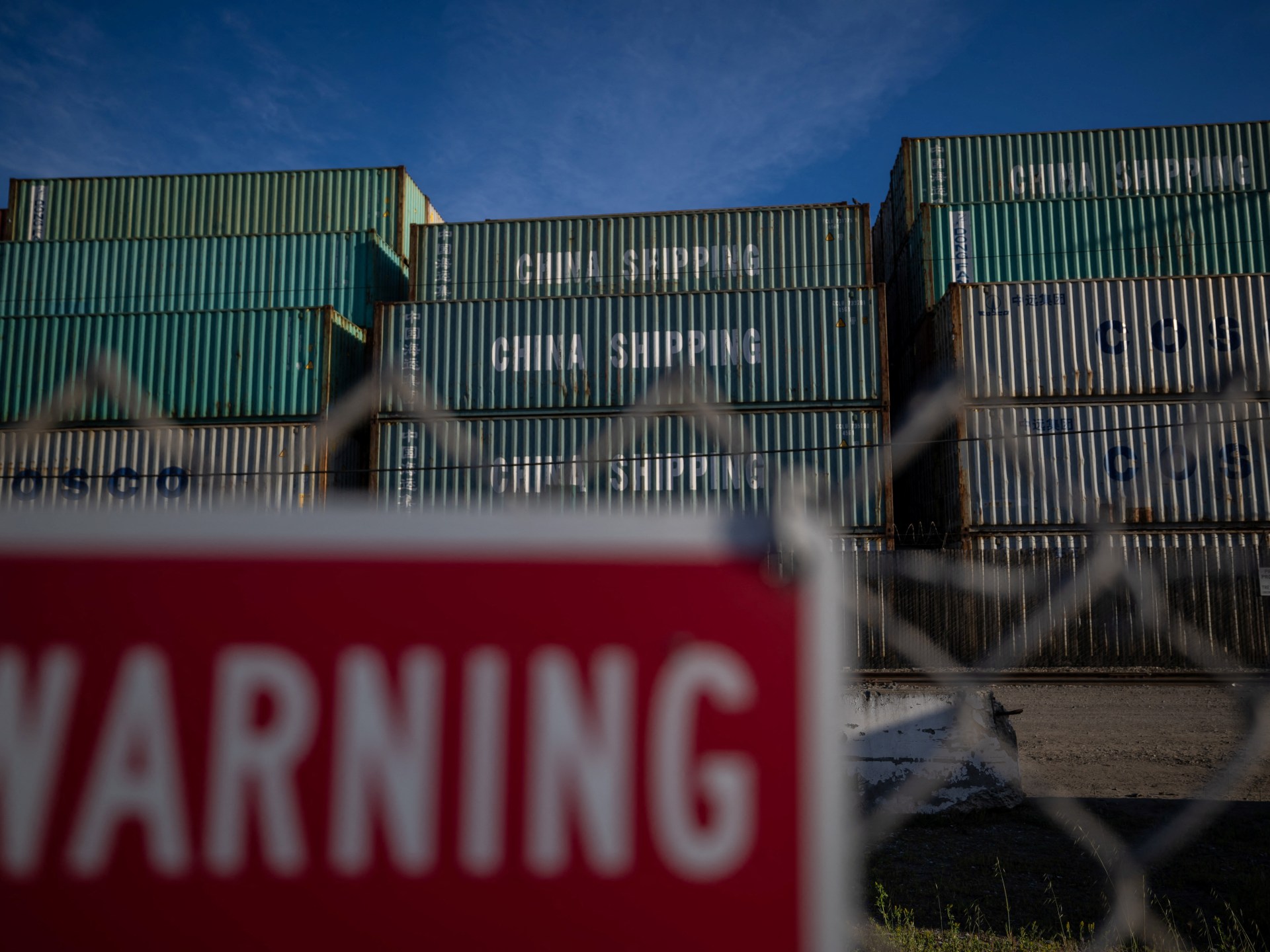

United States President Donald Trump has slammed the Supreme Court as a “disgrace” after a six-to-three ruling that struck down his global tariffs, asserting that he will maintain the levies through alternative means.
During a Friday news conference, the president attacked the high court for being allegedly “swayed by foreign interests”.
- list 1 of 3In major blow to Trump, US Supreme Court strikes down his global tariffs
- list 2 of 3Can Europe reduce its dependence on the US and at what cost?
- list 3 of 3US trade deficit swells in December as imports surge
end of list
He then proceeded to attack the justices, denouncing the liberal members as a “disgrace to our nation” and the conservatives who sided with them as “unpatriotic and disloyal” to the Constitution.
But Trump proceeded to say he was unbowed by the decision, arguing that another law, the Trade Expansion Act of 1962, gave him the legal basis to continue his global tariffs.
“ I have the right to do tariffs, and I’ve always had the right to do tariffs,” he said, brushing aside the ruling.
Switching laws
Friday’s decision struck down Trump’s ability to use the International Emergency Economic Powers Act (IEEPA) to impose tariffs, an import tax never mentioned in the law, without the consent of Congress.
Three left-wing justices and three conservatives made up the majority in the ruling. They emphasised that Congress alone holds the power to levy tariffs in peace time.
But instead of using IEEPA, Trump said on Friday that he would turn to the Trade Expansion Act to impose a 10 percent global tariff for 150 days, replacing some of the tariffs that were struck down by the court.
He added that investigations into unfair trade practices would allow him to expand his tariff campaign as well.
Advertisement
“We’re going straight ahead with 10 percent, straight across the board, which was the absolute right to do,” Trump said.
“That’s a lot of money coming into our country. And then during that period of about five months, we are doing the various investigations necessary to put fair tariffs — or tariffs, period — on other countries.”
Future of US tariff revenue
The duties would be over and above some of the tariffs that are currently in place, specifically the sectoral tariffs on steel, aluminium, auto parts and other products. The new 10 percent tariff is expected to go into effect in about three days.
Friday’s decision was a major blow to Trump’s economic agenda as the tariffs were expected to rake in nearly $3.6 trillion in revenue from 2026 to 2035, as per estimates by Oxford Economics.
Friday’s ruling sharply lowers the effective tariff rate immediately to 8.3 percent from 12.7 percent, according to Bernard Yaros, the lead US economist at Oxford Economics.
But the US president has argued that his powers under the Trade Expansion Act could result in even higher tariff revenue in the long run.
“In order to protect our country, a president can actually charge more tariffs than I was charging in the past period of a year under the various tariffs authorities,” Trump said.
“So we can use other of the statutes [sic], other of the tariff authorities, which have also been confirmed and are fully allowed.”
‘Tariff cudgel diminished’
That will be easier said than done, experts warned.
“Overall, it’s still a block to the Trump administration as it is harder to announce and implement tariffs quickly,” Rachel Ziemba, a senior fellow at the Center for a New American Security, told Al Jazeera.
“The administration, as expected, is trying to patch together, via existing tools, a set of measures that will maintain tariff revenue and some leverage. But it is a time of uncertainty.”
In a note to Al Jazeera, Kimberly Clausing, a researcher at the Peterson Institute of International Economics, agreed that, with Friday’s ruling, “the strength of the president’s tariff cudgel is diminished”.
“Governments abroad and businesses at home can both expect, somewhat, less mercurial US tariff processes,” she said.
But the uncertainty that US consumers and businesses have faced over the past year is far from over, given Trump’s plan to pivot to other means to levy tariffs.
“This means that Trump’s tariffs will continue to burden the US economy, even if alternative instruments are not as agile or broad as the IEEPA tariffs,” Clausing said.
Advertisement
Over the last year, Trump has used tariffs to not only raise revenue for the US and increase domestic manufacturing, but also as a catchall to pressure countries into compliance with US foreign policy.
For instance, he slapped India with a punitive 25 percent tariff for buying oil from Russia, a longtime US adversary.
With the IEEPA no longer available as a cudgel, it’s possible that Trump will lean more heavily on other economic penalties like sanctions — and even military action — to push his agenda.
“He was already using military force including to enforce sanctions in Venezuela and Iran,” Ziemba pointed out.
“The bigger issue is if he tries to continue to pressure friend and foe alike and to change US friends. It’s too soon to tell on this but his escalate to de-escalate strategy has its costs.”
Related News

New Israeli housing plan near Jerusalem slammed as ‘disguised annexation’
Palace says King Charles will ‘support’ police probe into ex-Prince Andrew
Kosovo’s parliament approves new gov’t ending yearlong political deadlock