US judge weighs Trump decision to bar Venezuelan funds for Maduro’s defence
 26 March 2026

A United States judge has said that he will not dismiss the drug-trafficking and weapons possession charges brought against former Venezuelan President Nicolas Maduro and his wife Cilia Flores.
But in a Thursday court hearing, Judge Alvin Hellerstein questioned whether the US government has the right to bar Venezuela from funding Maduro’s legal expenses.
- list 1 of 3Venezuela’s Maduro set to again appear in US court: How strong is the case?
- list 2 of 3Venezuela’s Maduro set to appear in US court months after abduction
- list 3 of 3Delcy Rodriguez replaces Venezuela’s Defence Minister Vladimir Padrino
end of list
The hearing was the first for Maduro and his wife since a brief January arraignment, where they pleaded not guilty.
Maduro and Flores have sought to have the charges against them thrown out. Hellerstein declined to do so, but he pressed the prosecution on some of the issues Maduro’s legal team raised in its petition to dismiss the case.
Among them was a decision by the administration of US President Donald Trump to prevent the Venezuelan government from financing Maduro’s defence.
Federal prosecutors argued that national security reasons prevented the US from allowing such payments. They also pointed to ongoing sanctions against the Venezuelan government.
But Hellerstein pushed back against that argument, noting that Trump had eased sanctions against Venezuela since Maduro’s abduction on January 3. He also questioned how Maduro might pose a security threat while imprisoned in New York.
“The defendant is here. Flores is here. They present no further national security threat,” said Hellerstein. “I see no abiding interest of national security on the right to defend themselves.”
Hellerstein emphasised that, in the US, all criminal defendants have the right to a vigorous defence, as part of the Constitution’s Sixth Amendment.
Advertisement
“The right that’s implicated, paramount over other rights, is the right to constitutional counsel,” he said.
Maduro, who led Venezuela from 2013 to 2026, has been charged with four criminal counts, including narco-terrorism conspiracy, conspiracy to import cocaine, the possession of machine guns and the conspiracy to possess machine guns and other destructive devices.
He and his wife were taken into US custody on January 3, after Trump launched an attack on Venezuela.
The Trump administration has framed the military operation as a “law enforcement function”, but experts say it was widely considered illegal under international law, which protects local sovereignty.
Maduro has cited his status as the leader of a foreign country as part of his push to see the case dismissed.
When he last appeared in court, on January 5, he told the judge, “I’m still the president of my country.”
In a February hearing, his defence team sought to dismiss the charges on the basis that preventing Venezuela from paying his legal fees was “interfering with Mr Maduro’s ability to retain counsel and, therefore, his right under the Sixth Amendment to counsel of his choice”.
In an interview with the news agency AFP on Thursday, Maduro’s son, Venezuelan lawmaker Nicolas Maduro Guerra, said that he trusts the US legal system but believes that his father’s trial has been mishandled.
“This trial has vestiges of illegitimacy from the start, because of the capture, the kidnapping, of an elected president in a military operation,” Maduro Guerra said in Caracas.
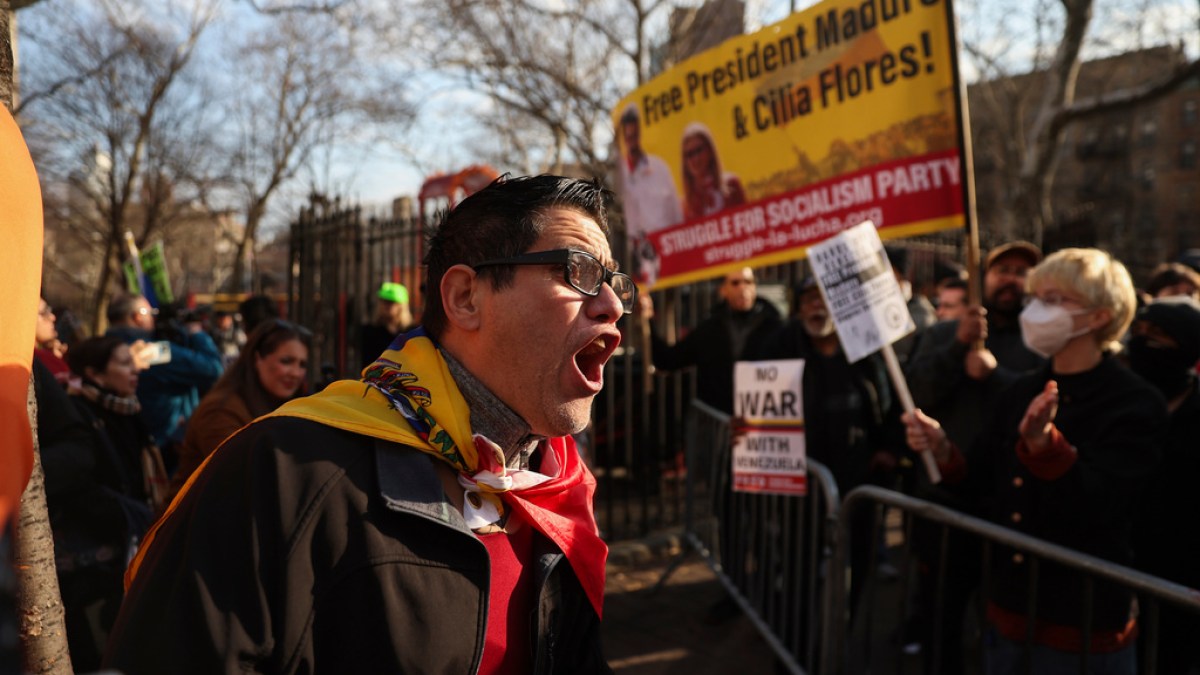
Protests and counter-protests took place in front of the New York City courthouse on Thursday, with some condemning the US’s actions and others holding signs in support of the trial with slogans like, “Maduro rot in prison.”
Trump himself weighed in on the proceedings during a Thursday cabinet meeting, hinting that further charges could be brought against Maduro.
“He emptied his prisons in Venezuela, emptied his prisons into our country,” Trump said of Maduro, reiterating an unsubstantiated claim.
“And I hope that charge will be brought at some point. Because that was a big charge that hasn’t been brought yet. It should be brought.”
Trump has had an adversarial relationship with Maduro since his first term in office, when he issued a bounty for the Venezuelan leader’s arrest. He has frequently repeated baseless claims that Maduro intentionally sent immigrants and drugs to the US in a bid to destabilise the country.
Those claims have served as a pretext for Trump claiming emergency powers in realms such as immigration and national security. On Thursday, Trump emphasised that, while he expected a “fair trial”, he expected more legal action to be taken against Maduro.
Advertisement
“I would imagine there are other trials coming because they’ve really sued him just at a fraction of the kind of things that he’s done,” Trump said. “Other cases are going to be brought, as you probably know.”
Related News
Oil prices surge after Israeli strike on Iran’s South Pars gasfield
Can Iran’s asymmetric warfare hold US-Israeli military power at bay?
Iran threatens to strike Gulf energy facilities after South Pars attack