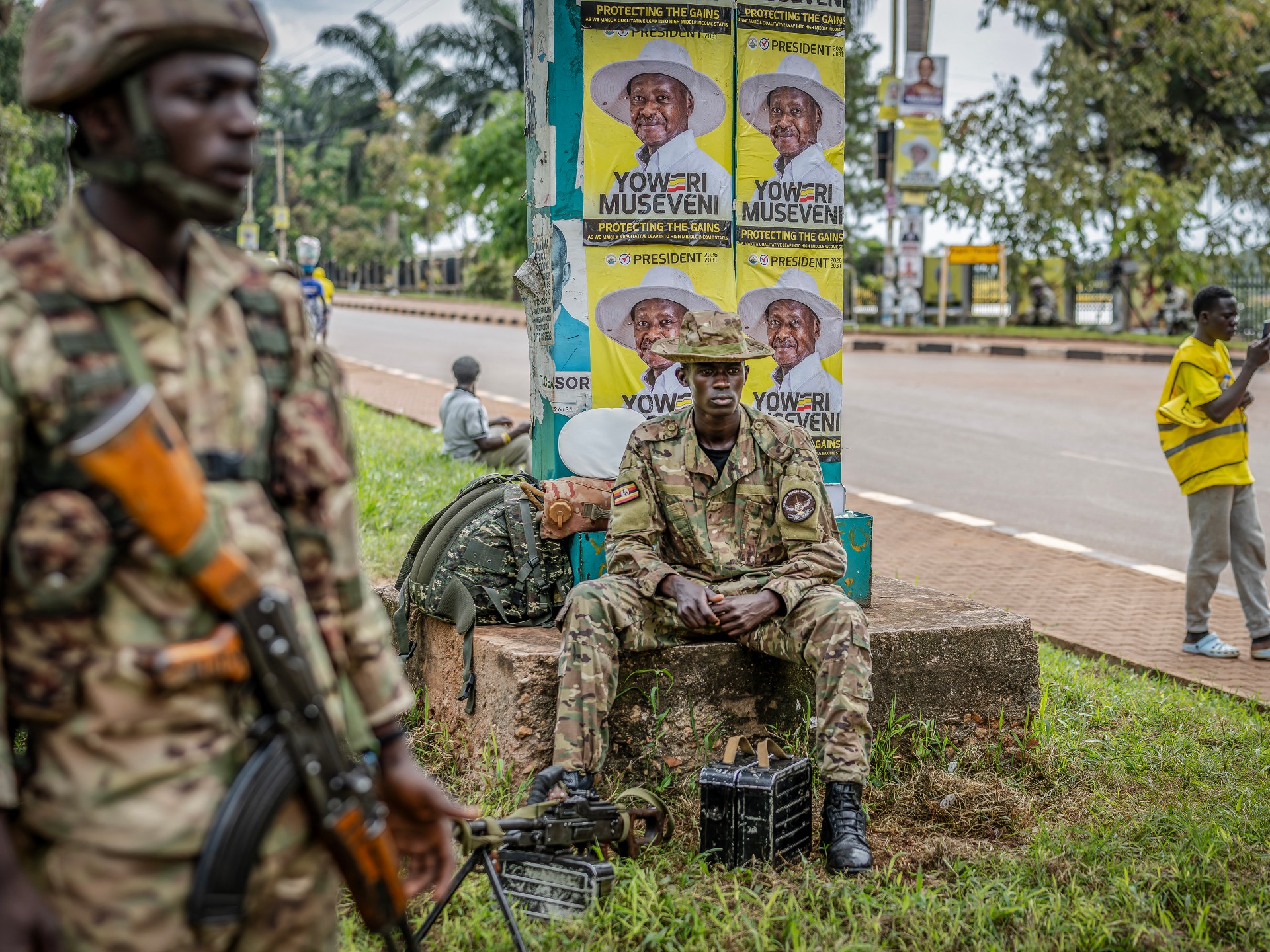

Ugandan authorities have imposed a nationwide internet blackout days before presidential elections in which President Yoweri Museveni is expected to prolong his 40-year rule.
A government regulatory body instructed mobile network operators to block public internet access starting at 6pm (15:00 GMT) on Tuesday. Internet monitor NetBlocks later confirmed a “nation-scale disruption to internet connectivity”.
- list 1 of 3Why are some African countries banning US citizens from entry?
- list 2 of 3Trump recalls dozens of career diplomats in ‘America First’ push
- list 3 of 3Collision on highway in Uganda kills 46 people
end of list
The network outage has heightened concerns about repression in the run-up to the January 15 vote, in which 81-year-old Museveni, Africa’s third-longest-serving leader, is being challenged by pop star-turned-politician Bobi Wine.
Musevni’s re-election ‘all but locked down’
Ugandan security personnel have rounded up hundreds of opposition supporters in advance of the vote and repeatedly fired live bullets and tear gas at pro-Wine campaign rallies. Meanwhile, opposition figure Kizza Besigye, who challenged Museveni in four previous elections, is jailed on charges of treason.
The United Nations Human Rights Office has criticised Uganda’s authorities for creating an environment of “widespread repression and intimidation” before the vote.
Brussels-based International Crisis Group has assessed that Museveni, “with his firm grip on the levers of state power … has re-election all but locked down.”
Wine views his candidacy as a campaign “against impunity,” reported Al Jazeera’s Catherine Soi from Kampala, Uganda. But “he doesn’t believe that he is going to get a free or fair election.”
Advertisement
Government bans two NGOs from operating
Museveni’s government said security forces are acting to stop what it described as lawless conduct by opposition supporters. The Uganda Communications Commission defended the internet shutdown as necessary to “curb “misinformation, disinformation, electoral fraud and related risks.”
In addition to cutting off the internet, the government on Tuesday ordered two local rights groups that have been critical of authorities – Chapter Four Uganda and Human Rights Network for Journalists-Uganda – to halt their work.
The state-run National Bureau for NGOs accused Chapter Four Uganda of engaging in activities “prejudicial” to Uganda’s security and “should cease operations … with immediate effect”.
Kristof Titeca, a Uganda expert based at Antwerp University, said the government’s clampdown has made it “too dangerous” for the opposition to effectively organise.
“The price people have to pay for engaging in political opposition has become very high,” said Titeca.

Uganda also blocked internet access during its last election in 2021 – a vote marred by reports of state violence and electoral manipulation. Authorities had repeatedly promised the internet would remain available this time, saying as recently as January 5 that “claims suggesting otherwise are false, misleading, and intended to cause unnecessary fear and tension among the public”.
In addition to Museveni and Wine, six other candidates are running for president in the East African nation of roughly 45 million people. Electoral authorities say there are 21.6 million registered voters.
Related News
Donald Trump pauses US tariff hike on furniture, cabinets for one year
Internet disruption, several arrests made as Iran protests continue
Countries demand Israel lift Gaza aid restrictions as Palestinians suffer