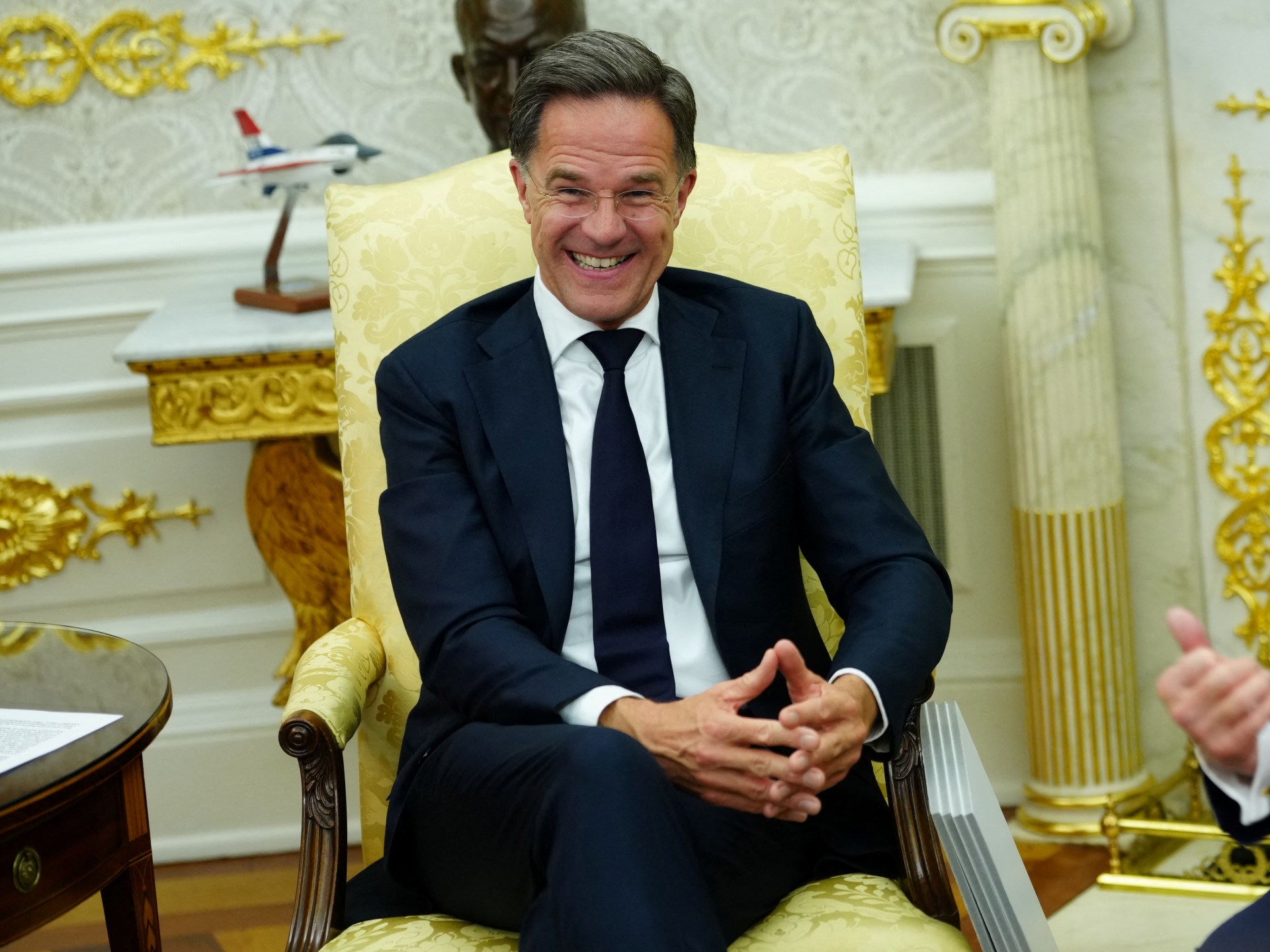

United States President Donald Trump has returned to a familiar theme during a meeting with NATO chief Mark Rutte, slamming European countries for not supporting the US-Israel war on Iran.
Sitting across from Rutte in the White House’s Oval Office, Trump reiterated his frustration that members of the NATO alliance did not join in the war effort.
- list 1 of 3Top European leaders vow ‘strong’ support for Ukraine ahead of NATO summit
- list 2 of 3Pentagon chief announces review of US forces in Europe, slams NATO allies
- list 3 of 3France-Germany jet plans crash: Can Europe end reliance on US for security?
end of list
“We didn’t need help on this at all. We demolished them in literally the first week,” Trump said of Iran.
“But it would have been nice if they would have said, ‘We’d like to help.’ We didn’t even need it, but it would have been nice if they said that.”
Trump, who has openly mused about pulling back from the transatlantic alliance, signalled he would discuss the matter further with Rutte behind closed doors.
“ We’re going to be discussing what took place, and we’ll see what happens,” he said.
Trump has frequently expressed disappointment that European nations did not do more to support the US in its war against Iran, which unleashed weeks of conflict across the Middle East and sent shockwaves through the global economy.
But Rutte’s appearance in the Oval Office comes at a critical time. In roughly two weeks, on July 7, NATO is slated to hold its annual summit in Ankara, Turkiye’s capital.
Rutte is widely seen as sympathetic to Trump, and critics view his visit to the White House as an attempt to soothe the US president.
Trump, for his part, praised Rutte at Wednesday’s meeting as a “great guy, great leader, great secretary-general”.
“ If anybody else were in that position, we wouldn’t even be meeting today, to be honest with you, because we were let down,” Trump said, referring to his disappointment with the NATO alliance.
Rutte opened the Oval Office appearance by displaying a series of charts showing increased defence spending by NATO members.
Advertisement
He also praised the US attacks on Iran, exhibiting the trademark flattery that has defined his approach to managing fragile relations between Trump and European allies.
“I really want to make clear how important it is what you are doing on Iran,” Rutte said, calling Trump the “leader of the free world”.
“This is, first of all, about the nuclear capability Iran was basically getting its hands on—and it would have been a threat to the region. It would’ve been a threat to the whole world. This is a country that is exporting chaos, is exporting terrorism.”
Despite Rutte’s claims, there is no evidence that Iran was on the verge of obtaining nuclear weapons when the US and Israel launched their attacks on February 28, triggering the war.
The attacks came as the US was negotiating with Iran over the future of its nuclear programme. Many experts have slammed the military offensive as unprovoked, saying it likely violated international law.
Earlier this week, US and Iranian delegates were in Switzerland, negotiating a tentative ceasefire memorandum signed on June 17.
One of the key impasses in the current negotiations is control over the Strait of Hormuz, a key passageway for global goods, including oil, fertiliser and natural gas.
Since the start of the war, Iran has shut down traffic through the strait, which passes by its shores. The June memorandum has seen Iran lift its chokehold on the waterway, pending further discussions.
But in March, as the blockade was in full force, Trump had called on NATO allies to send their militaries to guard the waterway. “It will be very bad for the future of NATO” if they don’t, he warned.
While no NATO ally committed military forces to the conflict, Rutte on Wednesday tried to advance the argument that they had helped in other ways.
The NATO chief pointed approvingly to the central role that European military bases played in the war.
“When you look at the numbers, four to five thousand US planes [were] taking off from bases in Europe in the six weeks this war took place,” Rutte said.
“I know there have been isolated cases about which you are really disappointed, but generally speaking, your European allies have been there.”
He also acknowledged Trump’s frustration, but brushed it aside as not representative of the NATO alliance.
“ I do agree there’s reason for disappointment, absolutely. But my argument is this: These are isolated cases,” Rutte said.
Trump did not appear moved by the argument, but praised Rutte for his role.
“ I think if I would’ve called him, he probably would have found a way to help if we needed it,” Trump said.
Advertisement
The US-Israel war on Iran killed thousands of Iranian civilians and temporarily displaced millions more.
Related News
Ukraine reclaims territory as it doubles attacks on Russian logistics
One in 70 people worldwide is forcibly displaced: UNHCR
Khamenei’s MoU stance stirs debate as Iran and US meet in Switzerland