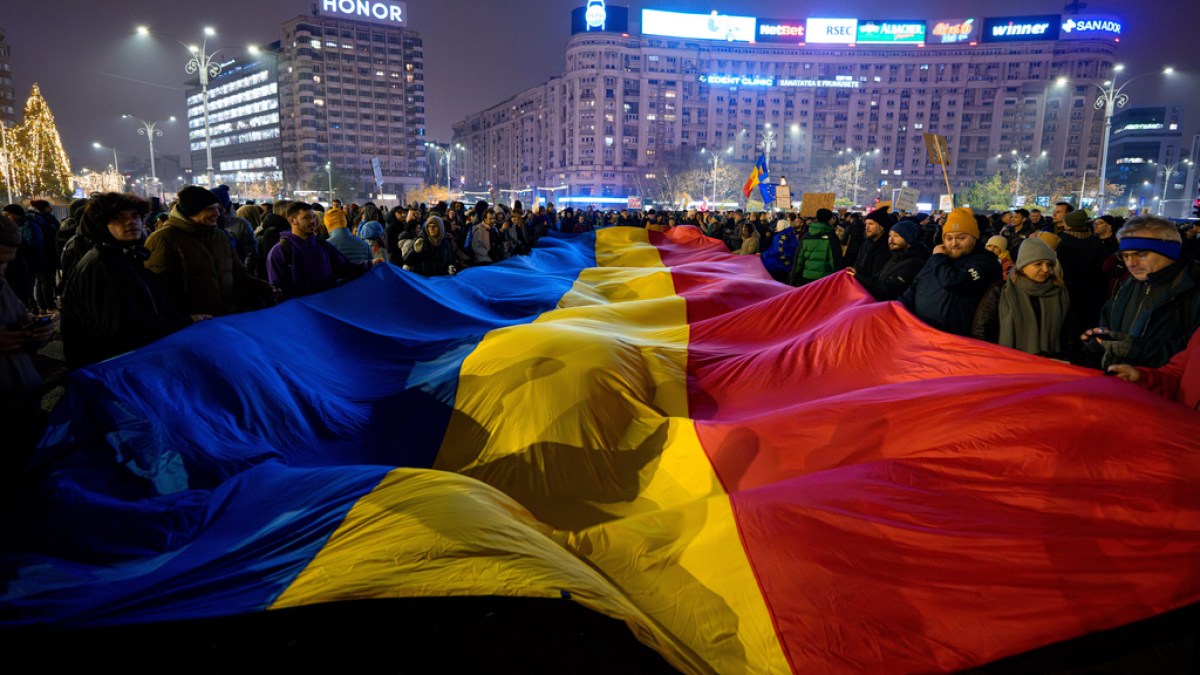

Mass protests have filled the streets of several Romanian cities for a fifth day in a row against alleged judicial corruption.
Thousands took to the streets of capital Bucharest and other cities on Sunday to show support for judges and prosecutors that denounced systemic abuse in the judicial system in an investigative documentary.
- list 1 of 3Romanian prosecutors indict pro-Russian former presidential candidate
- list 2 of 3Romania, Poland, Portugal election results: Who are the winners and losers?
- list 3 of 3Romania’s PM resigns after far right wins first round of presidential vote
end of list
Aired by media outlet Recorder on Tuesday, the documentary alleged that politically backed senior judges use legal loopholes for unethical practices – including questionable acquittals. Judges and prosecutors who complain assert that they often face disciplinary action.
Roughly 10,000 people marched in Bucharest on Sunday evening, chanting “Justice not corruption” and “Independence not obedience”, according to the Reuters news agency.
Thousands of protesters also gathered in other cities across Romania, as they have each day since the protests erupted on Wednesday.
The same day, several hundred judges and prosecutors signed an open letter on social media denouncing “profound and systemic dysfunction” in the justice system.
“Truth and integrity must not be penalised but protected. Silence is not an option when the values of the profession are threatened,” said the letter, which attracted support from politicians and business leaders.
President Nicusor Dan announced he would hold consultations with members of the judiciary on December 22, saying the number of complaints regarding “an integrity problem in the justice system” indicated “things are very serious.”
Judicial corruption has been a long-running issue in Romania. The southeastern European state’s judicial system was kept under special monitoring by Brussels even after it had met the requirements to join the European Union in 2007.
Advertisement
That observation was lifted in 2023. The pace of anticorruption investigations has since slowed, and the judiciary has delivered some high-level acquittals that have raised concerns that the fight against corruption has waned.
Romania, which ranks poorly in Transparency International’s corruption perception index, included corruption among the main vulnerabilities in its new defence strategy adopted by parliament in November.
Several judges and prosecutors who have spoken out against systemic abuses over the years have been transferred, demoted, investigated or sacked outright.
One of the courts mentioned in the documentary, the Bucharest Court of Appeal, defended itself in a news conference last week, but one of its judges broke ranks and publicly denounced pressure behind closed doors.
“We are simply terrorised with disciplinary actions,” Raluca Morosanu told the media, backing the allegations in the film.
Related News

Trump admin seizes oil tanker off Venezuela coast: Reports
France’s prime minister faces crunch vote in parliament
Australian PM says ‘shocking’ scenes after reported shooting at Bondi Beach