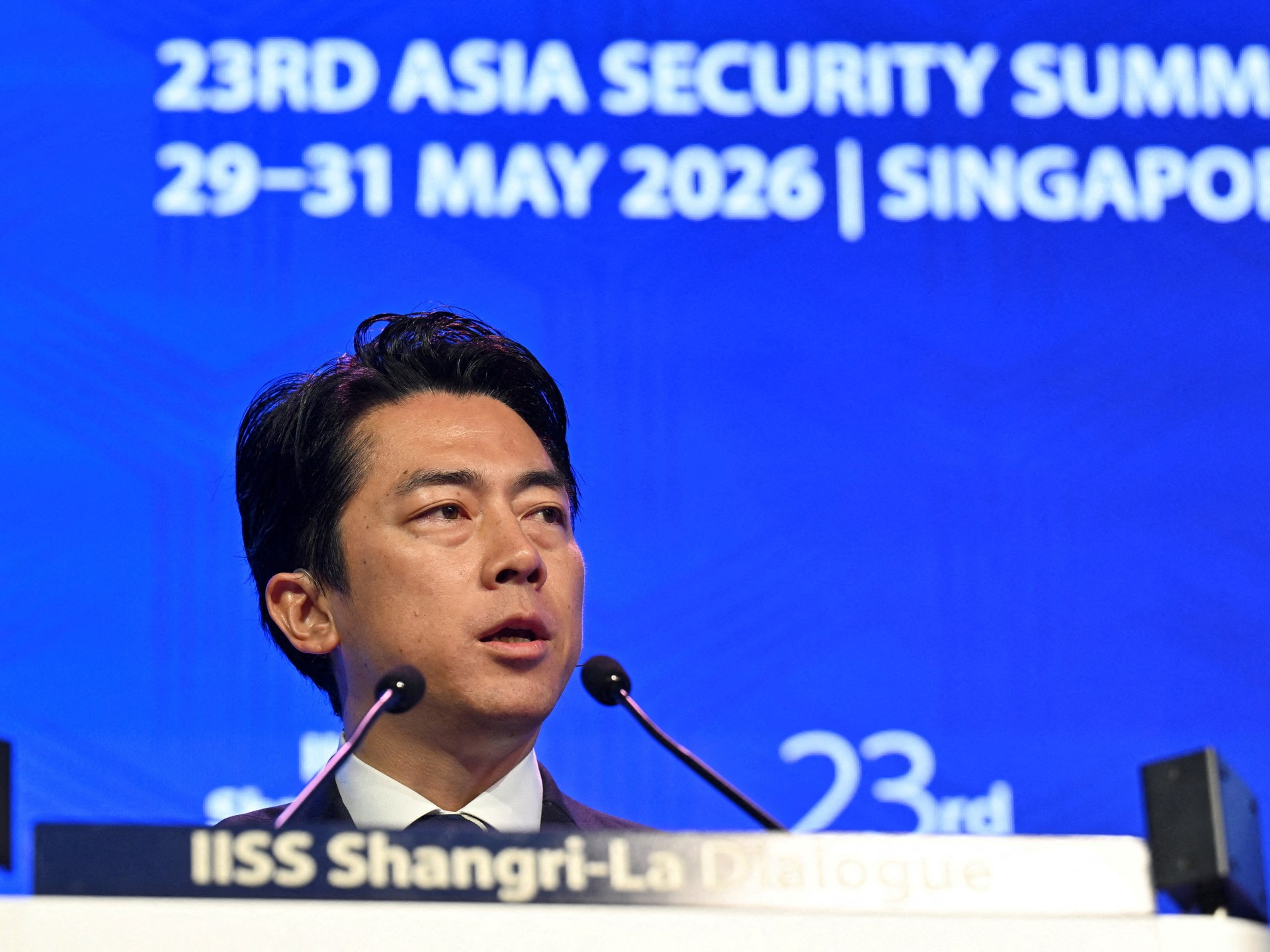

Japanese Defence Minister Shinjiro Koizumi has dismissed claims that Tokyo is pursuing “new militarism” and accused China of rapidly expanding its military with limited transparency.
China continues to increase its defence spending at a high level, Koizumi said on Sunday at the Shangri-La Dialogue in Singapore.
- list 1 of 3Australia, Japan strike largest defence deal for advanced warships
- list 2 of 3Taiwan monitors ‘unprovoked’ Chinese combat patrol near island
- list 3 of 3Some fear US-Philippines war games are drawing conflict closer to home
end of list
“China’s external approach and military activities are matters of serious concern for Japan and the international community at the same time,” he added.
“Think about it. There’s a country that has a huge arsenal of nuclear weapons and strategic bombers. Japan has neither of such weapons, and yet Japan is labelled ‘new militarism’?”
Koizumi said Japan’s record since World War II “speaks for itself”, citing its adherence to international law and commitment to the United Nations Charter alongside efforts to uphold a “free and open international order”.
In May, China’s Ministry of Foreign Affairs called on Asia Pacific countries to be vigilant and “jointly resist the reckless actions of Japan’s neo-militarism”.
At the Singapore forum, Chinese delegate Major General Meng Xiangqing criticised Japan.
“I deeply doubt whether a country that has not thoroughly eradicated the toxic legacy of militarism is qualified to talk extensively about defence cooperation on international occasions and whether it can win the trust of the international community, especially the Asian countries it once invaded,” he said.

Ties between Japan and China sank to their worst level in years after Japanese Prime Minister Sanae Takaichi warned in November that a hypothetical Chinese attack on Taiwan could draw a Japanese military response.
Advertisement
China claims Taiwan as its own territory over the objections of the island’s government.
Koizumi said transparency comes from “discussion and dialogue” and lamented that China had not sent its defence minister to the conference, but he insisted Japan remains open to engagement.
“We keep the door open,” he said, reaffirming Japan’s commitment to dialogue with China and other regional players to foster stability.
As China has been rapidly expanding and modernising its military, Japan has been reshaping its own defence policy. Last month, Takaichi’s cabinet scrapped a ban on lethal weapons exports, a major change in its post-war pacifist policy.
Separately on Sunday, Koizumi praised US Secretary of Defense Pete Hegseth for his commitment to the Asia Pacific but at the same time stressed the continued need for strong coalitions globally.
“Division weakens deterrence. Unity strengthens deterrence,” he told the conference in Singapore.
“If gaps emerge among the United States, Europe and allies and like-minded countries, forces which take it as an opportunity will surely come in,” he said.
“We must prevent such a situation. We must keep our cooperation going on. Now is the time to make our cooperation even stronger.”
US President Donald Trump has been harsh about fellow members in NATO, and the comments at the Shangri-La conference came the day after Hegseth again chided Western European allies at the forum for not devoting enough resources to defence.
Related News
UN urges ‘urgent’ action to protect children online
Bolivian president to reshuffle cabinet amid anti-government protests
Thousands of protesters demand president’s resignation in Bolivia’s La Paz