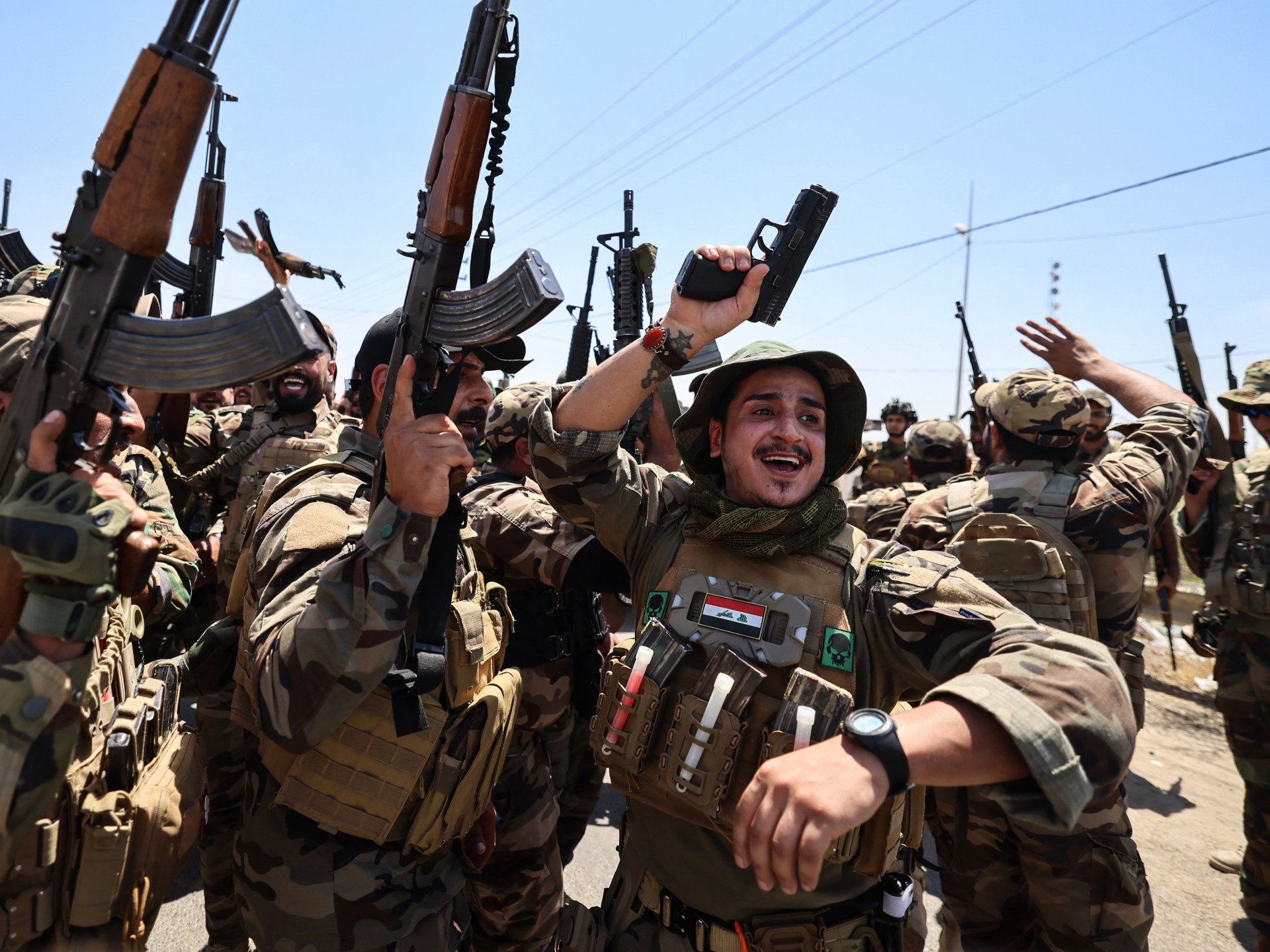

It was his first speech in front of parliament as Iraq’s prime minister, and Ali al-Zaidi was quick to set out his stall.
“[I am committing to] reforming the security apparatus by restricting weapons to state control and strengthening the capabilities of the security forces,” al-Zaidi pledged in mid-May.
- list 1 of 3One in 70 people worldwide is forcibly displaced: UNHCR
- list 2 of 3Which World Cup players and officials have faced visa troubles in the US?
- list 3 of 3How Lebanon became the breaking point for the Iran war ceasefire
end of list
Al-Zaidi is not the first Iraqi prime minister to promise that the state will have a monopoly on arms in a country where paramilitary groups – including many backed by neighbouring Iran – have been powerful since the 2003 United States-led war on Iraq.
But with pressure from Washington to disarm the groups amid the US-Israel war on Iran, and the economic challenges brought on by that war, al-Zaidi knows that he needs to clamp down on the power of Iraq’s paramilitary groups to attract outside investment, and not attract the ire of the US.
A number of the groups have played a role during the regional conflict, launching missiles and drones at US facilities in Iraq and the Gulf.
Iraqi oil revenue has sharply declined since the beginning of the war in the region in late February and the closure of the Strait of Hormuz, one of the world’s main conduits for oil. Iraq had exported about 3.3 million barrels per day (bpd) before the war, roughly 90 percent of it through the Strait of Hormuz. Figures for March show oil exports dropping to about 600,000bpd. Oil revenue represents more than 90 percent of Iraq’s state budget.
“Neither the economy not stability can flourish while arms remain out of the state’s control,” political analyst Mujashaa Altimimi told Al Jazeera. “Addressing this issue has become more of an economic necessity than it is a security one for the prime minister.”
Al-Sadr leads the way
One of the most powerful Iraqi Shia leaders, Muqtada al-Sadr, was quick to back al-Zaidi when he announced on May 27 that the Saraya al-Salam group would separate from the political movement under al-Sadr’s control and integrate its members into the state’s armed forces.
Advertisement
“Complying with the national interest of the state and to avoid the dangers threatening our homeland, it is our obligation to announce the complete dissociation of Saraya al-Salam from the National Shia Movement in order to fully integrate them into the state under the military general commander,” al-Sadr said in a statement welcomed by al-Zaidi.
Al-Sadr also called on other paramilitary groups – in particular, those affiliated with the Iran-backed and largely Shia Popular Mobilisation Forces (PMF) – to follow his lead and dissolve themselves.
Some have promised to do so, including Asaib Ahl al-Haq, a US-designated Foreign Terrorist Organization.
Faleh al-Fayyad, the head of the PMF, also said there would be a “complete disengagement” between the PMF and any political groups, adding that the goal was to make the PMF “an institution subject to a unified system and linked to the commander-in-chief of the armed forces [the Iraqi prime minister]”.
But other groups, including the powerful Kataib Hezbollah and Harakat al-Nujaba, have rejected compliance with the government’s call to restrict weapons to the state.
Path forward unclear
Speaking to Al Jazeera, one of Iraq’s most influential Shia figures, who did not wish to be named, said the groups that rejected the government’s efforts would be sidelined, but added the integration process would have to be done carefully.
“[A lengthy] process to dismantle these factions is better than confrontation, which may cause bloodshed,” said the figure, who requested anonymity. “Those who reject the government’s call will find themselves alone. And will find out that they were mistaken.”
But even with the groups that have agreed to comply with the state’s order, there are questions over implementation and what comes next.
Will powerful groups that have built up military might over years agree to simply hand over their weapons? If so, what will they expect in return?
Al-Sadr, for example, previously “retired” from politics in 2022, after his supporters attempted to overrun parliament during a political crisis. While he has since maintained a boycott of parliamentary elections, he did officially rebrand his political movement from the Sadrist Movement to the National Shia Movement, indicating that he is not fully done with politics yet.
A popular figure among large numbers of Iraqi Shia, al-Sadr may be positioning himself for a future where powerful political parties are more important than armed groups.
“I think he wants to send a message that ‘although I am not part of the political scene, I can still influence it,'” said Rahman al-Jebouri, the head of the Political Leadership and Governance Development Academy. “I believe this is a smart gesture.”
Advertisement
Al-Jebouri believes that al-Sadr has shown he has a “clear understanding” of the push in the wider region, with US pressure, for disarming non-state actors – and this may also be another indication that he is thinking of returning to politics.
“It is difficult to predict how he thinks,” said al-Jebouri. “But I believe he now has solid ground for a possible return to the political scene.”
The next practical step in the dissolution of Iraq’s paramilitary groups is yet unclear. Analysts believe the process will be long, complicated, and full of unforeseen developments.
One of the solutions currently under discussion is the formation of a new security ministry that would incorporate various security forces, including the PMF and the Kurdish Peshmerga.
“It is too early to be optimistic,” Iraqi political analyst Hani Ashour told Al Jazeera. “It is better to think about the reality with limited optimism. Let’s wait and see how things will turn out.”
Related News
Sudan medical group says RSF-affiliated fighters kill 27 civilians
How could El Nino reshape tropical storms around the world this year?
Saudi energy minister calls for ‘stable energy sector’ during Russia visit