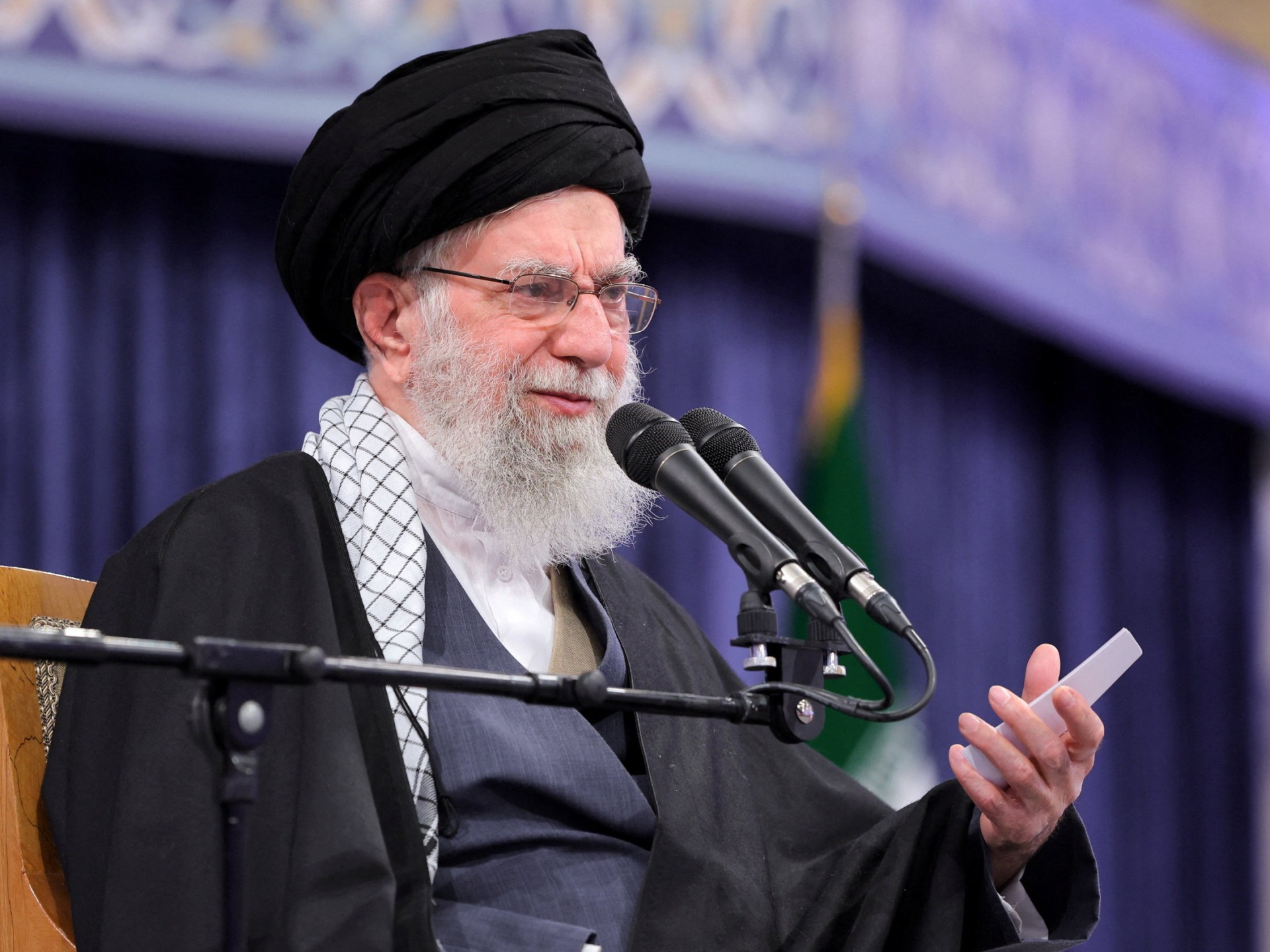

Tehran, Iran – Iran’s supreme leader, Ayatollah Ali Khamenei, has shot back at United States President Donald Trump and cast a pessimistic tone on negotiations with his administration even as Iran’s foreign minister says an understanding on “the guiding principles” of a deal has been reached.
The 86-year-old Khamenei said on Tuesday that Trump admitted that the US has tried to bring down the theocratic establishment in Iran since the country’s 1979 Islamic revolution but has failed.
- list 1 of 3Trump says he will be involved ‘indirectly’ in Iran nuclear talks
- list 2 of 3Iran launches naval drills ahead of US nuclear talks
- list 3 of 3Netanyahu calls for dismantling Iran’s nuclear programme in any US deal
end of list
“This is a good confession. You will not be able to do this either,” Khamenei said in an apparent reference to the US president telling reporters this week that a change in government would be “the best thing that could happen” in Iran.
Khamenei also used religious symbolism to draw parallels with figures who fought against Shia Muslim imams more than 1,350 years ago to cast doubt on any meaningful rapprochement with the US today. He said the Iranian nation “will not pledge allegiance to corrupt leaders like those who are in power in America today” based on religious beliefs.
“They say let us negotiate over your nuclear energy, and the result of the negotiation should be that you must not have this energy,” Khamenei said before adding that if any real negotiations were to take place, they cannot be predicated on any “foolish” demand that Iran move to zero enrichment of uranium.
His comments came hours before a statement made by Iranian Foreign Minister Abbas Araghchi after the conclusion of indirect talks with the US in Geneva.
Advertisement
“I can say, compared to the last round, we’ve had very serious discussions, and there was a constructive atmosphere where we exchanged our point of view,” Araghchi told reporters after the talks. “Those ideas were discussed, and we came to some agreements and some guiding principles. We will eventually draft a document. … We are hopeful we can achieve this.”
The message from the Iranian negotiating team through state media on Tuesday was that Tehran is “serious” about the indirect talks mediated by Oman and wants to see results – particularly the lifting of harsh US sanctions imposed after Trump in 2018 unilaterally withdrew from a nuclear deal that Iran had reached with world powers three years earlier.
For the US, which was also holding parallel talks with Ukraine and Russia in Switzerland, special envoy Steve Witkoff and Trump’s son-in-law Jared Kushner acted as lead representatives.
Both teams had separate meetings with Omani Foreign Minister Badr bin Hamad al-Busaidi as well as Rafael Grossi, the director of the International Atomic Energy Agency (IAEA) who will have to lead any potential future inspection missions of Iranian nuclear sites bombed by the US in June during a 12-day war between Israel and Iran.
‘Hard to be optimistic’
Washington has insisted that no uranium enrichment may take place inside Iran. It has also said Tehran must hand over its stockpiles of highly enriched uranium, which are believed to be buried under the rubble of the US air strikes in June, and limit its missile programme. Along with Israel, the US has sought an end to Iran’s support for the “axis of resistance”, the armed groups it backs in Lebanon, Iraq, Yemen and Palestine.
All these demands have been rejected by Iran, which said they cross “red lines” and undermine the country’s rights and security.
Instead, the Iranian team has proposed to dilute the uranium and to include the US in the potential economic benefits of any agreement.
Addressing a meeting of the leaders of the Iran Chamber of Commerce on Sunday, Deputy Foreign Minister for Political Affairs Hamid Ghanbari said the Trump administration would have to be offered deals in “areas with high economic output that can be achieved quicker”.
He suggested Iran could sell energy to the US, work on joint oil- and gasfields and minerals, or even buy aircraft from the US, but he did not say how Tehran believed such agreements could be achieved given the clashing positions offered by the two sides.
Iran’s currency, the rial, depreciated slightly after the indirect talks in Geneva ended on Tuesday after just over three hours. One US dollar was worth about 1.63 million rials on Tuesday, near an all-time low registered last month after a deadly crackdown against nationwide antigovernment protests and threats of war.
Advertisement
“It is hard to be optimistic about these negotiations that wrapped up very quickly. These are extremely complex subjects. Remember that it took two and a half years to negotiate the 2015 nuclear deal,” Ali Vaez, director at the International Crisis Group, told Al Jazeera.
“These talks usually require a lot of patience, a lot of focus, a lot of back and forth, a lot of discussions with experts. So if they wrap up this quickly, this is either a sign that the negotiators don’t have the patience that is required to reach an agreement or the gaps are simply too large to bridge.”
Shutting down the Strait of Hormuz
Beyond the rhetoric, developments on the ground also showed the two sides are no closer to reaching an agreement.
The US is still in the process of amassing soldiers and military equipment in the region with a second aircraft carrier on the way and more air defence systems positioned in multiple countries to fight against potential Iranian missile and drone attacks in case of a conflict.
Khamenei suggested Iran possesses weapons that can “sink” an aircraft carrier and “slap” the largest military in the world to the ground as the Islamic Revolutionary Guard Corps (IRGC) staged military exercises in the Strait of Hormuz.
IRGC navy chief Alireza Tangsiri told state television from the deck of a warship that if Iranian leaders order it, his forces are ready to make good on a longstanding threat to close down the strategic waterway, through which roughly 20 percent of global oil and gas supplies flow.
The IRGC said the strait was closed for several hours on Tuesday as its forces conducted the naval exercises. State television showed missiles being fired from warships and the shore to hit vessels at sea.
This comes as the US has also expressed a focus on hitting the ghost fleet of ships used by Iran to sell its oil, mostly to China, in defiance of Washington’s sanctions. The Trump administration has also threatened a 20-percent tariff on countries trading with Iran.
Ali Larijani, the secretary of Iran’s Supreme National Security Council, met with Russian Energy Minister Sergey Tsivilyov on Tuesday. Iranian media said the meeting took place in Tehran and the two sides were considering new energy agreements.
Iranian newspapers widely covered the Geneva talks and the IRGC exercises with none appearing to project that Iran and the US may have a credible pathway leading to an agreement in the foreseeable future.
“Power from Geneva to the Strait of Hormuz,” read the headline from the Tehran Municipality’s Hamshahri morning daily while reformist Shargh wrote, “Iran is not Venezuela.”
The conservative Farhikhtegan claimed that Iranian negotiators were in Geneva with “full hands” as they offered “initiatives” to advance the talks. The hardline Vatan-e Emrooz wrote about “Trump’s fears” of a military reprisal from Iran in case of an attack and what it described as the “broken bloc” alliance between the US and the European Union.
Related News

Israel approves proposal to register West Bank lands as ‘state property’
Portugal elects Socialist Party’s Seguro as president in landslide
Drone attack on busy market in Sudan kills at least 28