Epstein files fallout: Muted US response vs political reckoning in Europe
 24 February 2026
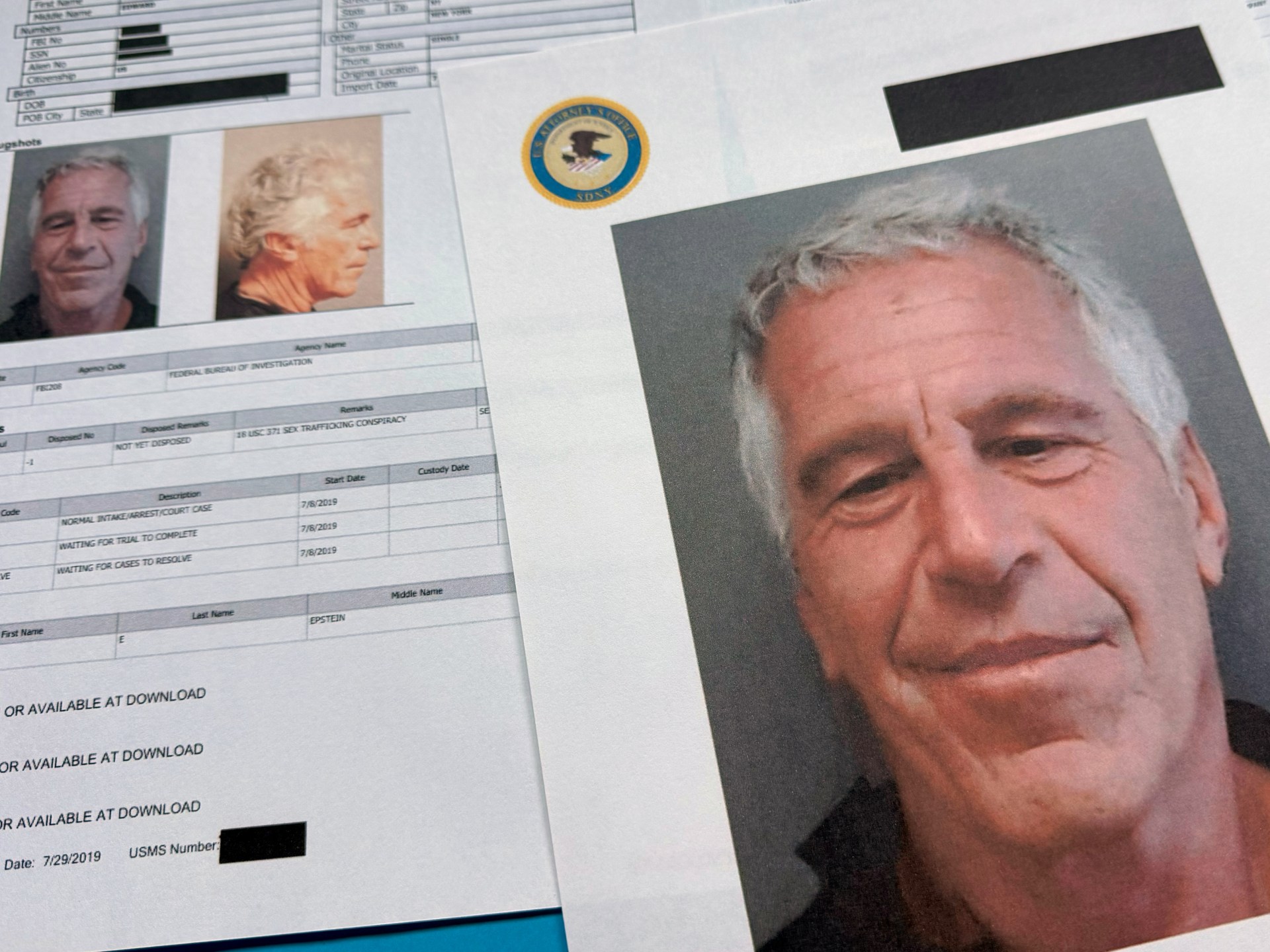

British politician Peter Mandelson has been released on bail after detectives questioned him for hours over the alleged leaking of sensitive government information to the late convicted paedophile, Jeffrey Epstein, while a government minister in the early 2000s.
The former United Kingdom ambassador to Washington was arrested on suspicion of misconduct in public office on Tuesday. His arrest followed the detention of Prince Andrew, now known as Andrew Mountbatten-Windsor, who was also questioned over similar misconduct linked to Epstein.
- list 1 of 3Peter Mandelson arrested amid Epstein files fallout
- list 2 of 3Trump set to deliver second term’s first State of the Union: What to expect
- list 3 of 3Australian PM backs removal of ex-Prince Andrew from succession line
end of list
The Epstein revelations have triggered investigations and resignations in Europe, but the fallout has been muted in the United States.
How have the Epstein files affected British politics?
The developments mark one of the sharpest reversals in recent British political life. Only months ago, Mandelson held one of the most senior (and coveted) diplomatic roles in the country.
He has since lost his post, faced a police raid at his home and now confronts the possibility of criminal charges. He has been forced to step down from the House of Lords, the unelected upper chamber of the UK parliament, and could be stripped of his title.
If convicted, he could face a maximum sentence of life imprisonment.
![Police lead Peter Mandelson to a waiting car upon his arrest on February 23, 2026. [Screenshot via Reuters]](https://www.aljazeera.com/wp-content/uploads/2026/02/peter_mandelson_arrest_screenshot-1771871477.jpg?w=770&resize=770%2C433&quality=80)
Prime Minister Keir Starmer’s decision to appoint Mandelson as British ambassador – a move made while his popularity has plunged – triggered the resignation of his chief of staff, Morgan McSweeney, and has raised questions about whether he can see out his term.
Advertisement
The scandal has also engulfed the royal family. After Andrew was arrested for leaking sensitive reports during his time as British trade envoy – the first arrest of a senior royal in centuries – King Charles III said “the law must take its course.”
British royal biographer Andrew Lownie, who interviewed the late Virginia Giuffre – who accused Epstein of forcing her to have sex with Prince Andrew three times when she was 17 – has warned that the fallout could also “bring down King Charles”, as scrutiny intensifies over what he knew about his brother’s conduct.
The cases form part of a broader European response to newly released troves of Epstein-related documents from the US.
Across the continent, authorities have opened investigations, and several public figures have stepped down or lost positions.

What’s happened in Europe?
France has also moved. Former Culture Minister Jack Lang resigned from his role leading a Paris cultural institution after the Ministry for Europe and Foreign Affairs sought to question him over contacts with Epstein.
In Norway, former Prime Minister Thorbjorn Jagland has been charged with “gross corruption” following disclosures that he stayed at Epstein’s properties in New York and Florida and visited his private island, as well as having the late sex offender cover his expenses and those of his family. He faces up to a decade in prison if convicted.
Norway’s ambassador to Jordan, Mona Juul, also resigned after reports that Epstein left $10m to her children in his will.
Meanwhile, Crown Princess Mette-Marit of Norway apologised after documents showed she had holidayed at one of Epstein’s properties.
In Slovakia, national security adviser Miroslav Lajcak stepped down after disclosures about his association with Epstein surfaced. Prime Minister Robert Fico confirmed he accepted the resignation.
For many in Europe, simply appearing in the files has triggered public scrutiny, investigations or resignations.
Governments have treated the document releases as grounds for formal inquiry, even when criminal liability remains unclear.

In the US, public anger has simmered for years. Democratic Congressman Ro Khanna and Republican Thomas Massie have led a bipartisan effort to release the files, using the term “Epstein class” to describe a wealthy elite who believe themselves to be above the law.
Advertisement
Yet criminal accountability beyond Epstein and his longtime associate Ghislaine Maxwell has remained limited. Maxwell is serving a 20-year sentence for sex trafficking offences.
FBI documents identify eight alleged co-conspirators, including the former CEO of Victoria’s Secret, Lex Wexner, Epstein’s former secretary Lesley Groff and modelling agent Jean-Luc Brunel, who died in custody in France.
None, apart from Maxwell, has faced a US criminal conviction in connection with Epstein’s trafficking case.
The lack of accountability has spanned Democratic and Republican presidents.
Epstein first avoided federal prosecution in 2007-08 through a controversial non-prosecution agreement reached during the administration of George W Bush.
Subsequent administrations under Barack Obama, Donald Trump’s first terms and Joe Biden did not bring sweeping new prosecutions tied to the broader network named in the files.
There is no sign that any prosecutions are under way, despite Congress forcing Trump to release the files.
Who has been affected in the US?
Several prominent Americans have stepped back from roles or faced reputational damage.
Former US Treasury Secretary Lawrence Summers took leave from academic duties at Harvard University after scrutiny over his ties to Epstein.
Lawyer Brad Karp resigned as chair of the law firm Paul Weiss. The National Football League said it would review correspondence between Epstein and New York Giants co-owner Steve Tisch.
Longevity specialist and high-profile physician Peter Attia issued an apology and resigned from his role as chief science officer at David Protein over emails exchanged with Epstein. He also stepped down as a CBS News contributor.
Others named in communications with Epstein have not faced formal charges.
Among them are former White House strategist Steve Bannon, Commerce Secretary Howard Lutnick and technology billionaire Elon Musk, who has said he never visited Epstein’s island despite discussing the possibility in emails.
Former President Bill Clinton has testified before Congress regarding his friendship with Epstein.
Trump, who also knew Epstein for years and appears thousands of times in the released documents, has denied wrongdoing, as has the White House.
Related News
Ukraine says Russia launched aerial attacks as peace talks enter second day

One killed, 11 injured in Yemen after security forces disperse STC storming
South Korea convicts ex-President Yoon Suk Yeol for insurrection