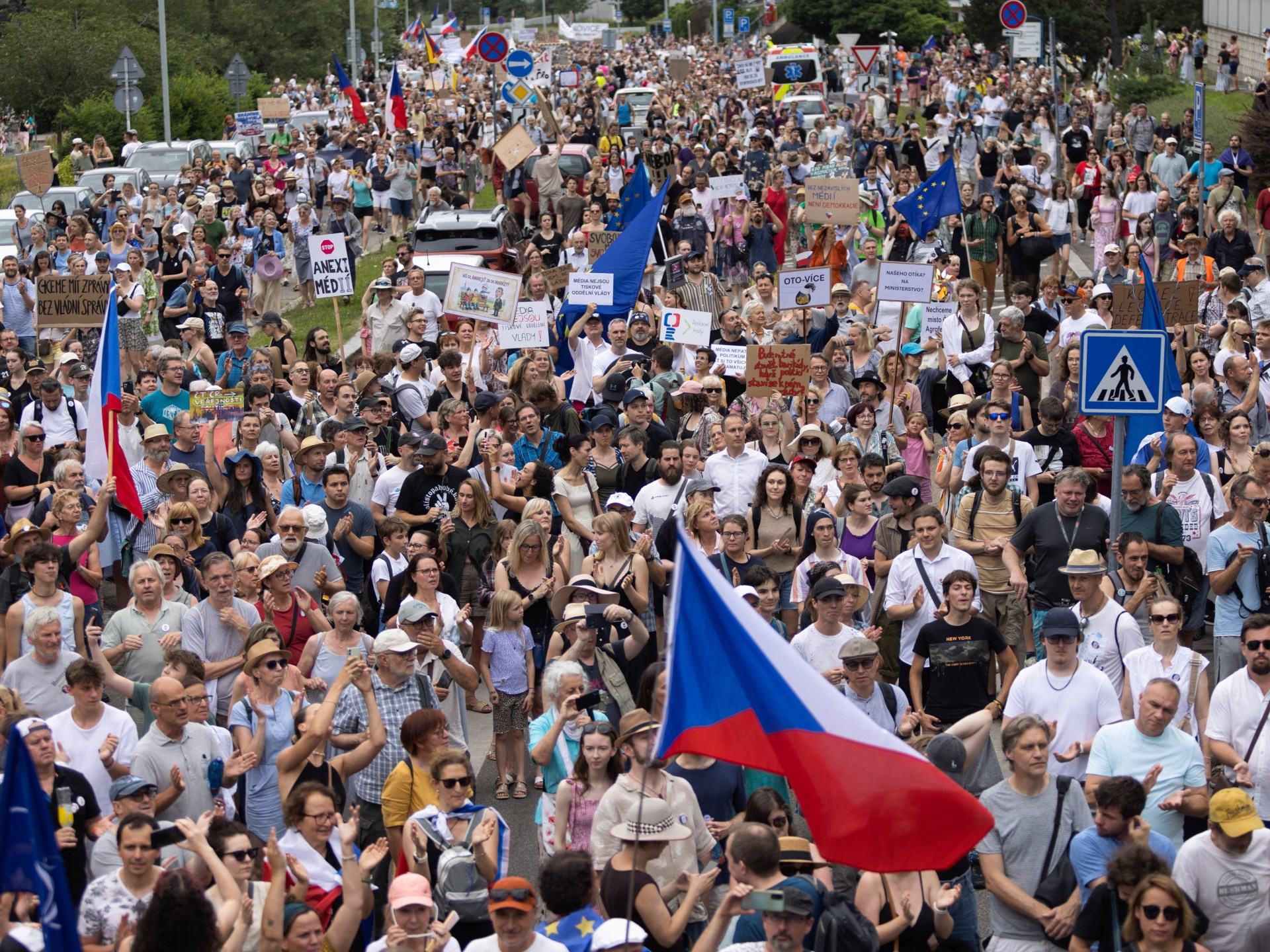

Czech public media employees have staged a one-day “warning” strike demanding that the government drop plans to put funding of Czech Television (CT) and Czech Radio (CRo) under direct control.
The strike, threatened weeks ago, was centred on CT’s headquarters in Prague on Monday and followed a large public protest at the same spot the previous day. It was the latest of many rallies warning that the populist government is threatening the independence of the country’s much respected public media.
- list 1 of 4Hungarian MPs approve PM limits to block potential return of Orban
- list 2 of 4From a meatball lunch to a hug: The normalisation of Sweden’s far right
- list 3 of 4Israel slams EU’s Kallas for ‘apartheid’ comment: Are ties unravelling?
- list 4 of 4Czech police detain Russian priest over ‘white substance’ find
end of list
The strikers, civil society groups, and large cohorts of the public, worry that the government led by Prime Minister Andrej Babis is seeking to exert political control over the outlets. The cabinet last week approved a long-threatened switch from a licence fee system to direct financing from the state budget.
Under the plan, the outlets would also see a cut in their funding to 2008 levels. The previous government last year raised CT’s level of funding for the first time in 17 years.
Babis has said that the new funding model would be fairer to poorer households and encourage the outlets to work harder at efficiency.
Critics say the change would give the government power to intervene in broadcasters’ work. They point to similar efforts by authoritarian governments in Hungary and Slovakia over recent years.
Reporters Without Borders (RSF) and other media observers have slammed the move and the potential impact on the state broadcasters.
Several programmes on Monday started with a minute’s delay and a countdown clock on the screen with an explanatory note as thousands of journalists and other state media employees joined the strike.
Advertisement
Hundreds of CT staff protested outside the television company’s headquarters in a southern suburb of the Czech capital. CRo staff formed a human chain around the radio station’s building in central Prague.
Most protesters wore black. They flashed banners saying “We are not state media” or “Independence is no expenditure”.

Babis’s vowed to cancel the licence fees ahead of taking office last December, and says his three-party government is now merely fulfilling that pledge to voters.
But under the plan the broadcasters would also end up with around 15 percent less money next year, and the directors of public radio and television have said that would force them to fire hundreds of employees and cancel programmes.
Babis insists that his government has no intention to interfere with the independence of the outlets, but he and other senior members of the government – which includes far-right and radical-right figures – have long complained of their liberal outlook and of bias.
However, opposition to efforts to suppress the Czech Republic’s public media is not new.
In 2000, a bid to seize political control saw journalists occupy the CT studios putting out their own broadcasts, with massive street protests helping force the government at the time to step back and to strengthen their independence.
Related News
Britain’s defence minister Healey quits over defence spending
Are UK Prime Minister Keir Starmer’s political days numbered?
Police charge man after suspected anti-Muslim attacks in Edinburgh