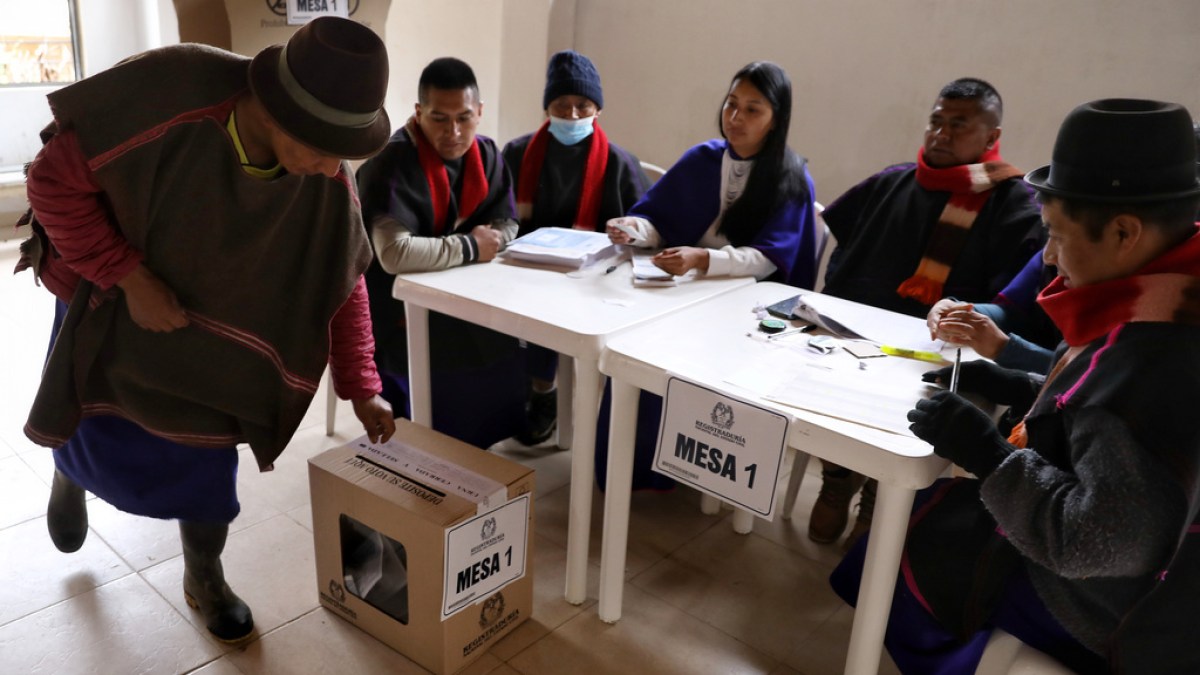

Polls have opened in the first round of Colombia’s presidential election, in which a left-wing lawmaker, an independent businessman and a right-wing senator are vying to succeed President Gustavo Petro.
Government-allied Senator Ivan Cepeda is currently leading in the polls. In Sunday’s election, he is angling to cross the 50-percent threshold in the vote tally to avoid a June run-off, which could allow the splintered right wing to consolidate around a single candidate.
- list 1 of 3Colombia’s ‘Total Peace’ plan: A failure or unfinished business for Petro?
- list 2 of 3‘Opposite visions’: What to know about Colombia’s presidential election
- list 3 of 3Al Jazeera exclusive interview with rebel FARC faction in Colombia
end of list
Whether Cepeda prevails or not is likely to be a bellwether for the strength of Colombia’s political left.
In 2022, Petro became the first left-wing president in Colombia’s history to be elected, and Cepeda has pledged to continue the outgoing leader’s social reforms to combat poverty.
But scandal and questions about the efficacy of his policies have dented Petro’s popularity. For months, polls had suggested that Petro — who is term-limited — would be replaced by an ideological rival.
But Cepeda, a 63-year-old senator, has been gaining popularity. A poll earlier this month from the National Consulting Centre (CNC) showed him with 33.4 percent support, the most of any candidate.
His closest opponent is Abelardo de la Espriella, 47, a businessman who is promising to crack down on crime and armed groups by bolstering security operations and constructing megaprisons, echoing the policies of El Salvador’s President Nayib Bukele.
Until recently, Paloma Valencia, a senator backed by former President Alvaro Uribe, was the favoured right-wing candidate, but she is currently third in the polls. If elected, Valencia would be the country’s first female president.
Advertisement
While the contest is shaping up to be a three-horse race, 14 candidates in total are running for the presidency.
If no candidate wins more than 50 percent of the votes on Sunday, the top-two vote-getters will face each other in a second round on June 21.
A heavy security presence is expected at Sunday’s vote, and officials are seeking to keep tensions low with a ban on the sale and consumption of alcohol in public places.
The threat of violence has loomed large over the elections. Last year, presidential candidate Miguel Uribe Turbay was assassinated during a campaign stop in the capital, Bogota.
Colombia has struggled with more than six decades of internal conflict, with criminal networks, right-wing paramilitaries, left-wing rebels and government forces all fighting for territorial control and political influence.
Uribe Turbay’s death was particularly symbolic, as his mother, journalist Diana Turbay, was famously killed in 1991 during a kidnapping by the Medellin cartel.
How to approach Colombia’s security and address the patchwork of belligerent factions remains a perennial issue in the country’s presidential races.
Cepeda has promised to push on with Petro’s “Total Peace” plan, prioritising talks with armed groups and criminal gangs rather than using a military-only approach.
That strategy has failed to stem the violence, but its supporters say it can root out the problem in the long term, while security crackdowns only offer a temporary solution.
“The solution to this conflict isn’t aggressive confrontations. It will only end in more bloodshed,” Cristian Morales, a 26-year-old Cepeda supporter, told The Associated Press news agency in Bogota.
“It’s so difficult because it’s either dialogue or arms, and an internal conflict isn’t good for anyone.”
But Maria Eugenia, a 57-year-old seamstress, said she favours de La Espriella’s call for a hardline military campaign to restore security.
“Of course, whenever you come down with a heavy hand, there’s always going to be debate,” she said. “But some people are going to have to fall to clean up what needs to be cleaned.”
The vote will be a referendum on the legacy of Petro, who sought to expand the country’s social safety net and was willing to take stances against the United States, one of Colombia’s closest allies.
A supporter of Palestinian rights, Petro faced US sanctions after President Donald Trump accused him, without evidence, of involvement in the drug trade.
He also spoke out against the US air strikes against suspected drug boats around Latin America — a campaign that rights advocates say amounts to extrajudicial killings.
Advertisement
After months of tensions that saw Trump threaten to take military action against Petro, relations improved after the Colombian president visited the White House in February.
Related News
US authorities say missionary who contracted Ebola en route to Germany
Sudan medical group says RSF-affiliated fighters kill 27 civilians
Massie race breaks spending record as pro-Israel groups target Trump critic