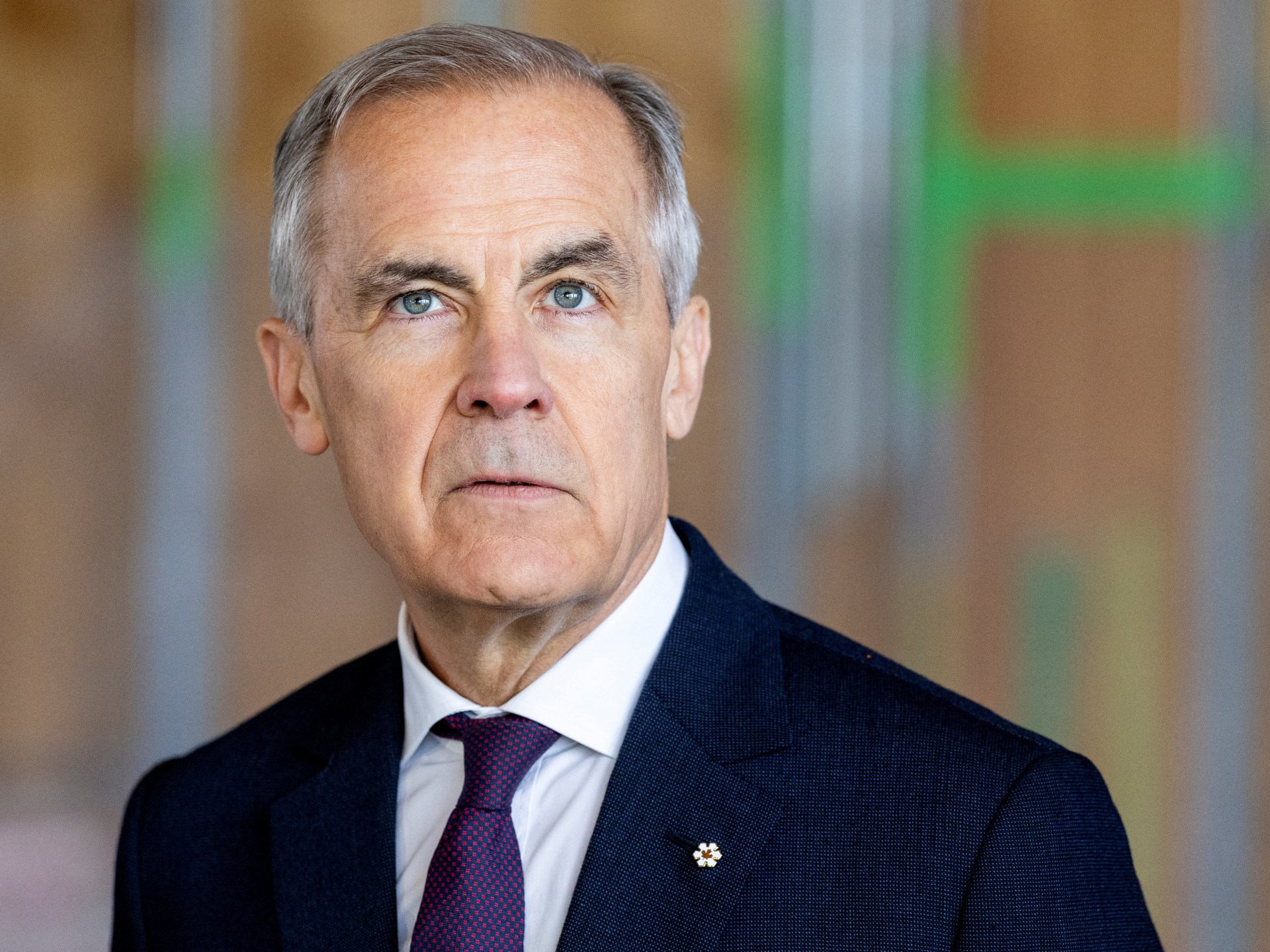

Canada’s Prime Minister Mark Carney has secured a parliamentary majority for his centrist Liberal government, strengthening his hold on power and allowing him to advance his agenda without relying on opposition support.
The Liberals now hold 174 seats in the 343-seat House of Commons of Canada after winning key by-elections in three ridings, or electoral districts, on Monday.
- list 1 of 3Canadian authorities investigating shooting at US consulate in Toronto
- list 2 of 3How Carney’s ‘build fast’ push divides Canada’s Indigenous peoples
- list 3 of 3Canada’s Bill C-12 an ‘attack on refugee, migrant rights’: Advocates
end of list
They include the Ontario ridings of University–Rosedale and Scarborough Southwest, as well as the closely contested Quebec riding of Terrebonne.
In a statement following the victory, Carney signalled that affordability and the economy would remain his central priorities. He added that voters had “placed their trust” in his government.
“We accept their support with humility, determination, and a clear understanding of what this moment demands for our country,” Carney said on Tuesday.
He also announced that Canada will suspend the federal fuel excise tax on petrol and diesel from April 20 to September 7 to help consumers cope with rising prices. The move, Carney explained, is expected to cut petrol prices by about 10 cents Canadian (US$0.07) a litre and diesel costs by four cents (US$0.03).
“[This] is a responsible measure that will reduce operating costs for truckers and businesses in the food, agriculture, housing, construction and delivery sectors,” he said.
The Liberals had relied on Conservative support over the past year to pass economic and trade-related legislation. With a majority now secured, that reliance is expected to end.
Advertisement
“He will be able to pass legislation without having to go to the opposition to secure enough votes,” said Andrew McDougall, an assistant professor of Canadian politics at the University of Toronto.
Conservative leader Pierre Poilievre, however, criticised the Liberal Party for securing its majority not through voter support but rather through “backroom deals”.
He pointed to instances before Monday’s by-elections where politicians switched their party allegiance to the Liberals.
Poilievre argued that Carney had focused more on political negotiations than on economic policy and that his government was seeking “total power without accountability”.
“While the Prime Minister spent the year on this cynical power grab, he has doubled the deficit and given Canada the worst grocery prices and housing costs in the G7,” Poilievre wrote, referencing the Group of Seven countries, some of the world’s biggest economies.
‘The large Liberal tent’
Before Monday’s results, Carney had already bolstered his ranks in the House of Commons through defections from other parties.
A total of five members of Parliament (MPs) switched parties over the past five months: four from the Conservatives and one from the left-wing New Democratic Party.
They include longtime Conservative politician Marilyn Gladu, who joined the Liberals last week, saying Canada needed “a serious leader” to navigate economic uncertainty linked to US tariffs. She thanked Carney for welcoming her into what she described as “the large Liberal tent”.
Canadian media have reported that other opposition MPs have been courted by the Liberals, too.
But Monday’s by-election victories reinforced the Liberals’ dominant position in the House of Commons.
The party successfully defended its seat in the University–Rosedale riding, which was previously held by former Deputy Prime Minister Chrystia Freeland, a longtime Liberal leader.
After Freeland stepped down to take a role advising Ukraine on economic development, fellow Liberal Danielle Martin claimed her seat in Monday’s by-election.
In Scarborough Southwest, Doly Begum — a New Democratic candidate turned Liberal — also held onto a Liberal seat recently vacated by Bill Blair, following his appointment as ambassador to the United Kingdom.
It was a more narrow race in Terrebonne, where an election last year between the Liberals and the separatist Bloc Quebecois came down to a single vote. This year, Liberal Tatiana Auguste narrowly edged ahead of her Bloc Quebecois competitor.

‘A competent manager’
Analysts say the Liberal majority reflects voter concerns about the economy. A former governor of the Bank of Canada and the Bank of England, Carney is seen as more fiscally savvy than his predecessors.
Advertisement
Laura Stephenson, chair of the political science department at the University of Western Ontario, said, for example, that Carney’s approach is seen to differ from that of his predecessor, former Liberal Prime Minister Justin Trudeau.
“He is focused on helping Canada survive the economic turmoil, not remaking society,” she said. “When we’re in tough times like this, there are different calculations being made.”
Recent polling from the research firm Nanos suggests Carney has gained ground with voters, with more than half of Canadians preferring him as prime minister, compared with about 23 percent backing Poilievre.
“Carney has done a fairly good job showing Canadians he can handle [US President Donald] Trump,” McDougall said. “He’s shown Canadians he’s a competent manager of the economy and the country. And so far, Canadians have not been overly impressed by the alternatives.”
Trudeau was the most recent Canadian leader to win a majority mandate, securing it in the 2015 federal election before losing it in 2019. Thereafter, his party governed as a minority in the House of Commons.
Related News

Trump says US forces to stay near Iran, ready for ‘next conquest’

Drone strike on Sudan hospital kills 10, medical charity MSF says
Iran’s ex-foreign minister Kharazi ‘gravely wounded’ in attack on his home