Australian officials questioned on guns, anti-Semitism over Bondi shooting
 15 December 2025
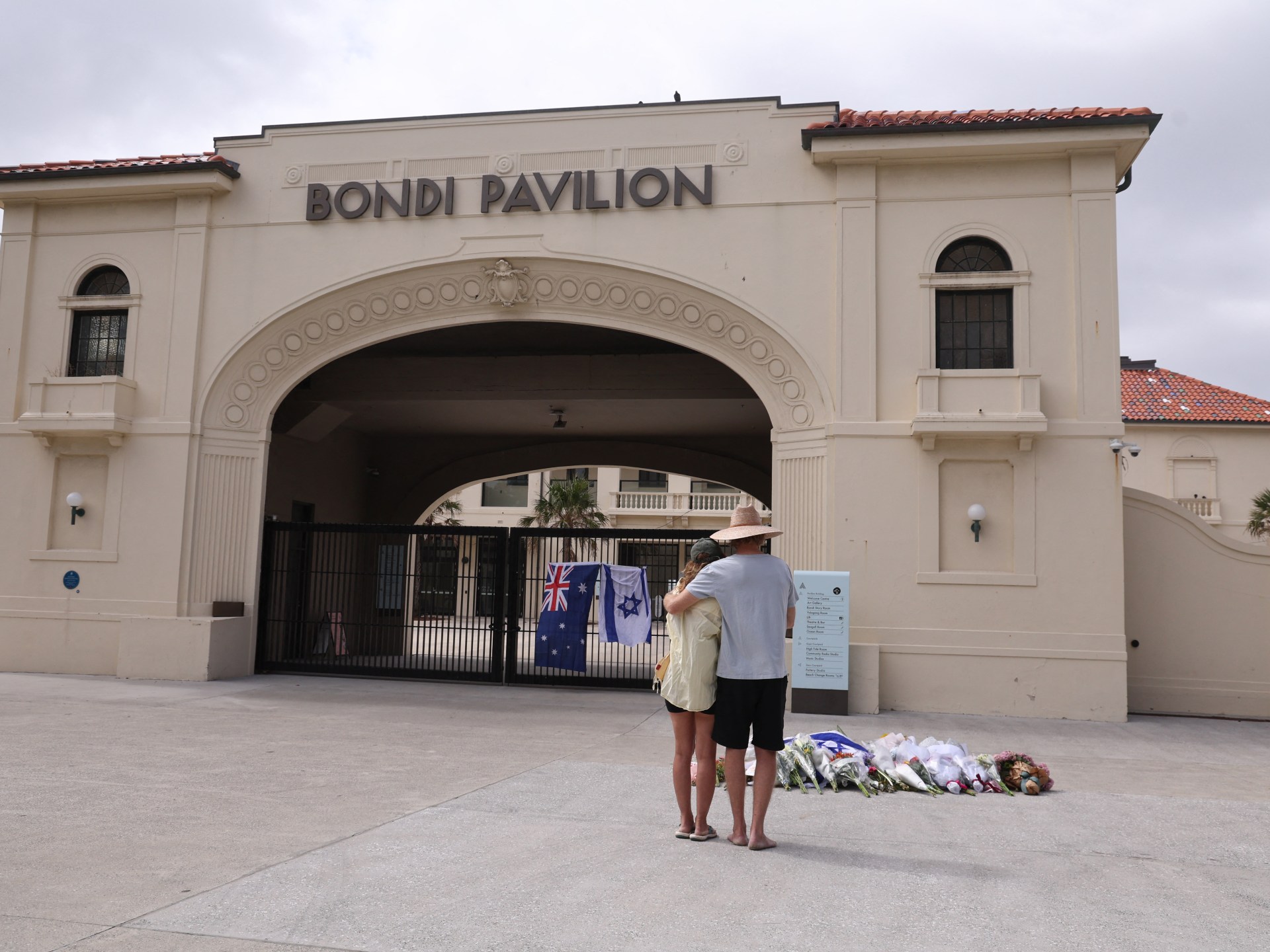

Australian Prime Minister Anthony Albanese has pledged a review of his country’s gun laws and added support for Jewish Australians, as his government faces scrutiny following a deadly shooting at Sydney’s Bondi Beach.
On Monday afternoon, Albanese faced reporters to answer questions about the shooting, which took place a day earlier, during a local Hanukkah celebration. At least 15 people have died, including a 10-year-old girl, and dozens are reported injured.
- list 1 of 4Australia reels from mass shooting at Bondi Beach in Sydney
- list 2 of 4Photos: Deadly mass shooting at Sydney’s Bondi Beach stuns Australia
- list 3 of 4‘Hero’ bystander tackles gunman at Australia’s deadly Bondi Beach shooting
- list 4 of 4World reacts to Jewish festival shooting attack at Sydney’s Bondi Beach
end of list
“What we saw yesterday was an act of pure evil, an act of terror, an act of anti-Semitism: an attack on the first day of Hanukkah, targeted at the Jewish community,” Albanese said in prepared remarks, after visiting the crime scene.
“A dark day in Australia’s history, on what should have been a day of light.”
The Australian government has yet to name the suspected attackers, identifying them only as a 50-year-old man and his 24-year-old son. The father died in a shootout with police, while the son is currently being treated at a local hospital.
Hanukkah is sometimes called the Festival of Lights, and in Monday’s news conference, Albanese encouraged Australians to participate in a show of solidarity with the country’s Jewish community.
“I would urge and join with others who have urged Australians across the country to light a candle, put it in their front window tonight at 6:47pm [19:47 GMT] to show that light will indeed defeat darkness – part of what Hanukkah celebrates, of course,” he said. “We are stronger than the cowards who did this.”
Advertisement
But while Albanese and other officials urged calm, critics questioned whether the government had done enough to curtail both anti-Semitism and gun violence.
Netanyahu spurs scrutiny
One of Albanese’s highest-profile critics in the wake of the attack was Israeli Prime Minister Benjamin Netanyahu.
The right-wing Israeli leader blamed Albanese’s centre-left government for failing to protect Australia’s Jewish community. He also linked the shooting to Australia’s recent decision to recognise Palestinian statehood.
“Your call for a Palestinian state pours fuel on the anti-Semitic fire,” Netanyahu said in remarks directed at Albanese, voicing sentiments he later repeated in a social media post.
“It emboldens those who menace Australian Jews and encourages the Jew hatred now stalking your streets.”
Those remarks fuelled outrage and accusations that Netanyahu was leveraging the tragedy for political aims.
In a post on social media, UN special rapporteur Ben Saul also criticised Netanyahu for linking Australia’s recognition of Palestinian statehood to Sunday’s shootings.
“I am disgusted that the Israeli PM links Australia’s principled support for a Palestinian State with yesterday’s terrorist attack in Bondi,” said Saul, who also serves as an international law chair at the University of Sydney.
“Australia has taken extensive measures to prevent anti-semitism,” Saul added.
When asked on Monday morning about Netanyahu’s remarks, Albanese said his focus was on bringing people together.
“This is a moment for national unity,” the Australian prime minister told reporters in Sydney. “This is a moment for Australians to come together. That’s precisely what we’ll be doing.”
He also said his government would beef up funding and support to protect Jewish community members, including covering the costs of guard services.
“We’re extending the funding for the National Council for Jewish Community Security and its state-based community security groups, to provide overall security cover to the Jewish community,” Albanese said.
“We’re also working with Jewish community organisations to see how we can best support charity efforts, including through tax-deductible status for donations.”

Australia’s gun reforms under scrutiny
Albanese also told reporters on Monday afternoon that he would be convening a meeting of state premiers to discuss “tougher gun laws, including limits on the number of guns that can be used or licensed by individuals”.
Advertisement
“People’s circumstances change. People can be radicalised over a period of time. Licences should not be in perpetuity,” said Albanese.
His remarks follow questions about the six guns recovered from the scene of the shooting and the revelation that the 24-year-old suspect had previously come under police scrutiny.
Officials have repeatedly said the 50-year-old suspect had “met the eligibility criteria for a firearms licence”, and that the 24-year-old was previously not deemed to be a threat.
Australia introduced some of the world’s strictest gun laws, including bans on automatic and semiautomatic rifles and shotguns, after a shooter killed 35 people in the Tasmanian town of Port Arthur in 1996.
The 1996 reforms, introduced under former Prime Minister John Howard, were hailed as a success after Australia saw no mass shootings occur for close to two decades.
However, according to a recent report from the Australia Institute, the implementation of the laws has lapsed in recent years, with more guns now in the country than before 1996.
On Monday, Albanese said the reforms had “made an enormous difference” and were a “proud moment” of bipartisan action, but that reviews were now needed to ensure better coordination between states.
Chris Minns, the premier of New South Wales, where the shooting took place, also told reporters on Monday he would be reviewing gun laws.
“We want to make sure that prospective reform and change in New South Wales has a lasting impact,” Minns said. “It’s not the last time I’ll be mentioning it, and you can expect action soon.”
Sunday’s shooting at Bondi Beach follows several other mass shootings in recent years, including a 2022 attack in Wieambilla, Queensland, linked to Christian fundamentalist ideology that left six people dead.
An Australian man was also responsible for the attack in 2019 that killed 51 people at a mosque in Christchurch, New Zealand, where semiautomatic weapons are still sold.
Related News

At least 23 people killed in nightclub fire in India’s Goa
EU’s Kallas says Washington ‘biggest ally’ despite US security downgrade
Agent-tracking app ICEBlock sues Trump administration in free speech fight