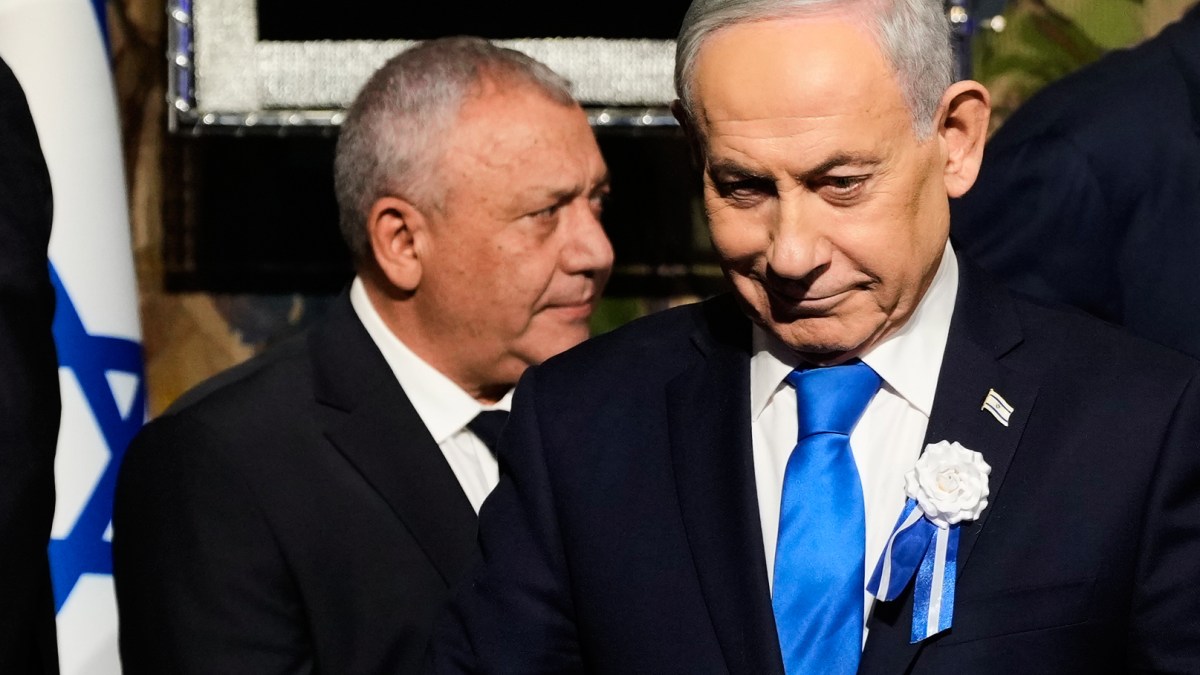

Israel’s caretaker Prime Minister Benjamin Netanyahu has renewed his appeal for a unity government with opposition leader Gadi Eisenkot, casting a coalition that would keep him in power as integral to Israel’s national security.
In a video statement on Saturday, Netanyahu said his meeting with Eisenkot on Thursday “only strengthened the conviction that it is essential to form a national unity government”. He said such a government could “eliminate the Iranian threat once and for all” and claimed Tehran would “not hesitate to use nuclear weapons against us”.
- list 1 of 4Polls open in Cape Verde in race with first female presidential candidate
- list 2 of 4Spain football coach denies racism ahead of England match
- list 3 of 4‘Disgusting behaviour’: Aggression mars India’s cricket win over Pakistan
- list 4 of 4Give Donbas, take NATO seat: Could new US pitch work for Ukraine, Russia?
end of list
Eisenkot, the leader of the Yashar party and the man given the first shot to form Israel’s next government by President Isaac Herzog, called Netanyahu’s appeal a “bluff”.
“Nice try, but these tricks don’t work on me. Nor on Israel’s citizens,” Eisenkot said.
But Eisenkot confirmed that Yashar and Netanyahu’s Likud Party were talking about the proposal for a shared government.
So what, if anything, would it take for them to govern together, and what other options does Eisenkot have?
How do the numbers in the Knesset add up?
In Israel’s October 27 election, the four-party bloc led by Eisenkot won 48 of the 120 seats in the Knesset, Israel’s parliament. Netanyahu’s right-wing and religious bloc secured 53. Two Palestinian-led factions, the Joint List and Ra’am, also known as the United Arab List, won a record 19 seats between them.
Last week, Eisenkot’s bloc showed what it could do with the backing of both Palestinian-led factions, securing a 63-to-50 vote to approve the makeup of the Arrangements Committee, a panel that helps set the Knesset’s agenda while coalition talks are under way. The bloc then moved to set up temporary committees overseeing finance, foreign affairs and defence.
Advertisement
Eisenkot’s bloc and the two Arab-led factions hold 67 seats combined, six more than needed for an outright majority. Another possibility is a minority government backed by Ra’am’s eight lawmakers. Their support would give Eisenkot 56 votes against Netanyahu’s 53 if the Joint List’s 11 lawmakers abstained or stayed away from the confidence vote. That would allow a government to take office with fewer than 61 votes in favour, but it would depend on how all three groups voted.
But getting Eisenkot’s allies to agree to such a deal is another matter. Yair Golan, who leads the Democrats, is open to working with the Palestinian-led factions, while Yisrael Beiteinu leader Avigdor Lieberman and Together leader Naftali Bennett have rejected a coalition with Palestinians. However, both served in the government formed in 2021, when Ra’am became the first Arab party to formally join an Israeli governing coalition.
“One of Eisenkot’s main difficulties is the opposition of Avigdor Lieberman and Naftali Bennett [leaders of parties in his alliance] to relying on Arab parties,” Yasser Manna, a researcher at the Jerusalem Center for Studies on Israeli Affairs, told Al Jazeera. “This position restricts Eisenkot’s coalition options, but it does not automatically make a unity government with Netanyahu more likely. Instead, it increases the importance of negotiations with other parties, particularly the ultra-Orthodox parties.”
The other main option, which according to experts is the most likely scenario, is the Eisenkot bloc going into a coalition with both ultra-Orthodox parties in Netanyahu’s bloc, Shas and United Torah Judaism, which would take the Eisenkot bloc to 61.
Advisers from one faction of United Torah Judaism have reportedly sought a written commitment from all 48 lawmakers in Eisenkot’s bloc to pass a law exempting Jewish religious seminary students from military service and to shield it from being struck down by the High Court. Eisenkot and Lieberman are reportedly opposed to this compromise.
Could Eisenkot and Netanyahu govern together?
President Herzog gave Eisenkot until December 6 to form a government. Herzog can grant an extension of up to 14 days, which would take the deadline to December 20.
Eisenkot has left the door open to members of Netanyahu’s Likud Party and to far-right Finance Minister Bezalel Smotrich’s Religious Zionist Party, provided they back a government led by Eisenkot and accept his programme.
“If members of Likud and the Religious Zionist Party truly believe this is a time for unity, as they told the president, I cannot conceive of any reason why they would not support a government under my leadership and the principles I have presented,” Eisenkot said at the ceremony where Herzog handed him the mandate.
Advertisement
Daniel Levy, a former Israeli peace negotiator and president of the US/Middle East Project, told Al Jazeera that agreeing to meet can serve both men politically. “The coalition formation period is about spin and distortion and trying to gain leverage,” he told Al Jazeera. “So you take a meeting to show that you were willing to talk, then say the other side made unreasonable demands.”
The two men know each other well. Eisenkot led Israel’s military from 2015 to 2019 and served as an observer in Netanyahu’s war cabinet during the first eight months of Israel’s genocidal war on Gaza. He left the emergency government in June 2024.
“I believe the relationship between Benjamin Netanyahu and Gadi Eisenkot is marked by a deep crisis of trust that goes beyond political competition,” Manna said. “However, it is important to distinguish between their political disagreements and their relatively similar approaches to national security. Both prioritise military and security considerations, particularly regarding the Palestinians and Iran.”
An early test could come on Tuesday, when Eisenkot’s allies plan to replace Knesset Speaker Amir Ohana of Likud with Yashar lawmaker Matan Kahana. Eisenkot has challenged Netanyahu and Smotrich to back Kahana and allow the vote to go ahead as scheduled, saying their response would show how serious they are about cooperation.
But even if Eisenkot and Netanyahu agreed on a policy plan for government, they still have to decide who leads. “The question of who would serve as prime minister remains the central obstacle,” Manna said. “Eisenkot has so far rejected a rotation arrangement with Netanyahu.”
Could a security crisis change the talks?
Meanwhile, Netanyahu is still in office as caretaker prime minister while negotiations continue. That gives him an incentive to exploit divisions among Eisenkot’s potential partners and wait for his mandate to run out, experts say.
“At this stage, Netanyahu does not necessarily need to form a new coalition himself,” Manna said. “Preventing Eisenkot from forming one may be enough to preserve his position temporarily.”
Manna said Netanyahu could also use a security crisis to increase pressure for a national government. “A renewed large-scale confrontation could increase pressure for a national unity government or shift the priorities of coalition negotiations,” he said. “At the same time, it could generate new disagreements over military decision-making, the management of the conflict, and the authority of a caretaker government.”
If talks with the ultra-Orthodox parties fail, Levy said, Eisenkot could ask his allies to choose between accepting support from the Palestinian-led parties and leaving Netanyahu in office. He could also propose a short-lived government whose immediate purpose would be to replace Netanyahu and prepare for another election.
He added that in such a scenario, Eisenkot might tell his allies to “form a government for a few months, just to get Bibi [Netanyahu] out of power and prepare for new elections”.
Advertisement
This would prevent Netanyahu from using “his position as prime minister to create a crisis”.
Related News
Tanzania court jails opposition leader for incitement, lifts treason charge
FAA ground stop lifted: Why were US flights grounded, and what’s next?
AI titan Jensen Huang out as Nvidia CEO