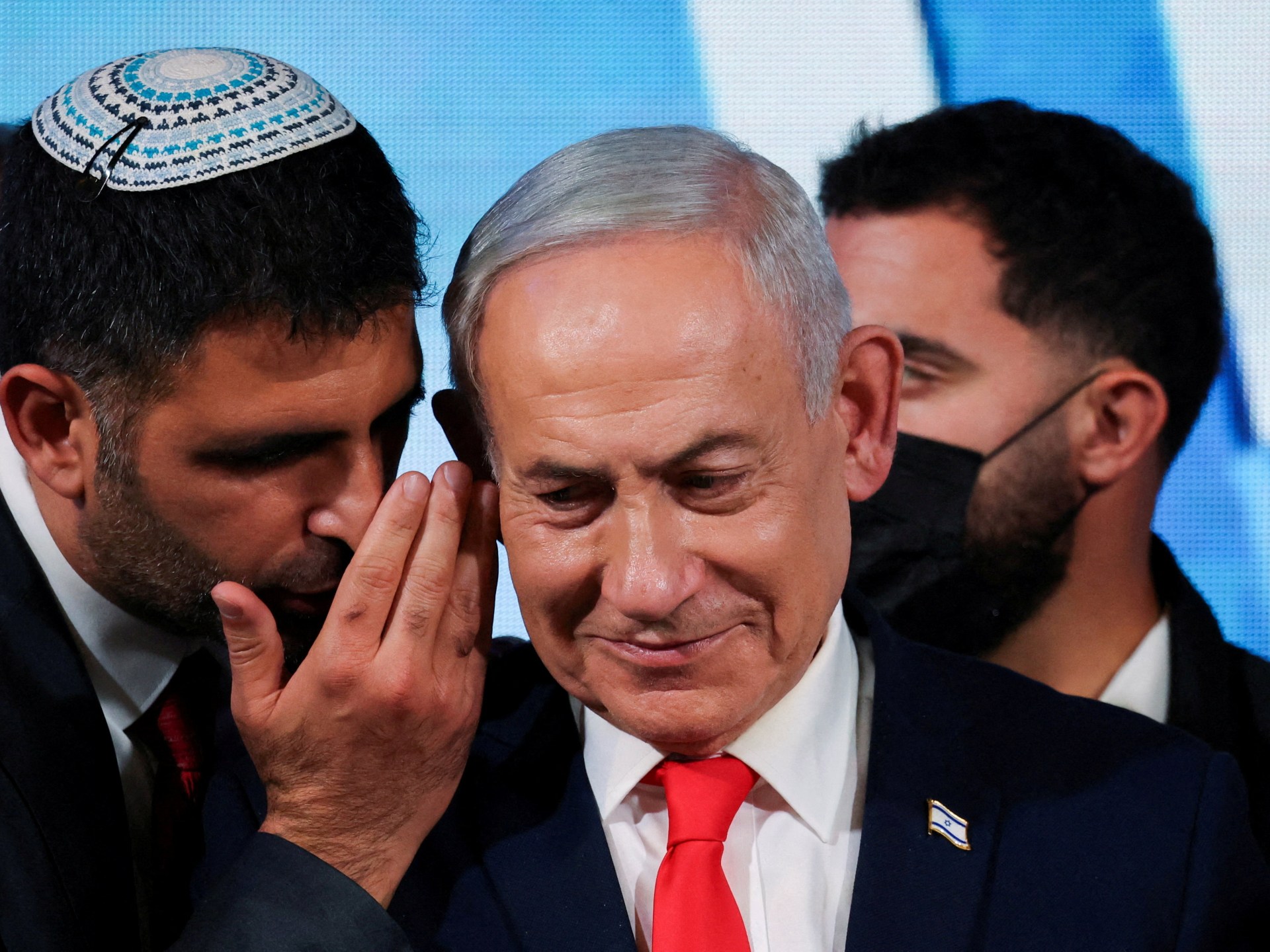

In the last few days, in marked contrast to an election campaign defined by its bitterness and the closeness of its personal attacks, Israel’s current prime minister Benjamin Netanyahu has spoken of national unity and coming together with the opposition bloc that edged out his ruling coalition in October’s election.
On Saturday, the same day that Israeli President Isaac Herzog tasked former Chief of Staff Gadi Eisenkot with forming a government capable of commanding the Knesset, Netanyahu published a video on his social media account claiming Israel to be facing the genuine risk of civil war if a government were established with the support of Arab parties which he accused of wanting to “eliminate the State of Israel”.
- list 1 of 4Israel’s Shin Bet finds no evidence of foreign election meddling: Report
- list 2 of 4What powers does Netanyahu have as Israel’s interim PM?
- list 3 of 4Trump says Israel, Gulf allies must repay Iran war cost: What does it mean?
- list 4 of 4Israeli soldiers are also settlers in West Bank: Al Jazeera investigation
end of list
Two days later, Netanyahu returned to the theme of existential threat in a further video, calling upon the leaders of the more successful bloc to recognise the “needs of the hour” and join, under his leadership, a single unified government that would also include the ultra-Orthodox parties, at least one of which is understood to be in talks with Eisenkot, as well as the prime minister’s controversial allies on the far right, Bezalel Smotrich and Itamar Ben-Gvir.
“It’s all a game at the moment. It’s leverage, it’s one-upmanship, it’s psyops, it’s spin, it’s counter-spin,” former Israeli government adviser Daniel Levy said of the invariably long and complex negotiations that take place ahead of establishing a government,
Currently, with the new Knesset being sworn in on Tuesday, speculation is focussing on the role of the Ultra Orthodox, or haredim, parties, which have traditionally offered support to Netanyahu in return for measures shielding their young male yeshiva students from the military draft in defiance off a Super Court ruling of June 2024.
Advertisement
Strategy
Nevertheless, irrespective of the past political cover offered to their members by Netanyahu, there are suggestions that one of the Ultra Orthodox parties United Torah Judaism (UTJ) – which refused to endorse Netanyahu’s selection to build a government by the President – is preparing to throw in behind Eisenkot, with the objections of one of the opposition’s principal figures Avigdor Lieberman said to be quieted in the face of either partnering with one of the Arab parties or the continued rule of Lieberman’s nemesis, Netanyahu and the prospect of further elections.

“‘It’s political strategy, that’s all,” Netanyahu’s former aide, Israeli pollster Mitchell Barak said from Jerusalem. ‘But he’s negotiating from a weakened position. With the UTJ, Eisenkot’s got 67 seats,’ he said of the numbers needed to gain a working majority in the 120 seat Knesset, “so, of course, Netanyahu’s going to do all he can to reinforce his bloc; Barak said of negotiations regarded by many as critical to Netanyahu’s personal future.
Netanyahu faces a number of challenges that speak directly to both his political legacy and personal freedom that he will lose all influence over should Eisenkot succeed him.
Foremost are like to be the multiple corruption charges that is is presently on trial for and, despite his claims of innocence that he has already preemptively petitioned the country’s President and his former political rival, Isaac Herzog for. Secondly, and more pressingly is the question of his and his government’s culpability for the alleged failings ahead of the October 7 Hamas led attack that triggered the genocide unleashed upon Gaza by Israel and the multiple strikes and attacks launched by Israel non regional neighbors in the years since.
New Knesset, new danger
Many of the new MKs being sworn in on Tuesday, including bereaved family members, reservists, advocates for the 250 or so Israelis taken captive that day and Eisenkot himself, who lost a son and two nephews in the genocide that followed, are all tied directly to October 7 and the wars that followed together creating a chamber where feelings over the October 7 attack and where culpability for its lies are said to run close to the surface.
In particular, attention is likely to focus sharply on Netanyahu himself, whose supposed miscalculations ahead of the attack, stories of numerous missed warnings and who was subsequently accused of dragging out the war, or sacrificing the welfare off the captives for his own political ends. Key among the opposition’s aims for the first day of parliamentary business is set to be the installation of Matan Kahana, a member of Eisenkot’s Yashar (“straight”) party and a keen advocate of a state inquiry into Netanyahu and the government’s failings ahead of the Hamas led attack.
Advertisement
“Having so many people connected so directly to October 7 is going to increase the temperature, but it’s become so politicized that a win for one side automatically becomes a loss for the other, so the bereaved family on the right can say we need to increase our militarism in honor of my son, and the bereaved family in the center says we need to enlist more people.
“Netanyahu can try to influence that but for the first time in a long time, he seems a bit lost,” Israeli political analyst Nimrod Flaschenberg said.
However, how lost Netanyahu may be, or how grounded his claims of pending civil war or destruction at the hands of regional adversaries may be, ultimately, his political and potentially personal fate now lies with an opposition that outstrips his own numerically and a volatile Knesset eager to comb over the mistakes of the past.
“There’s no appetite on the other side to go in with Netanyahu for a unity government,” Levy said,
“The only real circumstances under which that happen is if he can create a security emergency,” he said following a weekend where the UK press had reported daily phone calls from Netanyahu to the Trump administration urging renewed war on Iran.
Related News
Mediators continue US-Iran negotiations amid war rhetoric: What we know
How Paraguay’s Ueno collapse is only its latest banking crisis
Ebola outbreak kills more than 5,300 people in DR Congo