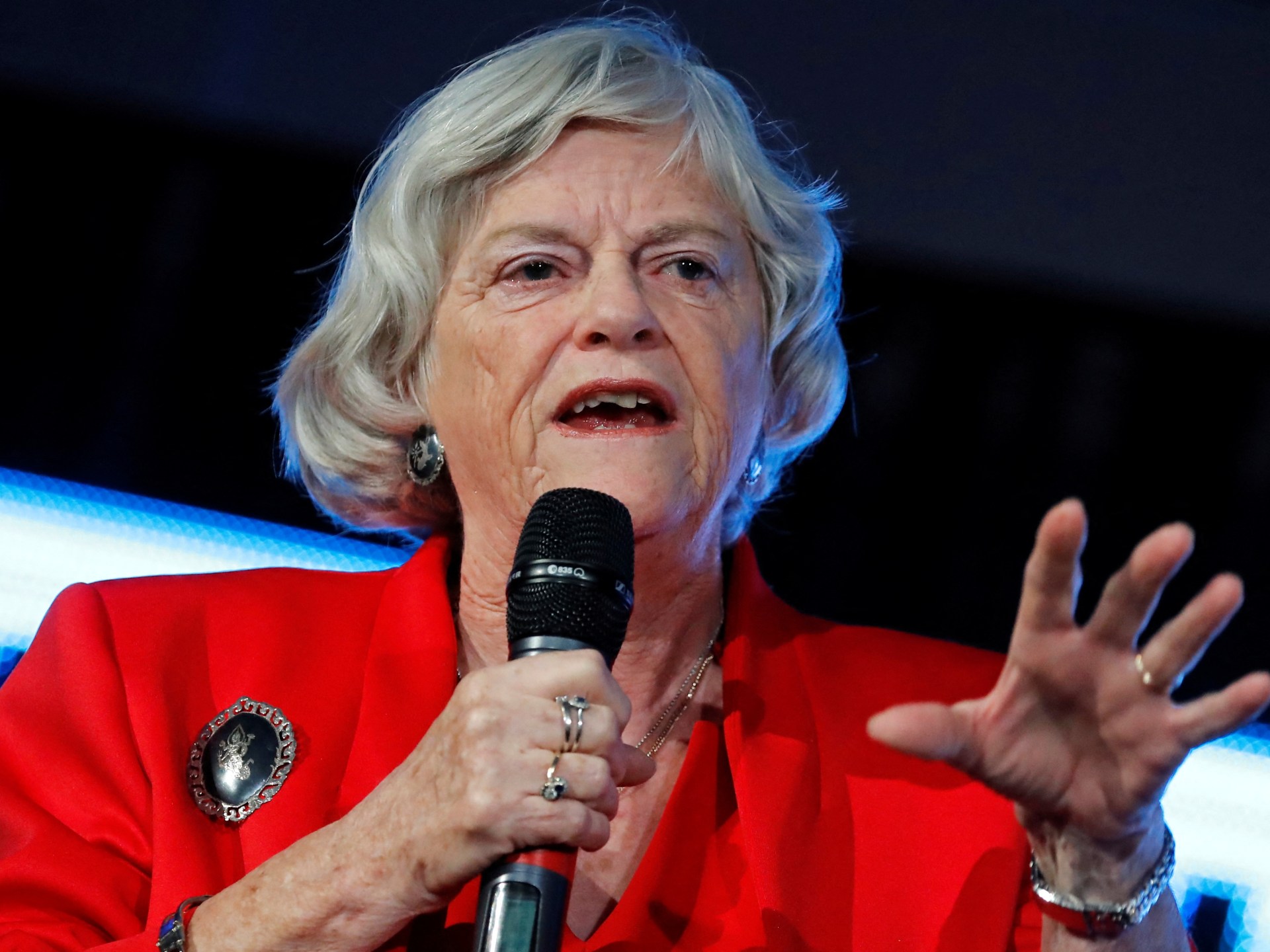

The murder of former British politician Ann Widdecombe has sent shockwaves through the country’s political circles, with the case now referred to the counterterrorism police.
Widdecombe, 78, was found dead at her home in southwest England last week with what police had described as “serious injuries”.
- list 1 of 3UK designates IRGC as terrorist organisation
- list 2 of 3UK arrests 12 over extreme right-wing ‘terror’ threat to Muslim event
- list 3 of 3Andy Burnham in line to become British PM after securing party support
end of list
On Friday, Devon and Cornwall police arrested a 28-year-old white man on suspicion of her murder. But on Monday, the man in custody was rearrested by counterterrorism police, now on suspicion of the commission, preparation or instigation of acts of “terrorism”.
Head of the national counterterrorism policing, Laurence Taylor, said on Monday they were “pursuing multiple lines of inquiry to establish the motivation for this attack”.
“Our priority is progressing this investigation quickly,” Taylor said.
Here’s what we know:
Who was Ann Widdecombe?
From 1987 to 2010, Widdecombe served as the Conservative MP for Maidstone and held government positions, including shadow home secretary in 1999.
After leaving the House of Commons in 2010, Widdecombe became a TV personality, featuring on Big Brother and the BBC show, Strictly Come Dancing.
However, Widdecombe’s political stance and her socially conservative views continued throughout her nonpolitical career, and by 2019 she had joined the Brexit Party to leave the European Union. She was also a member of the European Parliament from 2019 to 2020, representing the party.
In 2023, she joined the far-right Reform UK party and served as its immigration and justice spokesperson until her death.
Advertisement
She was known for her stance against abortion and against equalising the age of consent for gay and heterosexual relationships.
Widdecombe was found dead at her home in Haytor, northern England, at about 11:40am (10:40 GMT) on July 9.
However, police believe that she was attacked on Wednesday, nearly 24 hours before her body was found. They came to this conclusion after examining text messages between her and a researcher from Channel 5 who had been communicating with her about Widdecombe’s proposed interview. Her last reply to the researcher was sent at 12:19am (11:19 GMT) on Wednesday.
Security camera footage obtained by the Sun newspaper also showed a man, later identified as the suspect, getting into his car in Yorkshire with what appeared to be a long object protruding from his pocket. The suspect was also linked to a property in Rotherham, South Yorkshire, more than 320km (200 miles) from Widdecombe’s home.
On Friday, the police issued a statement saying they had launched a murder investigation, but said they had “no information that this is a politically motivated crime” and that it was not being treated as terror-related.
By Saturday, police said a 28-year-old white British national had been arrested in South Yorkshire by officers from the counterterrorism police and South Yorkshire police.
Why are counterterrorism police now leading the investigation?
So far, little information is available on why counterterrorism units have taken on the case.
On Monday, Home Secretary Shabana Mahmood said “new information” had come to light over the circumstances of Widdecombe’s death but said the suspect was not known to the country’s counterterrorism programme, Prevent.
“The police have cautioned against speculating about the case. That is the right thing to do for Ann’s family and friends. It is also vital that the police are given the space they need to carry out their work. For now, what matters most is supporting the investigation,” Mahmood said.
“And I would urge anyone, with any information at all, to come forward immediately,” she added.
Why has this set off alarm bells in British political circles?
Concerns over the security of politicians have grown in recent years after two serving MPs were murdered in the last decade.
In 2016, Labour MP Jo Cox was shot and stabbed by a Nazi-obsessed attacker during the Brexit campaign. In 2021, Conservative lawmaker David Amess was stabbed to death by a man who was inspired by ISIL (ISIS).
Advertisement
In her address in the House of Commons, Mahmood referred to the murders of Cox and Amess in the context of Widdecombe’s death and said, “Politics is a calling for those of us here, but it should not be a dangerous one.”
“The Home Office and the police work closely with the Parliamentary Security Department to provide practical advice and support directly to MPs. But we must always be vigilant to changing threats and respond,” she said.
“Security measures are kept under constant review to ensure MPs can carry out their duties safely. And I know the police intend to issue guidance to MPs soon,” Mahmood added.
Cox’s husband, Brandon Cox, also said on X on Tuesday that security for MPs “must be improved”.
“Provided on the basis of intelligence & threat level, blind to politics. But improved security cannot solve the problem. We need to change the culture that legitimises political violence, including the algorithmic social media that drives it,” he wrote.
Moreover, politicians have called for a crackdown on hate directed at them on social media.
Former Conservative Party leader Iain Duncan Smith urged the government to take stronger action against “visceral, violent language” on social media.
Related News
Reform UK’s Farage failed to disclose funds from convicted criminal: Report
Donald Trump reports $1.4bn in cryptocurrency income in government filing

Can Gulf countries defend themselves against renewed Iranian attacks?