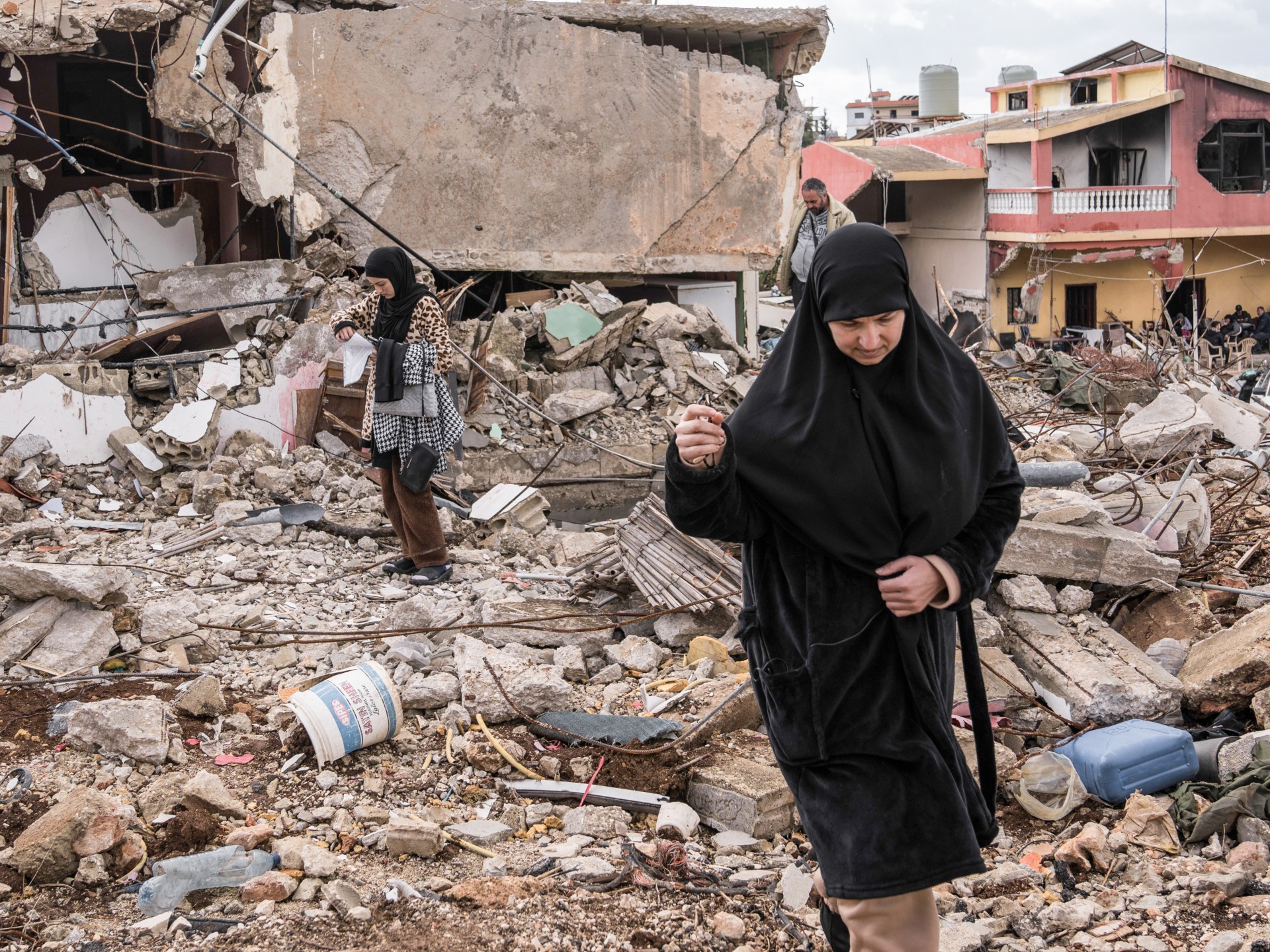

Beirut, Lebanon – In February 2025, Ali stood outside his house in Naqoura, in southern Lebanon, and pointed at the crack in the foundation and fruit trees pulled up by the Israeli military.
The Israeli military had recently withdrawn from the town as part of a ceasefire agreement, but had left behind detonated homes, a graffiti-laden school, and power lines pulled out of the ground. Ali, an elderly man from the town, said at the time that he would fix it all.
- list 1 of 3‘Will not leave’: Is Israel killing the US-Iran MoU by staying in Lebanon?
- list 2 of 3US-Iran negotiations: What’s the latest?
- list 3 of 3The Lebanon-Israel agreement is paving the way for the next war
end of list
But a little more than a year later, Israel has completely razed the area of Naqoura, one of many towns and villages in southern Lebanon that the Israeli military has made completely uninhabitable. Forced to flee when the Israelis invaded again in March, Ali has traded his garden and family home by the sea for a room on a rooftop in the heart of Beirut.
Sipping coffee, he lamented. “We had 20 good years,” he said, roughly referring to the period between the end of the 2000 Israeli occupation and the start of hostilities on October 8, 2023.
For thousands of people like Ali, who are from towns or villages now razed to the ground, the future is unclear. The pain of having lost their homes is devastating, but experts expect an even greater psychological burden should these people eventually return to their villages.
“When a village is flattened, and even the landmarks around it are gone, people lose more than their homes. They lose the markers that told them where they belonged, and that’s part of why we’re seeing such deep distress, including in people who have never struggled with their mental health before,” Basma Alloush of the International Rescue Committee told Al Jazeera.
Advertisement
“For many, it’s losing the physical traces of childhood, the tree they grew up near, the street they played in, the home that held a lifetime of memories, with no way to find or confirm any of it was ever there,” she added. “That kind of grief has nowhere to land, because the past itself feels erased along with the place that held it.”
Villages razed
On March 2, Israel intensified its war on Lebanon for a second time in less than two years. It responded to Hezbollah firing rockets – the first such attack against Israel by the group in more than a year – by re-invading southern Lebanon and striking targets all across the country.
Since then, Israel has killed 4,257 people in Lebanon and wounded more than 12,000 more. More than 1.2 million people were displaced at the peak of Israel’s attacks. Some of those people have gone home, but thousands remain displaced because their villages are occupied or because their homes were destroyed.
Israel currently occupies approximately 6 percent of Lebanese territory and a recent agreement signed between Tel Aviv and Beirut seems to indicate that Israeli troops will not be abandoning their positions anytime soon.
Human rights groups like Amnesty International were already calling Israel’s destruction in southern Lebanon “extensive” after Israel’s 2024 destruction. But following the 2026 offensive, a UNDP assessment found that 11,095 buildings were completely destroyed. Satellite analysis conducted by the French publication Le Monde also found that since March 2026, 45 percent of urban areas in southern Lebanon have been damaged or destroyed.
Among those areas are towns like Bint Jbeil, Kfar Kila, Meiss el-Jabal, Taybeh, Deir Siryan and Ali’s home town of Naqoura. The level of destruction is so severe that it can be hard for residents to determine where their homes are in relation to the rest of the town.
Davide Musardo, a clinical psychologist with Doctors Without Borders – known by its French initials MSF, who spent time in Gaza, said that residents from the devastated strip often lost “reference points” to where their homes were.
Musardo said that many of his patients who tried to return to their homes in Gaza after the ceasefire there told him that they “didn’t recognise where they were because everything was destroyed” and ended up feeling lost.
Losing a sense of self
Many in Lebanon are suffering psychologically from the recent Israeli war.
But even before Israel’s war on Lebanon, the country’s population was suffering from a mental health crisis. A study conducted in 2022 by Lebanese researchers found high rates of mental health disorders, including depression, anxiety and post-traumatic stress.
Advertisement
Lebanese have suffered deeply in recent years, with a 2019 uprising and crackdown followed by a banking and economic crisis, the 2020 port explosion, and now almost three years of war. Some of these crises have also compounded, as in the example of one young man who was wounded in the port explosion in 2020 and had the apartment below his mother’s home hit by an Israeli strike less than six years later.
Children have also been deeply affected psychologically by the latest conflicts. A teenager recently told AJ Plus that a part of her “has been destroyed” after her home in Tyre, southern Lebanon, was destroyed.
Many of the Israeli tactics of destroying towns in Lebanon were also used in Gaza. And now for Lebanese, having their homes destroyed extends “far beyond material loss”, according to Aya Mhanna, a mental health and psychosocial support and trauma specialist.
“When a village is destroyed, people are not simply losing their homes; they are losing a place that has silently organised their identity, relationships, routines, memories, and sense of belonging for years, sometimes generations,” she said.
“People don’t just grieve buildings; they grieve what those places represented and made possible. The loss is not only of what existed, but also of what can no longer exist,” Mhanna added.
The importance of rebuilding
Dr Joseph El-Khoury, a consultant psychiatrist and conflict medicine expert, told Al Jazeera that the home’s importance is very symbolic.
“It’s the place where everybody feels safe and, also particularly in villages, the connection goes back generations and generations, so it’s about your history and your identity being erased and not just bricks and mortar,” El-Khoury said.
He added that the loss of such an integral part to a person’s identity can lead to demotivation and nihilism. “It’s very important that the rebuilding starts as soon as possible, but also that it even tries to improve on what was there before.”
Currently, Israel occupies large swaths of southern Lebanon. The most intense fighting seems to have ceased, but Israeli officials indicate that people like Ali will not be allowed home in the coming weeks.
And even if they are able to return home in the near future, they will be returning home to devastated landscapes where the needed infrastructure – roads, water systems, electrical grids – have also been devastated.
“There might be an opportunity to rebuild properly with an even better ecosystem, but this requires a state, urban planning and peace,” El-Khoury said. Without that, he added, the people of south Lebanon’s destroyed villages “will not be able to heal.”
Related News
UK Labour’s Burnham apologises for response to Israel’s Gaza violence

Australia’s under-16 social media ban failing, study shows: What it means
Iran war live: Air raid sirens in Bahrain, Kuwait as US bombs Sirik, Qeshm