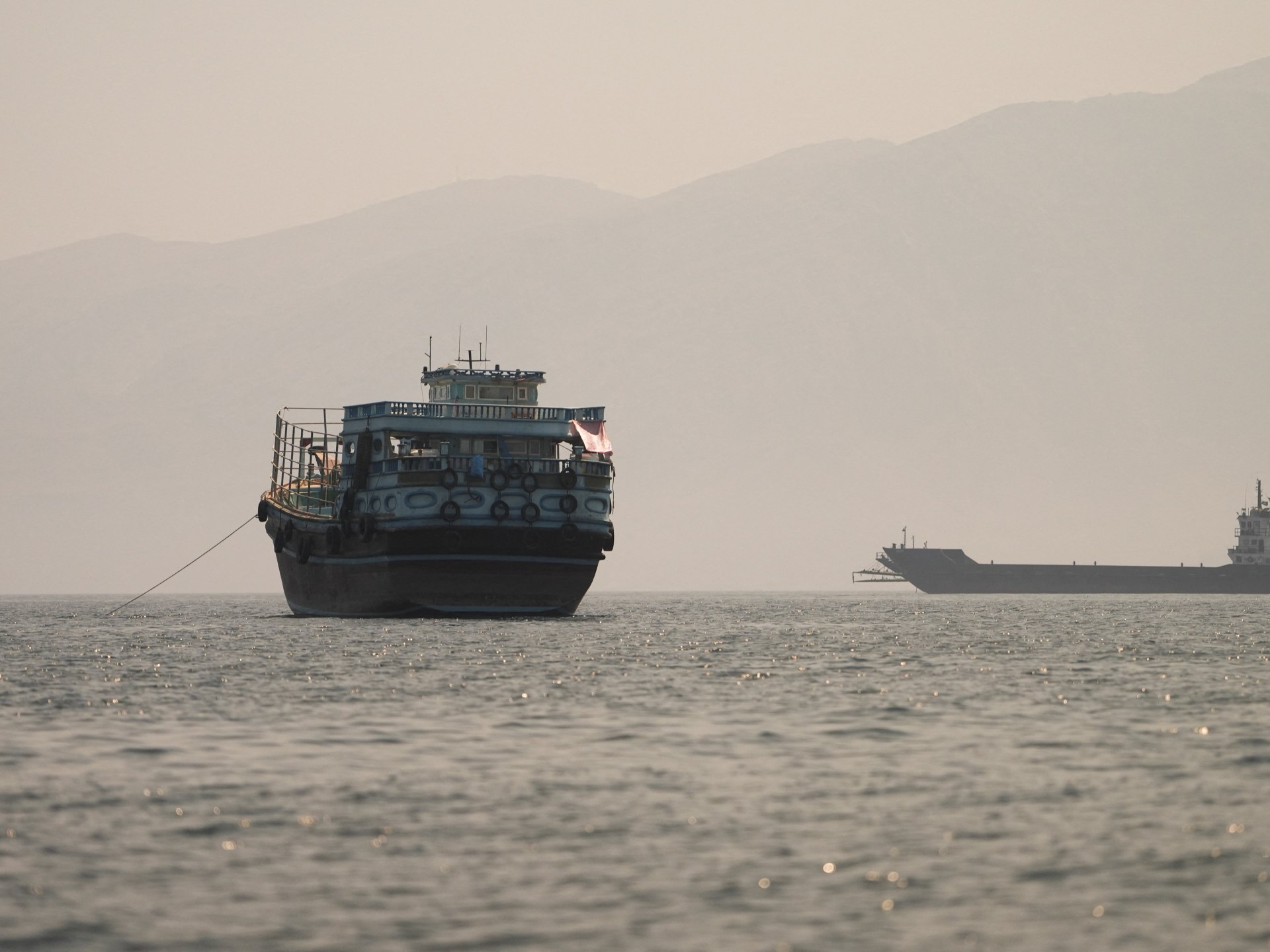

Iran’s Revolutionary Guards (IRGC) have warned against any crossings of the Strait of Hormuz without authorisation, saying vessels not complying “will be dealt with” and criticising a new route through the waterway.
The future of the strait, a vital route for energy shipments that was effectively blocked by Iran during the more than 100-day war between the United States and Iran, is a key sticking point in negotiations between the sides.
- list 1 of 4Has the worst of the Hormuz crisis passed?
- list 2 of 4UN starts evacuating 11,000 stranded sailors from Strait of Hormuz
- list 3 of 4US Senate votes to pass Iran war powers resolution in blow to Trump
- list 4 of 4Rubio says Iran cannot charge tolls in Hormuz: What we know
end of list
Tehran has said it plans to impose what it calls maritime service fees in the future, as opposed to tolls, while the United States argues it is an international waterway and therefore passage should not be subject to charges.
“The only authorised route for passage through the Strait of Hormuz is the route announced by the Islamic Republic of Iran,” the Revolutionary Guards, the ideological arm of Iran’s military, said on Thursday.
Any crossing without authorisation is “unacceptable and extremely dangerous”, they warned in a statement.
They also denounced what they said was a new route through the waterway announced by “certain authorities”, without elaborating.
The warning comes after a Liberian oil tanker made its way out of the strait on Thursday using a route close to Oman’s shore.
The Stoic Warrior – signalling that it planned to transit the Strait of Hormuz – set off early on Thursday morning on a trip that saw it hug the coast of the United Arab Emirates and then Oman, according to The Associated Press news agency.
AP said that the vessel then travelled around Oman’s Musandam Peninsula fairly close to the shore, part of a route that Oman laid out alongside the International Maritime Organization, an agency of the United Nations that oversees shipping at sea.
Advertisement
Al Jazeera’s Resul Serdar, reporting from Tehran, said that the Revolutionary Guards are frustrated over the new route.
“This is because the new route is somehow bypassing the IRGC’s control on the Strait of Hormuz,” he said.
Serdar said that the control of the Strait of Hormuz has been “a huge leverage for Iran to put pressure on its adversaries and the global economy since the beginning of the war”.
“Tehran says even after the parties [the US and Iran] reach a final agreement, Iran is not going to give up on this leverage in any way and there will be an Iranian control over there,” our correspondent said.
Hormuz is a narrow stretch of water between Iran and Oman through which roughly 20 percent of the world’s crude oil and liquefied natural gas normally transits.
At its narrowest, it is only about 30km (18 miles) wide.
The only route currently authorised by Iran runs through a corridor that follows the country’s coast.
A Memorandum of Understanding signed last week by Tehran and Washington to extend their ceasefire stipulates that commercial ships may transit the strait free of charge for the next 60 days.
With Iran and the US in negotiations over a permanent end to the war, it is unclear what arrangements will be in place after that period.
Iran and Oman announced on Tuesday that they would study the “costs” to be charged for services related to the administration of the strait.
But US Secretary of State Marco Rubio, visiting neighbouring Gulf countries this week, said Washington would not accept any tolls or fees.
Related News
US raises concern as RSF forces encircle Sudanese city of el-Obeid

Post-apartheid South Africa: 50 years after Soweto riots, what has changed?

Why are experts warning latest Ebola outbreak could be ‘worst ever’?