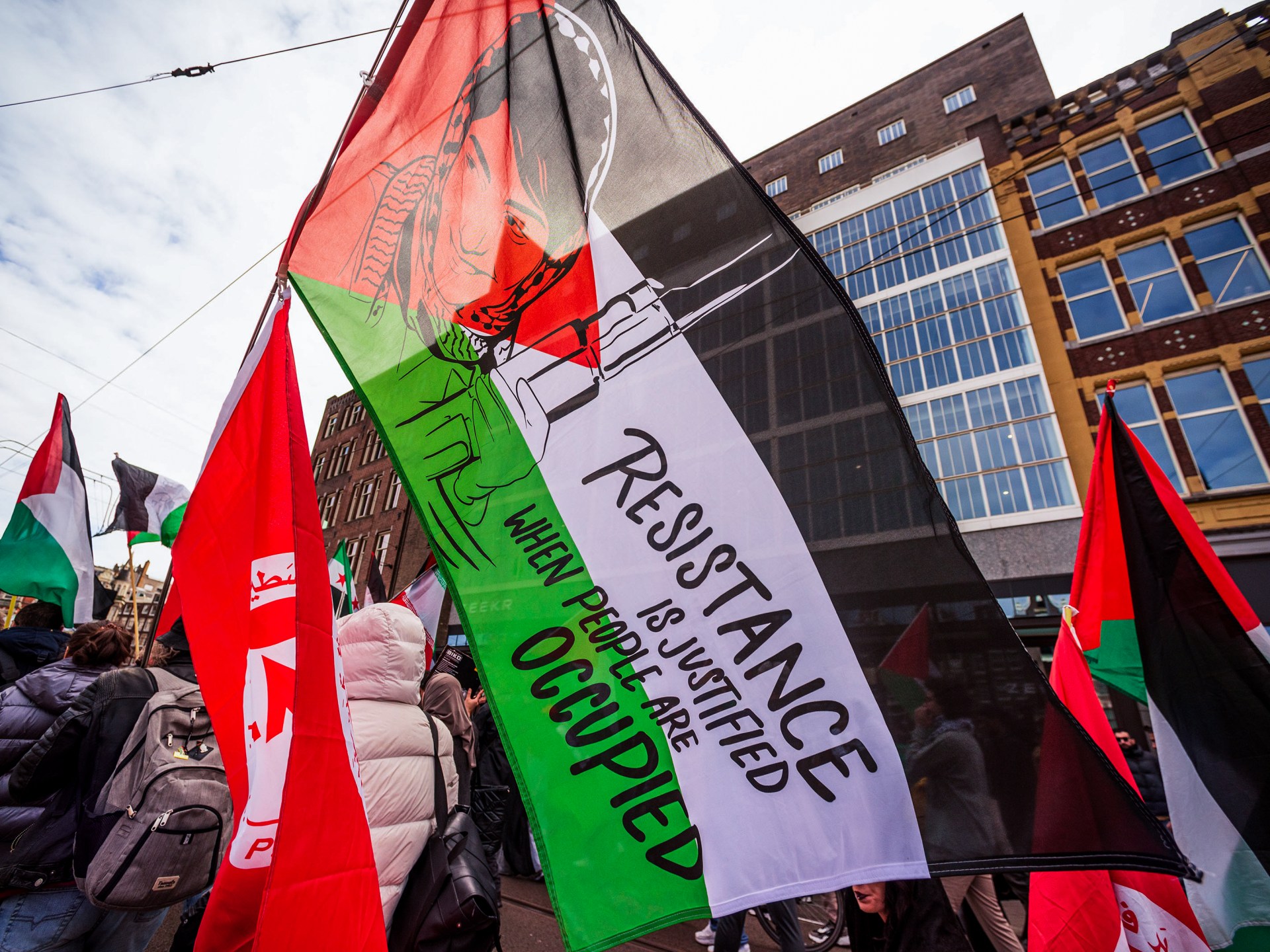

From courtrooms to cultural boycotts, a series of developments in the Netherlands all point to a Dutch society more sympathetic with the Palestinian cause, even if its government remains broadly supportive of Israel, analysts say.
The recent acquittal of Amin Abu Rashid, a refugee-turned-humanitarian worker, on accusations of funding Hamas has been a rare win for the pro-Palestine movement in the country. It is also one that pro-Palestinian movements hope will make it more difficult to target activism in the Netherlands against Israel’s actions.
- list 1 of 3Lebanese rush back to their devastated homes in south after US-Iran deal
- list 2 of 3Iran coach says team ‘oppressed’ by travel chaos after World Cup NZ draw
- list 3 of 3Israeli court rules to keep prominent Palestinian doctor in detention
end of list
The case escalated after Abu Rashid was accused of transferring funds to Hamas, after providing financial support to orphans in Gaza.
“When I look at the case today, I believe that its essence was not criminal as much as it was political,” Abu Rashid told Al Jazeera.
Despite beating the charges, Abu Rashid’s battle nearly cost him his life. During almost one year reportedly in solitary confinement, his health deteriorated to the point that a doctor advised that the 59-year-old be released from prison so he could “die in his home”.
His eventual acquittal months later was “a victory for the truth that I had held onto since the first day” and could set an important precedent for pro-Palestinian activism in the country.

Haroon Raza, cofounder of the Hind Rajab Foundation, described the verdict as a rare victory in the Netherlands, a country where successive governments have strongly supported Israel.
Advertisement
“The court clearly stated that actions geared toward humanitarian aid do not fall within the scope of sanctions. This verdict is final proof that the prosecution had no standing to begin with,” the group said at the time of Abu Rashid’s acquittal.
However, Evalien Stapper, the Netherlands monitor at the European Legal Support Center (ELSC), says that “counterterrorism” and financial regulations have been repeatedly used against Palestinians in the country for sending money to relatives in Gaza or supporting humanitarian endeavours there.
“We see multiple mechanisms and patterns of repression,” Stapper said. “While the Netherlands rushes to prosecute Palestinians, it continues its financial complicity in genocide and illegal occupation.”
The Netherlands has long been one of the strongest supporters of Israel within the European Union, while public opinion has historically and broadly supported the country since 1948.
While the public’s perceptions of Israel are changing – particularly after Israel’s genocidal war on Gaza – about two-thirds of European Union investments in Israel originate from the Netherlands, according to one report.
Maurits Berger, professor of Islam and the West at Leiden University, cautioned against reading too much into a single legal outcome regarding Abu Rashid’s case, and said the decades-long relationship between the Israeli and Netherlands governments will likely continue.
“In terms of government policy, there is little change in the Dutch-Israeli relation. These are hard to disentangle … [but] there is more criticism than ever on Israeli politics,” Berger told Al Jazeera.
“I doubt that the Netherlands will move away from its pro-Israel position. At best, it will become more critical.”
Berger says that before the Dutch government even begins to consider breaking ties with Israel, major changes would have to start at a societal level via community, student and civil society action.
Bottom-up pressure does appear to be emerging. Polling data reflects this change with a recent Ipsos I&O survey finding that about two-thirds of Dutch residents do not support their government’s approach to Israel and Israel’s genocidal war on Gaza. Other polls show that the Dutch public wants a review of the country’s decades-long backing for Israel.

The Dutch public broadcaster AVROTROS announced it would not participate in or broadcast the 2026 Eurovision Song Contest due to Israel’s genocidal war on Gaza and alleged political interference in the competition, which appeared to reflect the public’s views on the issue.
Advertisement
“This has not been an easy decision,” AVROTROS Managing Director Taco Zimmerman said. “Culture connects, but not at any cost … Universal values such as humanity and freedom of the press have been seriously violated and are non-negotiable for us.”
Sai Englert, a lecturer at Leiden University, believes that these developments indicate a deeper transformation in Dutch society regarding Israel’s actions in the region, as shown by the growing support for the Boycott, Divestment, Sanctions (BDS) movement.
“The combined effect of the genocide in Gaza, the US-Israeli wars across the region, and the sustained solidarity movement … have certainly shifted people’s perceptions quite dramatically,” he said.
“The debate is now much less about whether these actions are legitimate, but to what extent they should be implemented.”
Stapper agrees, saying that growing public awareness of Israel’s continuing oppression of Palestinians could force future governments to review ties with Israel.
“Continuous pressure and mobilisation work. Over time, it can bring about a shift in government policies and actions towards meaningful change,” Stapper said.
For now, the Netherlands reflects a growing divide: a government upholding longstanding alliances and a society increasingly questioning them. Whether public sentiment will bring political change remains uncertain.