
Ebola has spread to new areas of north-eastern Democratic Republic of Congo (DRC), including a crowded displacement camp, raising fears that the country’s near-month-long outbreak is entering a more dangerous phase and larger scale than previously thought.
The outbreak, caused by the rare Bundibugyo strain of the virus, is showing signs of local transmission in newly affected communities as response measures lag, a senior World Health Organization (WHO) official warned on Friday.
- list 1 of 3How the hosts are preparing for an Ebola outbreak during World Cup 2026
- list 2 of 3One killed as hundreds protest in Kenya against US Ebola quarantine centre
- list 3 of 3Ebola border shutdown leaves goods rotting between Uganda and DRC
end of list
Since the outbreak was declared on May 15, there have been 676 confirmed Ebola cases, including 136 deaths in the Ituri province – the centre of the outbreak – as well as North Kivu and South Kivu provinces, according to WHO figures. A total of 32 patients have recovered.
The United Nations agency reports a further 119 cases are suspected in the DRC, as the virus starts to spread to new areas.
Olivier le Polain, the WHO’s head of epidemiology and analytics, said that cases were being identified in new health zones within the three affected provinces on a near-daily basis.
“That reflects really the scale of this outbreak: a scale that is much bigger than what is being detected, and the high mobility of the population,” he said.
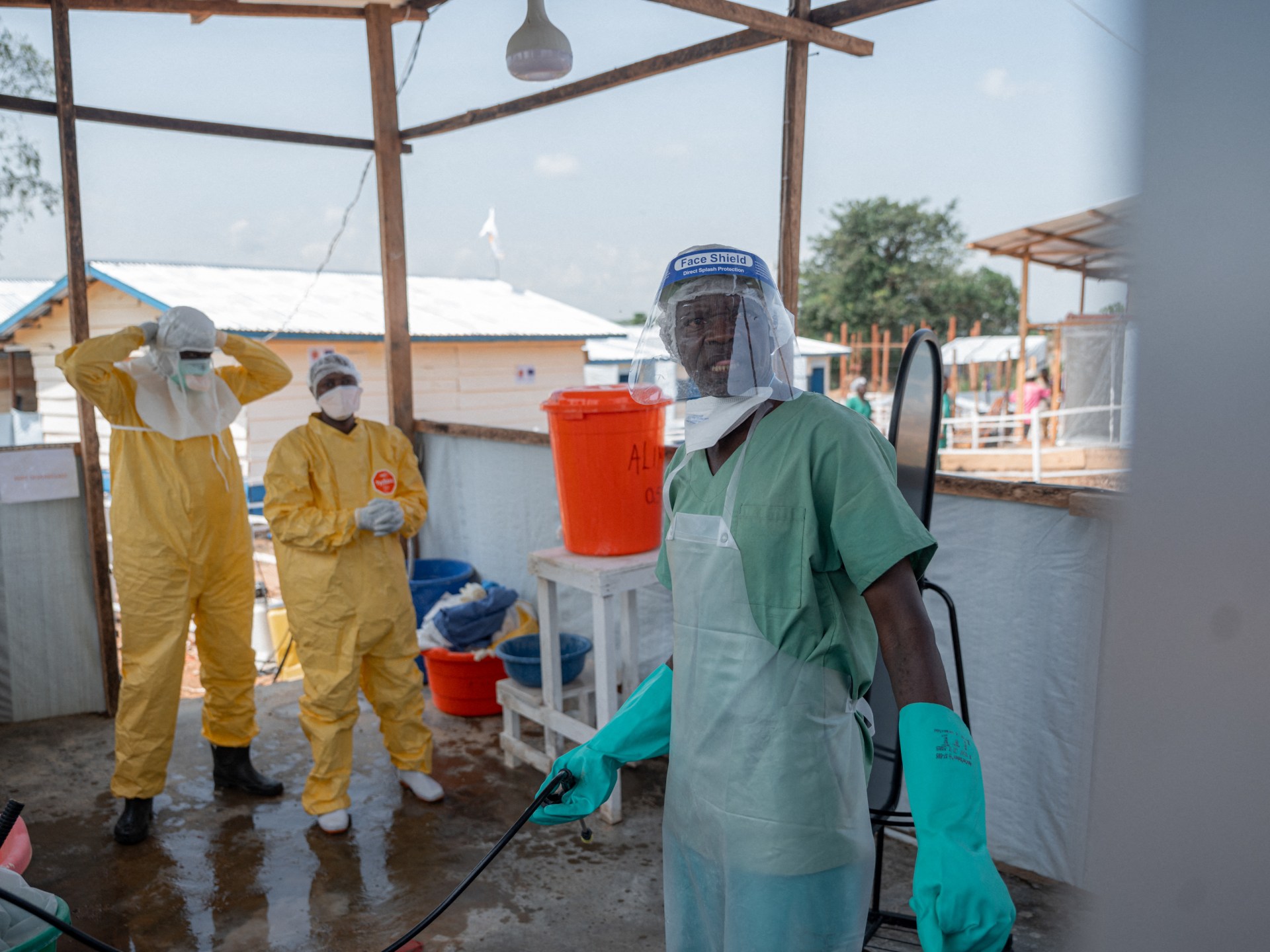
Much more needs to be done to contain the virus, the WHO said, with isolation bed capacity far below the anticipated need, based on how it is spreading.
No approved vaccines or treatments exist for the Bundibugyo species of the virus.
Le Polain added that while in recent weeks, cases in new areas could be traced back to travel from hotspots, now “we also see local community spread in new areas”.
Advertisement
“There are still many blind spots in some areas that are high risk,” he said. “The full scale of the outbreak is not yet clear and we’ll get more clarity as surveillance improves.”
Le Polain said contact tracing was getting better but was “still too low to ensure appropriate control”.
“There’s a lot more that needs to be done across the board: more supplies to ensure that we’ve got safe spaces to isolate patients. Surveillance can scale up, but if you don’t have any space to put your patients safely, it becomes very difficult,” he added.
The WHO official’s remarks came shortly after the UN’s refugee agency confirmed the first Ebola-related deaths in the crowded Kpanga displacement camp in Ituri province.
DR Congo’s struggle to contain the disease has been complicated by the legacy of decades of conflict in the region. The government lacks full oversight due to the presence of armed rebels seeking control over the mineral riches in the area, leaving infrastructure poor or destroyed, and violence having chased huge numbers of people from their homes.
According to an aid worker with knowledge of the cases cited by Reuters, those deaths occurred on May 31 and June 1.
Cramped conditions at camps like Kpanga, where hundreds of people sometimes share a toilet, have fuelled concerns of rapid contagion.
“We are all really worried that Ebola in these camps will spread extremely quickly and that there will be panic and people will flee all over whether or not they’re contacts, whether or not they’re ill,” Caitlin Brady, country director for the Danish Refugee Council in Congo, told Reuters.
That will alarm neighbouring Uganda, which has confirmed 19 cases and two deaths but was reported recently by the African Union’s health agency to have the situation “under control”.
Related News
Rescuers stop search for last two men lost in Laos cave

Democrat and Republican go head-to-head in California governor race
‘They were laughing’: Israel’s use of rape and sexual abuse in prisons