
Orapa, Botswana – It is a year since Motshwegwa Rakhudu lost his job after 14 years working as an installer at Debswana diamond mining operations in northern Botswana. He says he had been on rolling three-year renewable contracts with Enabler Hires (Pty) Ltd, and expected the arrangement would continue through to 2027.
Instead, he was retrenched and made redundant without warning.
“The shock was too much,” Rakhudu, (not his real name), told Al Jazeera.
“In early 2025, I took a loan of 26,000 pula (about $1,900) to buy a car because I believed my job was secure. By mid-May, I was out of work.” He said the sudden retrenchment left him struggling with debt and household responsibilities, including school fees, with no compensation received.
“Being caught unprepared has been very difficult. Jobs are scarce, and even when work is available outside mining, the pay is much lower. I am still looking for work,” he said.
Rakhudu said he has considered farming or starting a small business, but lacks the capital. Selling his car, he added, would only cover the outstanding loan.
“I would want to go into farming, but if I sell the car, the money will only clear the loan,” he said.
Al Jazeera contacted Gaotlhobogwe Radikwata, a senior management official at Enabler Hires (Pty) Ltd, for comment on the retrenchments.
“I am not going to answer your questions even if you convince me you are from Al Jazeera. Who gave you my number? I never shared my contacts with journalists. I am not at liberty to share information,” she said.
Advertisement
Jobs vanish as diamond production slows
The retrenchments come as Botswana’s diamond sector, the backbone of its economy, slows sharply.
Debswana Diamond Company, a joint venture between the government and De Beers, cut production by about 27% in 2024 to 17.9 million carats amid weak global demand, and plans further reductions to around 15 million carats in 2025. The company accounts for roughly 90% of Botswana’s diamond sales.
That slowdown has rippled through the wider economy. Botswana’s output contracted by about 5.3% in the second quarter of 2025, the sharpest fall since the pandemic, driven largely by declining diamond production, according to Reuters.
Diamonds account for around 70% of export earnings and roughly a third of government revenue, according to Reuters and S&P Global Ratings, which in 2025 downgraded Botswana’s sovereign credit rating to BBB-, citing sustained pressure from the global diamond downturn and weakening fiscal revenues.
Household pressure builds across mining communities
For workers, the impact is no longer abstract.
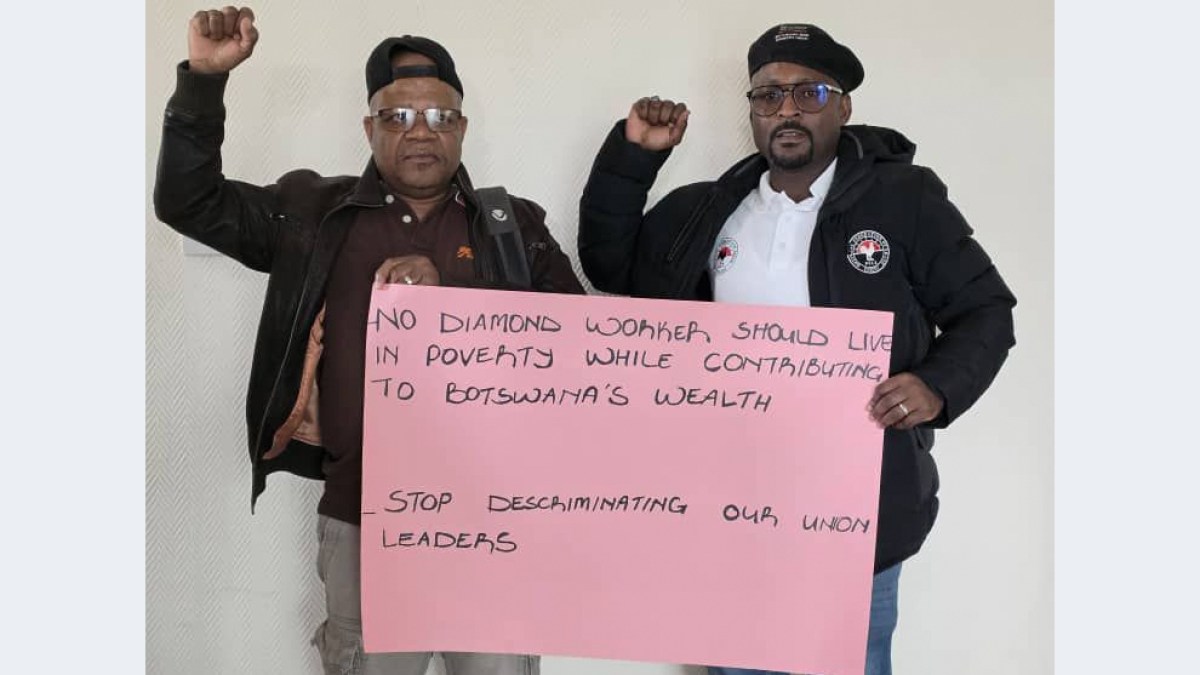
“The diamond downturn is no longer just a business issue. It is a human issue affecting workers, families, contractors and entire mining communities,” said Mbiganyi Gaekgotswe, General Secretary of the Botswana Mineworkers Union.
He said uncertainty now defines everyday life.
“The first question on everyone’s mind is whether they will still have a job next year,” he said. “Will contracts be renewed? Will overtime be reduced? These are not abstract concerns. They affect school fees, loans, medical bills and family responsibilities.”
Even where jobs remain, pressure is rising as wages stagnate while food and transport costs increase.
Restructuring has already filtered through contractors and service providers, with more workers shifted onto short-term agreements, said Dominic Obusitse Mapoka, Chairperson of the Botswana Diamond Workers Union.
“Workers who remain employed are increasingly on short-term or temporary contracts,” he told Al Jazeera. “This makes it difficult for families to plan because they do not know whether contracts will be renewed.”
He said many earn between $190-250 a month, while the cost of living continues to increase, with knock-on effects for small businesses tied to mining activity.
Since independence in 1966, Botswana’s diamond wealth has transformed what was once among the world’s poorest countries into a middle-income economy, financing infrastructure, public services and sustained growth.
Advertisement
But that success has also left it heavily exposed to global shocks. The sector is now under pressure from weak demand, competition from lab-grown diamonds and reduced luxury spending in key markets, according to S&P Global Ratings.
The downturn exposes the risks of economic concentration, said Levy Ndou, a political scientist at Tshwane University of Technology.
“When citizens depend heavily on one sector, a fall in global demand becomes very damaging.”
He called for faster diversification into agriculture and beef production, alongside stronger regional trade links.
Botswana’s Minister of Labour and Home Affairs, Pius Mokgware, said the government is responding by trying to absorb job losses, including expanding copper mining and opening new projects. He added that diversification efforts are also targeting agriculture, tourism and Information and Communication Technology.
Minister of Minerals and Energy, Bogolo Joy Kenewendo, did not respond to repeated requests for comment.
Tshepo Modibedi, President of the Small Scale Miners Association of Botswana, said smaller operators remain largely excluded from the diamond value chain, which is dominated by large firms.
While not directly involved in diamonds, the downturn still spreads through households nationwide, he said.
“Lab-grown diamonds and strict regulations are challenges,” he told Al Jazeera. “But they could also be opportunities, if policy becomes more inclusive.”
For Rakhudu, however, structural shifts in the global diamond market remain distant from daily survival.
“I am still looking,” he said. “I just want another chance to work.”
Related News

Iran reinstates some internet access but restrictions remain for most

Israeli attacks kill nine in Lebanon, reach Beirut outskirts

Denmark gets new government as Greenland crisis persists