
The United States has imposed sanctions on four activists involved in flotilla missions seeking to break Israel’s 19-year siege on Gaza, home to 2.3 million people, most of them displaced by Israel’s genocidal war on the enclave.
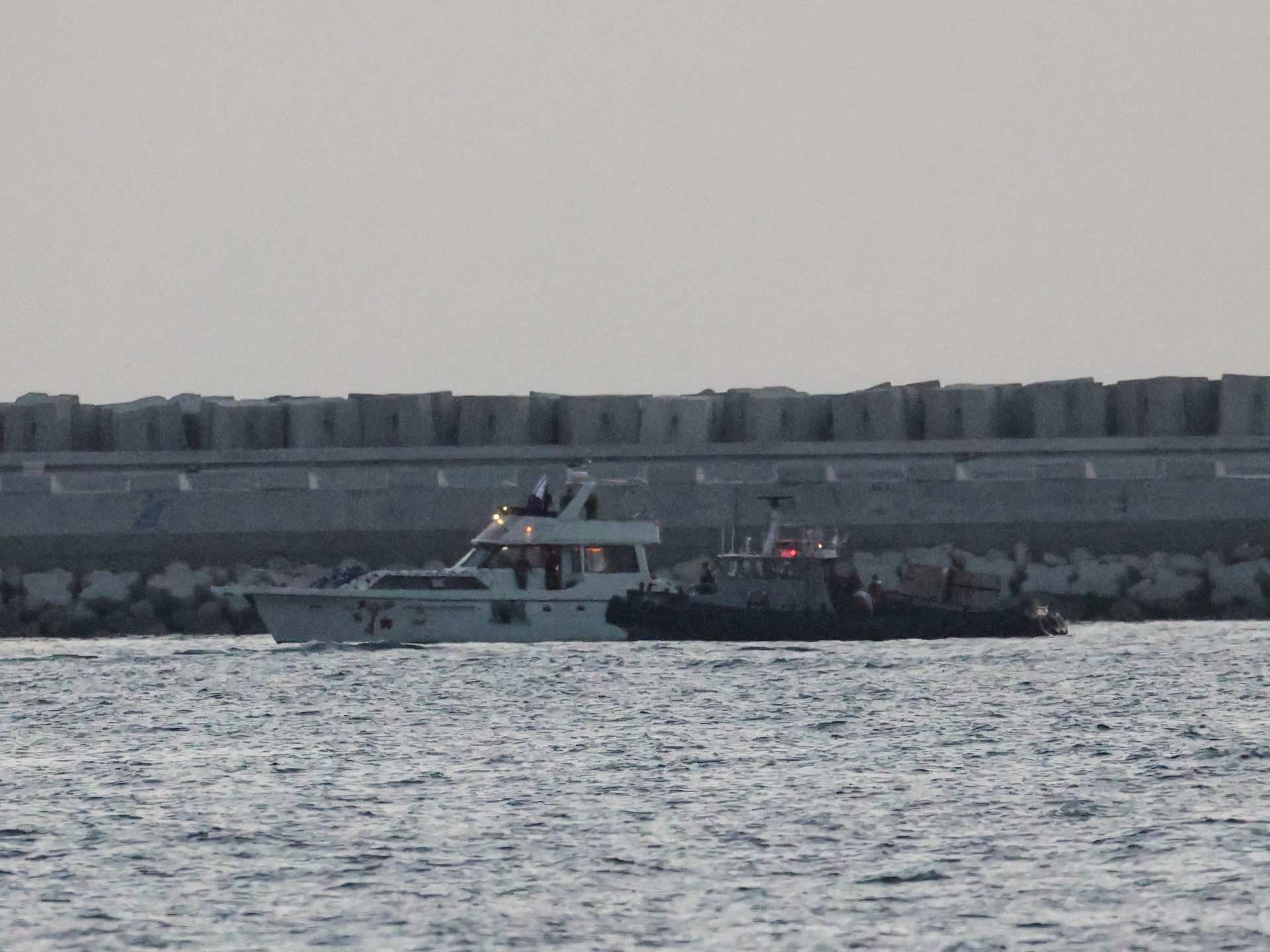
The sanctions were announced on Tuesday after at least 430 activists were abducted during Israeli interceptions of aid ships heading towards Gaza, which has been facing shortages of food and other necessities due to Israeli curbs on aid deliveries into the enclave.
Washington accused flotilla organisers, without publicly providing evidence, of trying to reach the Palestinian territory “in support of Hamas”.
Israel’s blockade of Gaza has caused severe shortages of food, drinking water, medicine and fuel. More than 72,000 Palestinians have been killed since the war began in October 2023, according to Gaza health authorities, while more than 800 have been killed since Israel agreed to a “ceasefire” in October last year.
International activists said the flotillas are intended to deliver aid and draw attention to the blockade, which rights groups and United Nations experts have described as collective punishment of Palestinians. Gaza has been under an Israeli air, land and sea blockade since 2007.
Now with activists from more than 46 countries detained, organisers said they fear the sanctions and accusations of Hamas links are being used to justify further crackdowns. The concerns come amid previous allegations by activists of abuse, including sexual abuse, during past interceptions by Israeli officials. Organisers have also accused Israeli naval forces of firing “rubber bullets” at activists during the latest interception, which occurred in international waters.
Advertisement
Activists fear the sanctions are being used as a tool to “legitimise violence by using these accusations”.
“It’s again the same propaganda that is being used against any humanitarian mission,” Sumeyra Akdeniz Ordu, a steering committee member of the Global Sumud Flotilla, told Al Jazeera. “They are trying to change the narrative. It’s [the sanctions are] not targeting four of our comrades but all of us.”
Who are the individuals slapped with sanctions?
The US Department of the Treasury announced sanctions on Tuesday against four activists linked to Gaza flotilla campaigns.
The measures target two representatives from the Popular Conference for Palestinians Abroad (PCPA), an organisation established in 2017 by Palestinians living outside Gaza and the occupied West Bank with offices in Beirut and Istanbul.
The PCPA held a conference in Turkiye earlier this year under the slogan, “The Palestinian people reject displacement projects and there is no alternative to the right of return,” and helped organise flotilla campaigns aimed at breaking Israel’s naval blockade of Gaza.
The sanctions also targeted two members of Samidoun, an international advocacy network that campaigns on behalf of Palestinian prisoners.
Among them are Mohammed Khatib of Samidoun, who has previously been detained in Belgium and Greece over his activism, and Jaldia Abubakra, who participated in the Global Sumud Flotilla last year.
The sanctions also targeted Saif Abu Keshek, a Spanish national detained and deported by Israel this month after taking part in a flotilla, and Hisham Abu Mahfouz, the acting secretary-general of the PCPA.
Abu Keshek was among roughly 180 activists intercepted by Israeli forces about 660 nautical miles (1,220km) from Gaza two weeks ago. After being taken to Israel, he reportedly carried out a weeklong hunger strike while in detention before he was deported to Madrid.
Jyoti Fernandes, a farmer and policy coordinator for the Landworkers Alliance, said the US government is seeking to undermine “the brave people seeking to deliver humanitarian assistance to Gaza”.
“Instead of protecting the flotilla and its citizens, the US is trying to ‘flip the script’ by lying and pretending that this peaceful civil society-led mission is supporting terrorists, labelling families, children and communities in Gaza facing the most appalling conditions imaginable,” Fernandes, who provides legal support for the Global Samud Flotilla, told Al Jazeera.
“All governments should be assisting these people, not sanctioning them. Our work is to see through their lies and demand accountability.”
Advertisement
What are the accusations?
US President Donald Trump’s administration has accused the activists of supporting Hamas. “The pro-terror flotilla attempting to reach Gaza is a ludicrous attempt to undermine President Trump’s successful progress toward lasting peace in the region,” US Treasury Secretary Scott Bessent said in a statement on Tuesday.
“Treasury will continue to sever Hamas’ global financial support networks, no matter where in the world they are.”
The Treasury Department alleged the flotilla was organised by the PCPA and the group had been established with funding from Hamas.
The US did not publicly provide evidence to support the allegations despite the sanctions having sweeping practical consequences for those concerned.
Any assets the targeted activists hold in the US may be frozen, and Americans are broadly prohibited from doing business with them. Banks and financial institutions around the world may also avoid providing services to sanctioned individuals to reduce the risk of violating US restrictions.
In practice, sanctions can make it difficult for those targeted to access bank accounts, loans, payment services or international financial systems even outside the US.
The Treasury also warned that foreign banks or organisations dealing with sanctioned individuals could themselves face penalties.
Washington has also imposed sanctions on International Criminal Court judges involved in war crimes cases against Israeli officials, including Prime Minister Benjamin Netanyahu, while revoking sanctions previously placed on violent Israeli settlers in the occupied West Bank.
Francesca Albanese, the UN special rapporteur on occupied Palestinian territory, was also sanctioned by the administration over her work documenting alleged Israeli abuses in Gaza although a US federal judge later blocked the penalties.
Albanese recently warned that flotilla activists faced serious danger after reports that Israeli forces had fired on vessels in international waters.
“Maximum alert on the Flotilla! Israel has been given license to threaten, kidnap and shoot at civilians ALSO in int’l waters!” Albanese wrote on X. “Welcome to apartheid without borders.”
What has been the response?
Flotilla organisers and rights advocates have condemned the sanctions as an attempt to criminalise humanitarian solidarity with Gaza.
“We are not afraid of sanctions,” Ordu told Al Jazeera. “We are trying to be more strategic. We will not give up, even if [we use] a land convoy or a new strategy.”
“Previously, with other flotillas, we were also getting accusations that they were Hamas members and hiding equipment on the boat. That’s why we show we are an unarmed mission. They are always trying to play the same game.”
Former United Kingdom Labour Party leader and current independent MP Jeremy Corbyn accused Western governments of enabling Israel’s assault on Gaza.
“People on board the flotilla sail to Gaza with one intention: to save the lives of Palestinians being starved to death by Israel,” he told Al Jazeera. “That is why they are being abducted. That is why they are being criminalised. … The siege is a crime. Breaking it is not.”
Advertisement
Irish MP Paul Murphy described the sanctions as “yet another illustration of how Israel’s genocide is backed by US power”.
“It is outrageous that the US is using its power to unilaterally sanction private individuals for the ‘crime’ of attempting to break the illegal blockade of Gaza and bring humanitarian aid to the people facing genocide,” he told Al Jazeera.
The interception of the flotilla has also drawn condemnation from several governments, including Turkiye, Spain, Jordan, Pakistan, Bangladesh, Brazil, Indonesia, Colombia and Libya.
The Palestinian Ministry of Foreign Affairs accused Israel of carrying out “a new crime aimed at covering up Israeli crimes of genocide [and] starvation” in Gaza.
“The Ministry views this aggression as complete piracy and a grave violation of the rules of international law,” it said in a statement.
Irish President Catherine Connolly, whose sister Margaret is among those detained, said she was “proud” but “very worried” about her and others in the flotilla.
How many flotilla campaigns have been undertaken for Gaza?
The modern flotilla movement emerged in 2006 during Israel’s war on Lebanon, and it expanded after Israel imposed its blockade on Gaza in 2007.
Since then, hundreds of vessels organised by international solidarity groups have tried to reach the territory while carrying humanitarian aid and activists.
In 2008, two boats from the Free Gaza Movement became the first to successfully reach Gaza by sea despite the blockade.
But since 2010, Israeli forces have intercepted nearly every flotilla in international waters.
The deadliest raid came in May 2010 when Israeli commandos stormed the Turkish ship Mavi Marmara, killing 10 activists and wounding dozens. The attack triggered global outrage and severely strained relations between Israel and Turkiye.
Subsequent flotillas in 2015 and 2018 were also intercepted before reaching Gaza. The latest mission followed another major flotilla launched in 2025, from which hundreds of activists sailing from Barcelona were detained and deported after Israeli forces intercepted the convoy in international waters.
Organisers said many of those detained in the latest interception remain missing.
“They have had no contact with legal counsel. They have been denied consular access. Their families have not been informed of their whereabouts,” flotilla organisers said in a statement.
Related News
Iran war live: Trump says deal with Tehran ‘possible’; Israel bombs Beirut
‘Potential security risk’: Unpacking the UK’s trust issues with Palantir
Why Louisiana paused its US House primary election amid redistricting push