Three life terms for Kashmir’s Aasiya Andrabi fit India’s ‘broader pattern’
 09 April 2026
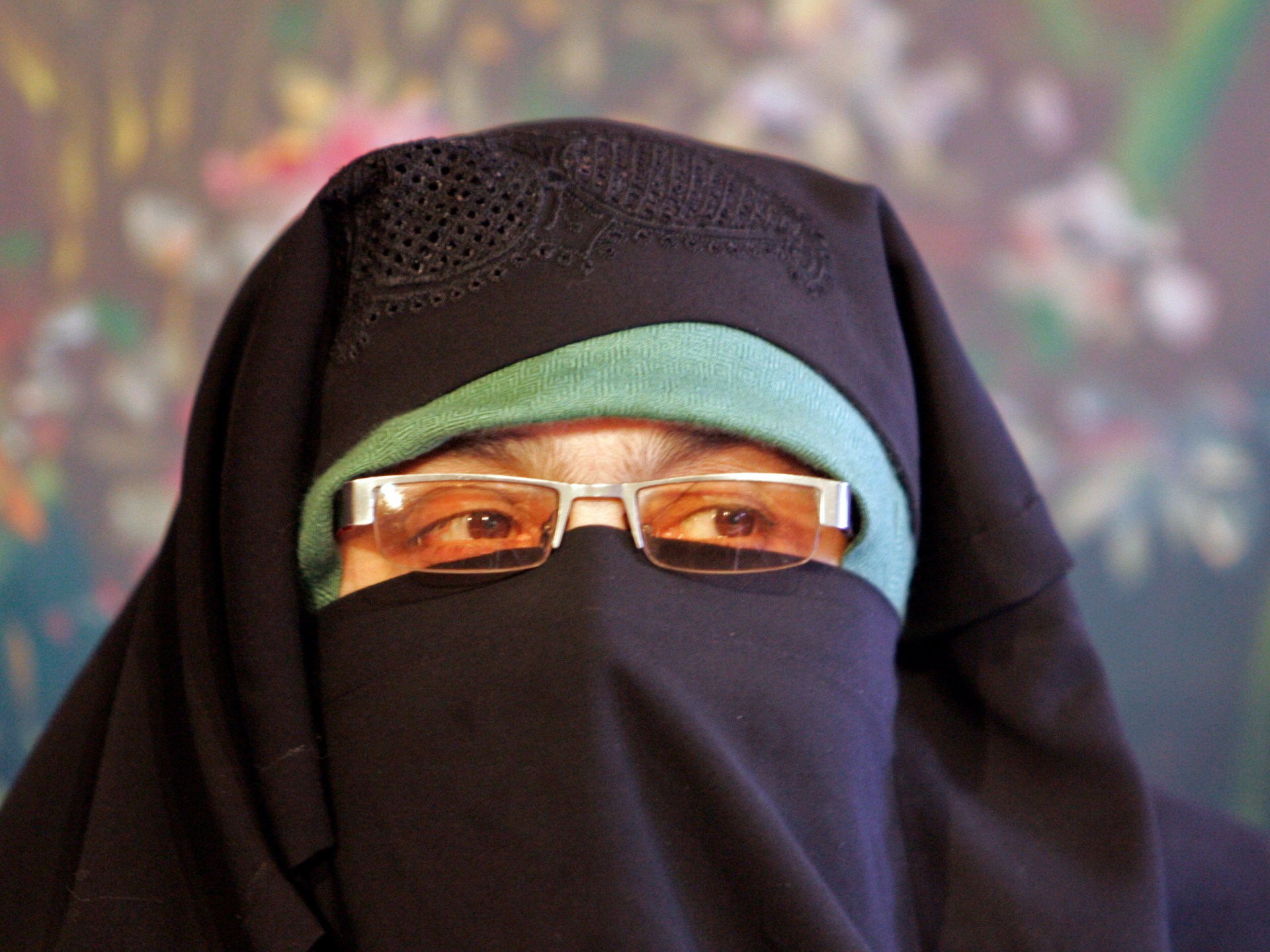

Activists and legal experts have condemned an Indian court’s verdict that handed down three life sentences to prominent Kashmiri separatist Aasiya Andrabi, saying the harsh sentencing of a 64-year-old woman “fits a broader pattern” of India’s policy with dissenting voices in the disputed region.
Andrabi, the founder of Dukhtaran-e-Millat (DeM), a banned all-women’s organisation, was sentenced on March 24 by a special National Investigative Agency (NIA) court in New Delhi. Two of her associates, Sofi Fehmeeda, a wheelchair-bound 36-year-old, and 61-year-old Nahida Nasreen, were also given 30 years in jail.
- list 1 of 4Kashmir, spying, demolitions: How Modi’s India embraced ‘Israel model’
- list 2 of 4Attacked in India, Kashmiri shawl sellers choose between safety, livelihood
- list 3 of 4India shuts Kashmir medical college – after Muslims earned more admissions
- list 4 of 4Kashmiri women united by loss
end of list
The three women were arrested by the NIA in 2018 under the Unlawful Activities Prevention Act (UAPA), a draconian anti-terror law, and various sections of the Indian Penal Code.
The UAPA, first introduced in 2008 by the centrist Congress party, was given more teeth by Prime Minister Narendra Modi’s right-wing government, which allowed authorities to declare individuals – not just organisations – as “terrorists” among the several amendments made in 2019.
Andrabi was accused by the NIA of waging war against the Indian government, raising funds for terrorist acts, and being a member of a terrorist group.
In his 290-page judgement, however, Judge Chander Jit Singh found no evidence related to these charges, yet convicted her on a series of less serious allegations, such as provoking hostility between communities, undermining national integration, and instigating public disorder. Two major charges dropped by the court include financing terrorist acts and instigating or taking part in an armed rebellion.
Advertisement
“There are evidences [sic] in the form of videos or interviews or posts where stone pelting or use of gun [sic] towards secessionist approach of Kashmir has been approved or endorsed and encouraged, but no violent incidence in particular, pursuant to such endorsement or encouragement, has been brought on record,” the court noted in its judgement, seen by Al Jazeera.
“The acts of the convict brought on record may not apparently be the direct cause of inciting violence but infusing the minds of Kashmiries especially the youngsters with the idea that Kashmir is not part of India and India has occupied the Kashmir illegally and in a hostile manner can evoke the sentiments of the people of Kashmir as well as it may lead them to use all kind of method including violence to seek the supposed liberation, the idea of which is wrongly seeded in their minds.”
‘Deeply problematic’
But legal experts say Aasiya Andrabi’s conviction is mainly based on offensive speech-making, a move that raises questions about India’s tolerance of dissenting voices.
“Ideology is not punishable by law; only actions are. But the UAPA’s scope has been widened significantly through several amendments, especially in 2019, to criminalise a range of activities, including a person’s ideology,” a Kashmir-based legal researcher told Al Jazeera on condition of anonymity, fearing reprisals from the Indian government for criticising its actions in the disputed region.
“She [Andrabi] is also charged with sedition, threatening national integration and separatism. Freedom of speech in India does not protect against speech or civil action made in favour of separatism. The law has been deliberately designed to perform this precise task.”
Andrabi’s son, Ahmed bin Qasim, described the conviction as “effectively a death sentence” as her mother was already above 60 and had spent more than 10 years of her life in various Indian jails since her first imprisonment in 1993.
Her husband, Ashiq Hussain Faktoo, a former rebel leader, has also remained imprisoned since 1992. In 2003, he was further convicted for the murder of H N Wanchoo, a Kashmiri human rights activist.
In his verdict against Andrabi, the judge also argued that since the convicted members of the outfit have displayed no remorse during the trial, the courts were not obliged to show compassion as that “has a potential to send a message to others with similar ideas that they can get away with such acts through incarceration for some years and may promote the ideas of causing secession of part of India”.
Advertisement
Kashmir Times, one of Kashmir’s leading independent voices, criticised the verdict in an editorial on March 25, calling the court’s remarks over the supposed lack of repentance on the part of Aasiya and her associates as “deeply problematic”.
“Remorse is inherently subjective. It is an internal state that cannot be easily measured or verified,” the editorial said. “Elevating it to a central consideration risks penalising an accused for what they believe or choose not to express, rather than for what has been proven in law.”
‘Flattened into caricatures’
Born in 1962 in Indian-administered Kashmir’s main city of Srinagar, Andrabi grew up in a turbulent Kashmir – a Himalayan territory divided between India and Pakistan and claimed by both the nuclear powers, with China also controlling a sliver of its land. Most Kashmiris on the Indian side support an independent land or merger with Muslim-majority Pakistan.
After India reneged on its promise to the United Nations to hold a referendum to allow the Kashmiris self-determination of their political future and consolidated its grip over the region with a heavy military presence, a violent rebellion broke out in the 1980s, which has since killed tens of thousands of people, most of them civilians.
In 2019, India unilaterally scrapped Kashmir’s historical special status, which had, among many things, guaranteed it partial autonomy and safeguarded its lands and jobs for the residents. The abrogation of Article 370 of the Indian constitution was followed by the division of the territory into two territories to be directly governed by New Delhi, and a months-long security clampdown on the valley, which saw its political leaders and activists arrested and an unprecedented operation to clear the region of its rebels and other dissenters.
In 1987, when anti-India sentiments were at a peak in Kashmir, Andrabi, an undergraduate in biochemistry and a master’s in Arabic, formally named her group of female activists as Dukhtaran-e-Millat (DeM), an organisation that focused on education and women’s rights as prescribed in Islam.
Its members, clad in head-to-toe burqas, would be seen lashing out at Kashmiri women for not observing purdah. DeM also railed against what it described as the intrusion of Western mores into the cultural fabric of Kashmir, as it demanded an imposition of strict Islamic cultural norms in Kashmir and the closure of liquor stalls and beauty salons.
Triggered by New Delhi allegedly rigging the 1987 election to allow pro-India parties to win against the region’s separatist groups, Andrabi turned into a political hardliner and became one of the most staunch advocates of Kashmir’s merger with Pakistan. In a 2018 interview with the now-defunct Kashmir Ink magazine, Andrabi had termed the act of taking part in the elections under the Indian constitution as “haram” or forbidden in Islam.
A Kashmir-based member of Modi’s Bharatiya Janata Party (BJP) told Al Jazeera that Andrabi’s DeM was declared a terrorist organisation by the Indian government in 2004.
Advertisement
“The association with a proscribed group played a huge role in securing their conviction. So how can one say that the terrorism angle doesn’t figure?” he said on condition of anonymity since he was not authorised by his party to talk to the media on the matter.
“Besides, she [Andrabi] had been openly canvassing support for Kashmir’s secession and encouraging terrorism by supporting ideas of martyrdom. The conviction was, in fact, long overdue. They should have happened long ago.”
However, most Indian media reports and commentaries on Andrabi’s conviction largely focused on the DeM’s alleged acts of moral policing and enforcement of conservative cultural norms among Kashmiri women as the reasons for the unusually harsh sentencing for a 64-year-old grandmother.
But experts have questioned why those allegations – if at all they were legally tenable – did not feature during the trial. “These are two separate questions that should not be collapsed,” Ather Zia, a United States-based Kashmiri academic, told Al Jazeera.
“One can strongly disagree or critique Dukhtaran-e-Millat’s coercive social interventions around dress and morality, which many Kashmiri women did challenge at the time, and still oppose the criminalisation of political speech and dissent.”
Zia said the state cannot selectively invoke women’s rights or what she described as “liberal feminism” as a pretext to stifle dissent. She said the court dropped terrorism allegations and punished Andrabi “for her words”.
“That should concern anyone committed to civil liberties and political freedoms,” she added. “In Kashmir, this fits a broader pattern in which all forms of political resistance are disciplined, while complex women political actors are flattened into caricatures of being either victim or zealot.”
Related News

Migrants march in southern Mexico to denounce immigration restrictions
WTO holds crunch meeting amid growing uncertainty over multilateral system
US diplomat Marco Rubio denounces settler violence, tolls in Hormuz strait