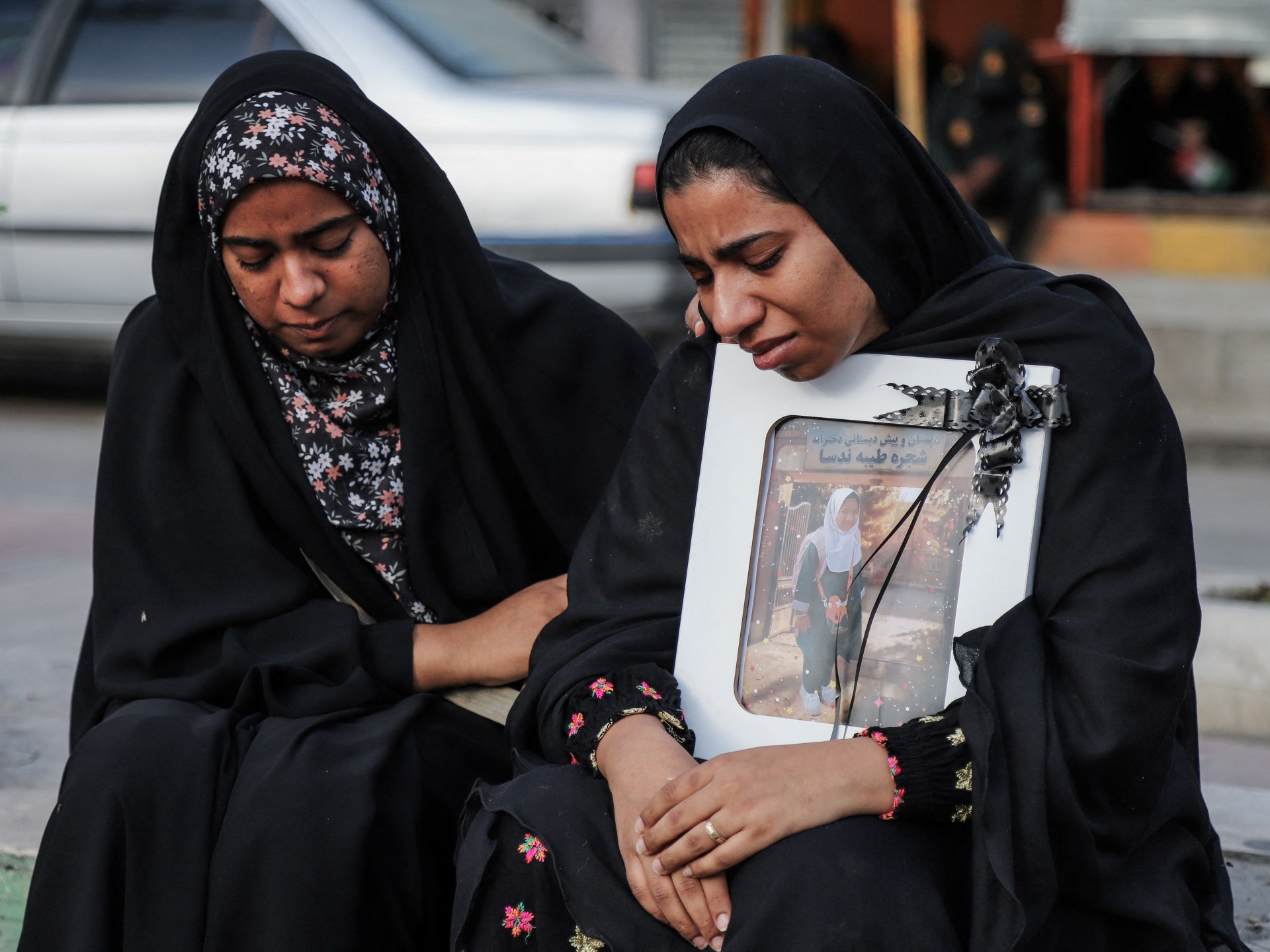

Calls are growing for an independent investigation into an attack on a girls’ school in southern Iran that killed 165 young pupils this week, with United Nations experts denouncing the deadly bombing as “a grave assault on children”.
In a statement on Friday, a group of UN experts said girls between the ages of seven and 12 were the main victims of the attack on the primary school in Minab on Saturday – the first day of the United States and Israel’s war against Iran.
- list 1 of 3Tehran hit by heavy bombing on day seven of US-Israel war on Iran
- list 2 of 3Elementary school in Tehran hit, Iran’s foreign ministry says
- list 3 of 3‘No deal with Iran except unconditional surrender,’ Trump says
end of list
“An attack on a functioning school during class hours raises the most serious concerns under international law and must be urgently, independently, and effectively investigated, with accountability for any violations,” they said.
“A strike on a school represents a grave assault on children, on education, and on the future of an entire community,” the experts said. “There is no excuse for killing girls in a classroom.”
Rights advocates have pointed to the Minab school attack as evidence of potential war crimes being committed by Israel and the US in a war that legal experts say was launched in violation of the UN Charter and in breach of international law.
They also say it is an example of the heavy toll Iranian civilians are paying amid the conflict, which has killed at least 1,332 people so far, according to the latest figures cited by Iran’s state media outlets.
Iran’s UN envoy, Amir Saeid Iravani, told reporters on Monday that the school was “deliberately destroyed” in US-Israeli attacks against the country. “As a result, 165 innocent schoolgirls were martyred. I repeat it – 165 schoolgirls martyred,” he said.
Advertisement
Investigations published in recent days suggest US President Donald Trump’s administration was responsible for the attack.
The Reuters news agency, quoting two unnamed US officials, reported on Thursday that American military investigators believe it is likely that US forces were responsible.
Using satellite imagery as well as verified videos and official statements, The New York Times also said US forces “were most likely to have carried out the strike” as they were attacking an adjacent naval base operated by the Islamic Revolutionary Guard Corps (IRGC).
White House Press Secretary Karoline Leavitt told reporters on Wednesday that Washington was investigating the incident.
“The Department of War and the United States armed forces do not target civilians,” she said.

UN human rights chief Volker Turk told reporters on Friday that, “whatever outcome there will be of the investigations, we hope they will be prompt and that they will be done in full transparency”.
“We also expect accountability to be served because obviously mistakes were clearly made,” Turk said in Geneva, Switzerland, stressing that “accountability is absolutely critical” along with redress and compensation.
“It is a lesson to be learned – a horrible, tragic lesson to be learned – when girls are killed in this way,” he said.
“I hope there will be not only guarantees of non-recurrence, but a review of all the standard operating procedures when it comes to these issues, and especially when it comes to conduct of hostilities.”
Meanwhile, DAWN, a US-based advocacy group, has urged Iran to give the International Criminal Court (ICC) jurisdiction over crimes committed on its territory since the war began.
“From the killing of over 150 students and teachers to strikes on hospitals full of newborns, every day more and more evidence emerges pointing to the commission of grave war crimes in Iran since the start of the war,” said the group’s executive director, Omar Shakir.
“Victims deserve justice. The mechanisms exist and the US has no veto over them.”

Related News
Iran says ready for talks but will defend itself against US aggression
Moscow policeman killed in bomb attack on Ukraine war anniversary
Epstein files fallout: Muted US response vs political reckoning in Europe