
Pakistan has accused Afghanistan’s Taliban of serving as a “proxy” for India, amid escalating hostilities between Islamabad and Kabul.
Just hours after Pakistan bombed locations in Kabul early on Friday, Pakistan’s Minister of Defence Khawaja Asif wrote on X that after NATO forces withdrew from Afghanistan in July 2021, “it was expected that peace would prevail in Afghanistan and that the Taliban would focus on the interests of the Afghan people and regional stability”.
- list 1 of 3Afghanistan promises ‘appropriate response’ after deadly Pakistani strikes
- list 2 of 3Pakistan ‘kills dozens’ in air strikes on Afghanistan
- list 3 of 3Photos: The aftermath of Pakistan’s air strikes in Afghanistan
end of list
“However, the Taliban turned Afghanistan into a colony of India,” he wrote and accused the Taliban of “exporting terrorism”.
“Pakistan made every effort, both directly and through friendly countries, to keep the situation stable. It carried out extensive diplomacy. However, the Taliban became a proxy of India,” he alleged as he declared an “open war” with Afghanistan.
This is not the first time that Asif has brought India into tensions with Afghanistan.
Last October, he alleged: “India wants to engage in a low-intensity war with Pakistan. To achieve this, they are using Kabul.”
So far, Asif has presented no evidence to back his claims and the Taliban has rejected accusations that it is being influenced by India.
But India has condemned the Pakistani military’s recent actions in Afghanistan, adding to Islamabad’s growing discernment that its nuclear rival and the Taliban are edging closer.
Earlier this week, after the Pakistani military carried out air raids inside Afghanistan on Sunday, India’s Ministry of External Affairs said in a statement that New Delhi “strongly condemns Pakistan’s airstrikes on Afghan territory that have resulted in civilian casualties, including women and children, during the holy month of Ramadan”.
Advertisement
After Friday morning’s flare-up between Pakistan and Afghanistan, India’s foreign ministry spokesperson Randhir Jaiswal again said New Delhi “strongly” condemned Pakistan’s air strikes and also noted that they took place on a Friday during the holy month of Ramadan.
“It is another attempt by Pakistan to externalise its internal failures,” Jaiswal said in a statement on X.
Has India’s influence in Afghanistan grown under the Taliban and what is India’s endgame with Afghanistan?
Here’s what we know:
How have relations between India and the Taliban evolved?
When the Taliban first rose to power in Afghanistan in 1996, India adopted a hostile policy towards the group and did not recognise its assumption of power. India also shunned all diplomatic relations with the Taliban.
At the time, New Delhi viewed the Taliban as a proxy for Pakistan’s intelligence agencies. Pakistan, together with Saudi Arabia and the United Arab Emirates, were the only three countries to have also recognised the Taliban administration at that point.
Then, in 2001, India supported the US-led invasion of Afghanistan, which toppled the Taliban administration. India then reopened its embassy in Kabul and embraced the new government led by Hamid Karzai. The Taliban, in response, attacked Indian embassies and consulates in Afghanistan. In 2008, at least 58 people were killed when the Taliban bombed India’s embassy in Kabul.
In 2021, after the Taliban returned to power, India closed its embassy in Afghanistan once again and also did not officially recognise the Taliban as the government of the country.
But a year later, as relations between Pakistan and the Taliban deteriorated over armed groups which Pakistan accuses Afghanistan of harbouring, India began engaging with the Taliban.
In 2022, India sent a team of “technical experts” to run its mission in Kabul and officially reopened its embassy in the Afghan capital last October. New Delhi also allowed the Taliban to operate Afghanistan consulates in the Indian cities of Mumbai and Hyderabad.
Over the past two years, officials from New Delhi and Afghanistan have also held meetings abroad, in Kabul and in New Delhi.
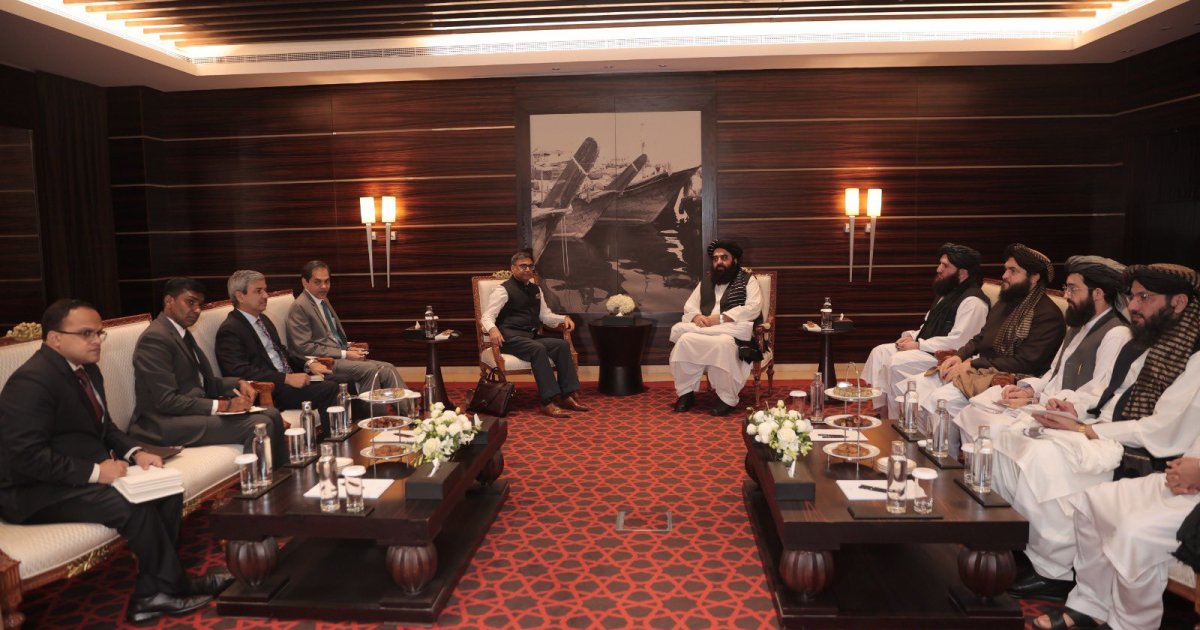
In January last year, the Taliban administration’s Foreign Minister Amir Khan Muttaqi met India’s Foreign Secretary Vikram Misri in Dubai, the United Arab Emirates.
Then, in October 2025, he visited New Delhi and met Indian foreign minister Subrahmanyam Jaishankar.
After this meeting, Muttaqi told journalists that Kabul “has always sought good relations with India” and, in a joint statement, Afghanistan and India pledged to have “close communication and continue regular engagement”.

Besides beefing up diplomatic ties, India has also offered humanitarian support to Afghanistan under the Taliban’s rule.
Advertisement
After a magnitude 6.3 earthquake struck northern Afghanistan in November last year, India shipped food, medicine and vaccines, and Jaishankar was also among the first foreign ministers to call Muttaqi and offer his support. Since last December, India has also approved and implemented several healthcare infrastructure projects in Afghanistan, according to a December 2025 report by the country’s press information bureau.
Praveen Donthi, senior analyst at the International Crisis Group, told Al Jazeera that the costs of avoiding engagement with the Taliban in the past have compelled the Indian government to adopt strategic pragmatism towards the Afghan leadership this time.
“New Delhi does not want to disregard this relationship on ideological grounds or create strategic space for India’s main strategic rivals, Pakistan and China, in its neighbourhood,” he said.
Raghav Sharma, professor and director at the Centre for Afghanistan Studies at the OP Jindal Global University in India, added that the current engagement also stems from New Delhi’s pragmatic realisation that the Taliban is now in charge in Afghanistan and that there is no meaningful opposition.
“States engage in order to protect and further their interests. While there is little by way of ideological convergence, there are areas of strategic convergence, which is what has pushed India to engage with the Taliban, some of their unpalatable policies notwithstanding,” he said.
Is this a new stance towards Afghanistan?
No. India’s growing influence and engagement with Afghanistan began well before the Taliban returned to power in August 2021.
Between December 2001 and September 2014, during the US presence in Afghanistan, New Delhi was a strong supporter of the Karzai government, and then of his successor, Ashraf Ghani’s government, which was in power from September 2014 until August 2021, when the US withdrew from the country.
In October 2011, under Karzai, India and Afghanistan renewed ties by signing an agreement to form a strategic partnership. New Delhi also pledged to support Afghanistan in the face of foreign troops in the nation as a part of this agreement.
Under both Karzai and his successor, Ghani, India invested more than $3bn in humanitarian aid and reconstruction work in Afghanistan. This included reconstruction projects like schools and hospitals, and also a new National Assembly building in Kabul, which was inaugurated in December 2015 when Indian Prime Minister Narendra Modi visited Afghanistan for the first time.
India’s Border Road Organisation (BRO) also assisted Afghanistan in the development of infrastructure projects like the 218km Zaranj-Delaram highway in 2009 under Karzai’s government.
Under Ghani, New Delhi undertook building the Salma Dam project to help with irrigating Afghanistan. In June 2016, when Modi visited Afghanistan once again, he inaugurated this $290m dam project. In May 2016, Iran, India and Afghanistan also signed a trilateral trade and transit agreement on the Chabahar port.

During this period – 2001-2021 – Pakistan’s unease with New Delhi and Kabul’s new partnership grew.
Advertisement
In October 2011, after signing a strategic agreement with India, Karzai had assured Islamabad that while “India is a great friend, Pakistan is a twin brother”.
But Karzai was critical of Pakistan’s support for the Taliban. In his last speech as president of Afghanistan in Kabul in September 2014, he stated that he believed most of the Taliban leadership lived in Pakistan.
In a 2011 report by a Washington, DC-based think tank, the Center for Strategic and International Studies, Amer Latif, former director for South Asian affairs in the US Office of the Undersecretary of Defense for Policy, noted that Karzai was walking a “fine line between criticising Pakistan’s activities while also referring to Pakistan as Afghanistan’s ‘twin brother’.”
“It is in this context that Karzai appears to be looking to solidify long-term partnerships with countries that will aid his stabilisation efforts,” he said, referring to Karzai’s visit to India and his efforts to improve relations with the subcontinent.
When Ghani rose to power in September 2014, he tried to reset ties with Pakistan and also visited the country in November that year. But his efforts did not result in improved ties due to border disputes with Pakistan continuing until his administration was overthrown by the Taliban in August 2021.
So why has India maintained ties with Afghanistan under the Taliban?
Initially, when the Taliban returned to power in 2021 following the withdrawal of the US, political analysts largely expected Pakistan to lead the way in recognising the Taliban administration as the official government of Afghanistan, improving bilateral relations which had turned icy under Karzai and Ghani.
But relations turned hostile, with Pakistan repeatedly accusing the Taliban of allowing anti-Pakistan armed groups like the Pakistan Taliban (TTP) to operate from Afghan soil. The Taliban denies this.
Then, the deportation of tens of thousands of Afghan refugees by Pakistan in recent years further strained ties between the two neighbours.
India has ultimately taken a pragmatic approach to the Taliban in order to maintain the good relations it built with Afghanistan from 2001 to 2021, and has somewhat leveraged poor relations between Pakistan and Afghanistan to cement these.
“With Pakistan’s increasingly strained relations with Afghanistan, the logic of ‘enemy’s enemy’ is acting as a glue between Kabul and New Delhi,” International Crisis Group’s Donthi said.
He added that despite the fact that India’s Bharatiya Janata Party (BJP)-led government opposes Islamist organisations, “the strategic necessity to counter Pakistan has led it to engage with the Taliban proactively”.
India and Pakistan are nuclear-armed rivals which engaged in a four-day conflict in May 2025 after armed rebels killed Indian tourists in Pahalgam, a popular tourist spot in Indian-administered Kashmir, last April. New Delhi accused Pakistan of supporting rebel fighters, a charge Pakistan strongly denied.
For its part, Afghanistan took the opportunity to strongly condemn the Pahalgam attack and the Indian Ministry of External Affairs expressed “deep appreciation” to the Taliban for its “strong condemnation of the terrorist attack in Pahalgam … as well as for the sincere condolences”.
India has also condemned Pakistani military action in Afghanistan and has provided aid to thousands of Afghan refugees displaced from Pakistan.
So what is India’s endgame in Afghanistan?
Sharma, the OP Jindal Global University professor, said India wants to ensure that Pakistan and China, whose influence has grown in South Asia in recent years, “do not have a free run”, as “there is a divergence of interest on Afghanistan” with both Pakistan and its ally, China.
Advertisement
“There are security interests New Delhi is keen to further and protect for which engagement [with the Taliban] is the only option,” he added.
Anil Trigunayat, a former Indian diplomat, noted that while Afghanistan and Pakistan relations have their own dynamic, currently the Taliban leadership, even if not a monolith, refuses to play to the tunes of the Pakistan military and its intelligence agency.
“Hence they [Pakistan] accuse Indian complicity in Taliban actions in Pakistan,” he said.
But the Taliban, he said, “understands and appreciates India’s intent, policies and [humanitarian] contributions”, making its leaders keen to continue collaboration with New Delhi.
Related News
Iran says US military build-up ‘unnecessary and unhelpful’, deal achievable
Gas explosion kills 13 in Pakistan’s Karachi, collapsing building
Trump suggests Iran has 10 days to reach agreement with US