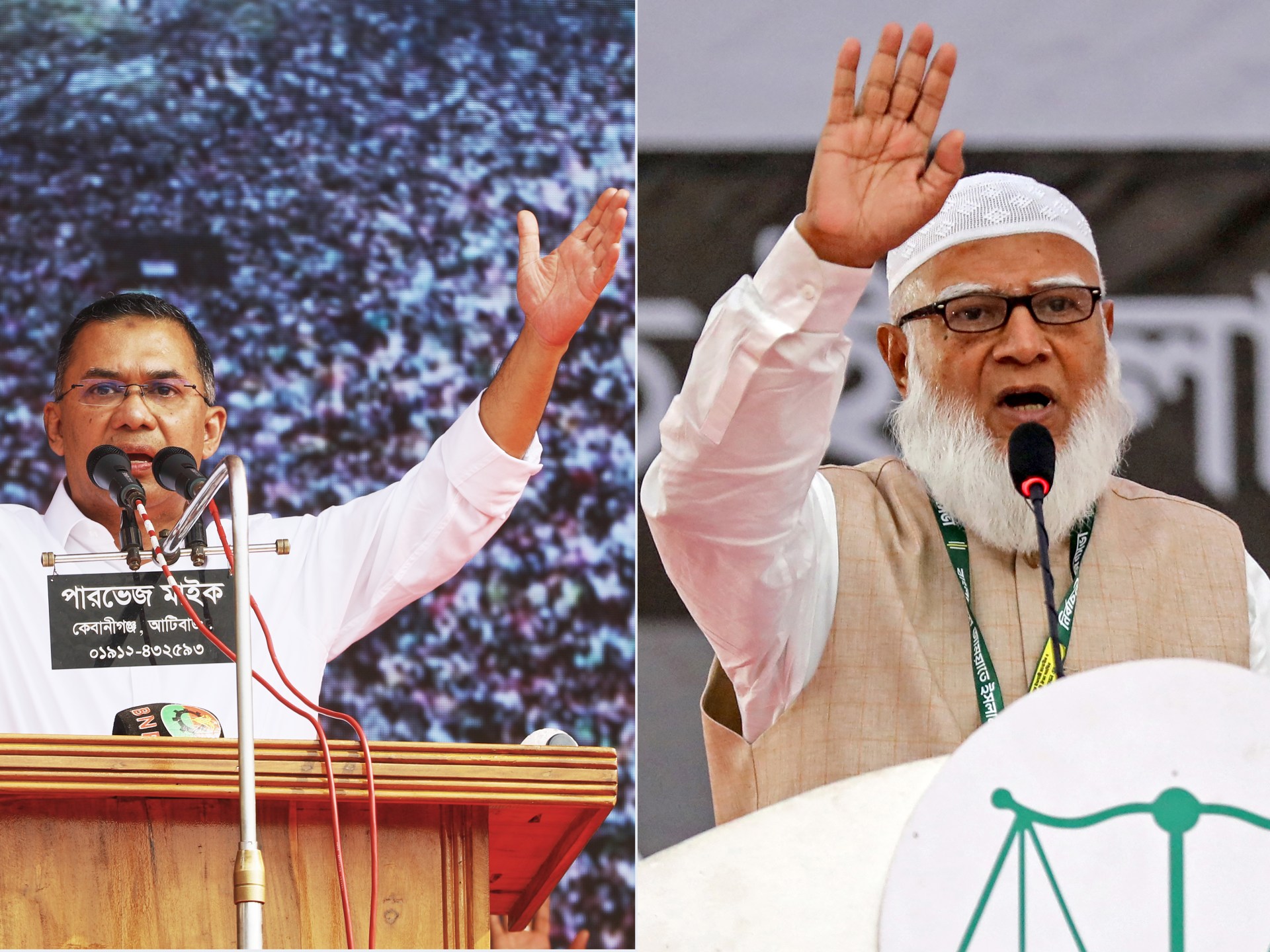

An array of political parties and alliances will be vying for seats in the Bangladesh Parliament on February 12 in the country’s first election since the ousting of former Prime Minister Sheikh Hasina in 2024. About 127 million registered voters are eligible to cast votes to elect 350 members of the Jatiya Sangsad, the country’s parliament.
The South Asian country has been in the hands of a caretaker government led by Nobel laureate Muhammad Yunus since August 2024, when a student-led uprising ended Hasina’s long rule. Hasina ordered troops to crack down on protesters, killing 1,400 people. She has since been sentenced to death by a special tribunal in Bangladesh for the brutal crackdown, but remains in exile in India, and her Awami League party has been banned from political activity.
- list 1 of 3Why is Pakistan backing Bangladesh in its T20 World Cup row with India?
- list 2 of 3Bangladesh election: Is the military still a power behind the scenes?
- list 3 of 3Exiled leader Hasina denounces upcoming Bangladesh election after party ban
end of list
Besides the election on February 12, Bangladesh will also hold a referendum on the July National Charter 2025 – a document drafted following the student protests, setting the foundation for future governance of the country.
The two biggest groups competing for parliamentary seats across the country’s 300 constituencies are the Bangladesh Nationalist Party (BNP), which is leading a coalition of 10 parties, and Jamaat-e-Islami (JIB), which heads an 11-party alliance, including the National Citizen Party, a group formed by students who led the anti-Hasina movement in 2024. The Awami League, which dominated Bangladeshi politics for decades, has been barred from fielding candidates.
Besides the two main blocs, the Islami Andolan Bangladesh, which broke away from the JIB-led alliance, and the Jatiya Party, a longtime ally of Hasina’s Awami League, are contesting independently.
Advertisement
Here is a look at the main political parties and their leaders vying for parliament seats this year, and the key players influencing the election.
Bangladesh Nationalist Party
Led by Tarique Rahman, the son of the late former Prime Minister Khaleda Zia, the BNP is seen as one of the main contenders in the upcoming elections.
The party was founded in 1978 by Ziaur Rahman, Tarique’s father and one of the leading military figures of the country’s independence war against Pakistan in 1971, on the principles of Bangladeshi nationalism. According to the BNP website, this is an “ideology that recognises the right of Bangladeshis from all walks of life, irrespective of their ethnicity, gender or race”.
As a centre-right political party, the BNP has been a popular political force in the country for decades and has traditionally exchanged power with the Awami League.
For four decades after Ziaur Rahman’s assassination in 1981, his wife and Tarique’s father, Khaleda Zia, led the party. Khaleda served as the country’s first female prime minister from 1991 to 1996 and again from 2001 to 2006. In that period, Jamaat was an ally of the BNP as they together fought against Hasina’s Awami League.
After Hasina came back to power in 2009 – she had also ruled between 1996 and 2001 – the BNP faced the wrath of her government over corruption charges, and Khaleda was put under house arrest in 2018 in two related cases. She was acquitted of all charges after Hasina’s departure in 2024.
Since Hasina’s ousting in 2024, the BNP has risen again as a political frontrunner. A December survey by the United States-based International Republican Institute indicated the BNP had the support of 33 percent of respondents. That was also the only month when the BNP — seeking to position itself as a liberal force ahead of the elections — broke its alliance with Jamaat. Polls show Jamaat just marginally behind the BNP in popular support.
Tarique, 60, had been living in London, United Kingdom, since he fled Bangladesh in 2008 over what he called politically motivated persecution. He arrived in Dhaka on December 25, 2025 to take over the BNP leadership ahead of his mother Khaleda’s death on December 30.
“We will build a Bangladesh that a mother dreams of,” he said in December after returning to the country and calling on citizens from the hills and plains – Muslims, Hindus, Buddhists and Christians – to join him in creating a secure and inclusive nation.
In election rallies, he has pledged to improve the country’s infrastructure, among other promises.
Advertisement
“If elected, the healthcare system will be improved, a flyover will be constructed in Sherpur, permanent embankments will be built in the river erosion areas of Dhunat, and the youth will be made self-reliant through the establishment of IT education institutions,” he said.
According to Khandakar Tahmid Rejwan, lecturer in global studies and governance at the Independent University, Bangladesh, since Rahman’s return, the BNP has become more organised.
“The party has basically revived with a newfound spirit in both its central and grassroots-level leadership,” he said.
“Typical objections against BNP and affiliated party activists, like [allegations of] extortion … have also significantly declined. Top leaders of the central committee have also been comparatively cautious to avoid any statement that might create popular outrage. Significantly, the people are flocking in thousands to hear from Rahman at his electoral rally, even late at midnight,” he said.
Rejwan added that it is widely believed that Rahman is the only man who can currently unite Bangladesh with an “inclusive vision”, unlike his Jamaat rivals, who have failed to address any clear stance or acknowledge what are seen by many as their restrictive policies towards women and religious minorities.
Jamaat-e-Islami
The party was founded in 1941 by Sayyid Abul Ala Maududi during British rule in India.
In 1971, during Bangladesh’s war of independence, Jamaat supported staying with Pakistan, and was banned after the country won its freedom.
But in 1979, four years after the assassination of Sheikh Mujibur Rahman, who had fought for Bangladesh’s independence and is seen by many as the country’s founding father, BNP founder Ziaur Rahman, who was the country’s president at the time, lifted the ban. Ziaur Rahman was also assassinated in 1981.
Over the next two decades, Jamaat developed into a significant political force. It supported the BNP-led coalition in 1991 and 2001.
But while Hasina was in power from 2009 until she was toppled in student-led protests in 2024 and fled to India, five top Jamaat leaders were executed, while others were jailed for crimes committed during the independence war of 1971. The party was barred in 2013 from running in elections.
In June 2025, the country’s Supreme Court restored the party’s registration, paving the way for its participation in elections.
While Jamaat no longer has an alliance with the BNP, its current leader, 67-year-old Shafiqur Rahman, has also focused on reorganising the party into a strong contender in the election.
Speaking at an election rally in Jamalpur city on Sunday, Shafiqur Rahman said the upcoming election “will be a turning point”.
“It is an election to end the cries of the families of martyrs. It is an election to bury the rotten politics of the past,” he said, according to The Daily Star newspaper.
But his party’s resurgence has also prompted debate over whether Bangladesh is prepared to be led by an Islamist force, which some fear could seek to enforce Islamic law or try to restrict women’s rights and freedoms.
Advertisement
However, Jamaat has rejected such fears and has told reporters it is focusing on expanding its electoral power. Last December, the party announced an alliance with the National Citizen Party, founded by 2024 leaders of the student-led uprising, and with the Liberal Democratic Party, led by 1971 war hero Oli Ahmad.
For the first time in its history, Jamaat is also fielding a Hindu candidate, Krishna Nandi, from Khulna, in a bid to attract non-Muslim voters.
The International Republican Institute survey suggested the Jamaat-led alliance at number two, with 29 percent, closely behind the BNP.
According to Independent University’s Rejwan, Jamaat has an appeal across Bangladesh’s social classes.
“Its student wing has literally outperformed any other political rivals in the university union elections. We are also seeing the Jamaat-affiliated women’s wing reaching out door-to-door in both rural and urban areas to expand their women’s base of voters. Moreover, since the fall of Hasina, we are seeing pro-Jamaat active and retired elites from security forces, university academics, and civil services constantly pushing the pro-Jamaat narratives within their respective capacities,” he said.
“Jamaat’s upper hand and pragmatic postures are now being extended to its allies, like NCP, which is explicitly reaping all the benefits of its senior partner in the alliance,” he added.
National Citizens Party (NCP)
The NCP, one of Jamaat’s allies, was formed in February 2025 by students who led the mass protests in July 2024 over government job quotas, which ultimately toppled Hasina’s government.
Seeking to stand for the 2026 elections, the leaders told a rally in February 2025 that they had formed the party “to uphold the spirit of the July movement among students”.
Led by Nahid Islam, 27, the stated ideals of the NCP are to ensure “governance without corruption” and to unite the country. The party says it aims to uphold freedom of the press, increase women’s representation in parliament and improve Bangladesh’s relations with neighbouring countries, such as India.
But lacking adequate funds to run by itself in an election, the party has allied with Jamaat. However, the move has been received poorly by some in Bangladesh. It also triggered some resignations by some NCP members over ideological differences.
According to local media reports, those members submitted a memorandum stating that Jamaat’s controversial political history and historical views against Bangladesh’s independence in 1971 were contrary to the NCP’s values.
In an interview with ABC News last month, Nahid Islam defended the decision to unite with Jamaat and said, “When we are forming an electoral alliance, we are not abandoning our own political beliefs. It’s just a strategic alliance.”
“It’s unfortunate to see the leader of the political party that arguably claims to own and lead the 2024 mass uprising and depose Hasina, now become a junior partner to a major political party,” Rejwan said.
“As a result, we see defections of many top leaders of NCP, and astonishingly, by allying, it was only able to bargain for 30 seats for its own candidate. To sum up, Nahid has sold his political autonomy and image of an exclusive figure by de facto becoming subservient to Jamaat,” he added.
Who are the other key players in the election?
Besides the main political parties, Muhammad Yunus, who currently leads the interim government, and General Waker-Uz-Zaman, the army chief, are also influential figures in this election.
Yunus, who was selected to run the government after Hasina’s ousting, is facilitating the election in his capacity as the country’s chief adviser.
Advertisement
But while political parties are campaigning for the election, Yunus is focusing on the referendum on the July Charter, which will take place on the same day.
After Hasina’s ousting, Yunus formed the Constitution Reform Commission (CRC) in 2025, seeking to amend the governance of the country. The commission proposed an anticorruption mechanism, electoral reforms and new rules the police must follow, among other issues. The July Charter is the culmination of the CRC’s work and takes its name from the protests which dismantled Hasina’s government in July 2024. Bangladeshis will vote to approve or reject it in the referendum.
Last month, Yunus expressed confidence in the results of the referendum and told the media he expected people and political parties to agree to the charter. But some critics have said holding the referendum and establishing the charter is not constitutional.

General Zaman is also a key player in the election.
Following the 1975 assassination of Sheikh Mujibur Rahman, Bangladesh’s founding leader and then-president, the country entered a period marked by coups, countercoups and military rule, which reshaped the state.
Currently, the army is not vying for electoral power, but its focus will be on ensuring public order and security during the election, in light of political violence that has spread in the country since the upheaval of 2024.
The military also plays a role with respect to backing the political party in power or deciding how to govern the country during a political crisis.
In September 2024, after the protests against Hasina, Zaman told the Reuters news agency that he would back Yunus’s interim government “come what may”, while also floating a timeline for elections within 18 months, placing him central to the political debate.
A successful election will require goodwill from both Yunus and the army chief, according to Rejwan.
“Executives under the leadership of Yunus are critical to ensure the nationwide voting, while the Chief of Army Staff Waker’s forces, which would be deployed throughout the country, are indispensable to maintain public order and prevent the proliferation of political instability, violence and chaos,” he said.

Does Hasina have any power at all?
Hasina, who is currently in exile in India, has denounced the upcoming elections since her party, the Awami League, has not been allowed to take part. However, those who voted for her in the past must now choose how to vote this time.
In a message sent to the media last month, Hasina stated that “a government born of exclusion cannot unite a divided nation”.
“Each time political participation is denied to a significant portion of the population, it deepens resentment, delegitimises institutions and creates the conditions for future instability,” the former leader warned in an email to The Associated Press news agency.
Bangladesh’s Ministry of Foreign Affairs said it was “surprised and shocked” that Hasina had been allowed to make a public address in India. Her speeches and statements are banned from the media in Bangladesh.
“Allowing the event to take place in the Indian capital and letting mass murderer Hasina openly deliver her hate speech … constitute a clear affront to the people and the Government of Bangladesh,” the ministry said in a statement.
Hasina was sentenced to death in absentia by a tribunal in Bangladesh last November, and Dhaka has called on New Delhi to extradite her.
But she remains in India, and Rejwan says she will be a key political instigator of unrest as the elections approach.
“If Hasina were a negligible figure, then the interim government wouldn’t have banned all of her speeches and statements from being aired on television or printed in newspapers … the interim government would also not have reacted so firmly against India for allowing her to speak,” he noted.
“This means Hasina is a factor that the interim government implicitly believes has an influence over the Awami League populace, who are yet undecided on whom to cast their vote for, given that AL is banned from the polls,” he said.
“The reality is that AL has its own clear political ideology and a base of loyal cadres, many of whom have declined to change their allegiance despite living a harsh clandestine life in Bangladesh or abroad,” he added.
Related News

US federal agents shoot another person in Minneapolis: Governor
UN says Gaza ‘dire’ with children hardest hit by Israel-imposed shortages
US Justice Department charges man with assault after Ilhan Omar town hall