India’s VPN ban in Kashmir ‘adds to psychological pressure’, say residents
 12 January 2026

Basit Banday*, employed with an IT firm based in the southwestern Indian city of Pune, handles sensitive healthcare data of his company’s clients, ensuring they are safe from leaks and cyberattacks.
Until late last year, the 27-year-old Kashmiri Indian was able to do that using a virtual private network (VPN), which allows a user to mask their internet protocol (IP) address by routing web traffic through a remote server in a manner that makes it undetectable to telephone data or internet service providers (ISPs).
- list 1 of 4‘Viva La VPN’: Kashmiris use VPN apps to skirt social media ban
- list 2 of 4Kashmir group calls India’s internet ban ‘digital apartheid’
- list 3 of 4India restores internet in Kashmir after 7 months of blackout
- list 4 of 4‘Biggest offender’: India tops global list of internet shutdowns
end of list
But that changed on December 29 when the Indian government ordered a sweeping ban on the use of VPNs for two months in Indian-administered Kashmir, citing “threats to national security” and alleged “misuse” of the services to “incite unrest”.
The government claimed the use of VPN in Kashmir has the potential to be exploited for “unlawful and anti-national activities”, including dissemination of inflammatory material, misinformation, and other activities that threaten public order.
“It was further observed that VPNs enable encrypted data transmission, mask IP addresses, bypass firewalls and website restrictions, and may expose sensitive information to potential cyber threats,” said one of the almost identical orders, issued by the chief administrator in every Kashmir district.
Banday now fears he may lose his job or will be forced to relocate to Pune, more than 2,000km (1,242 miles) away from his home in Pulwama district.
“Unfortunately, the recent government order appears to have been issued without adequate consideration for professionals whose livelihoods and responsibilities are directly dependent on secure VPN connectivity,” he told Al Jazeera.
Advertisement
“VPN is extremely important and mandatory for any IT organisation. Even applications such as corporate email cannot be accessed without connecting to the VPN. It also restricts access to external platforms, allowing only authorised organisation systems and thereby limiting exposure to the outside world.”
Banday’s fears are compounded by a security crackdown that followed the government order.
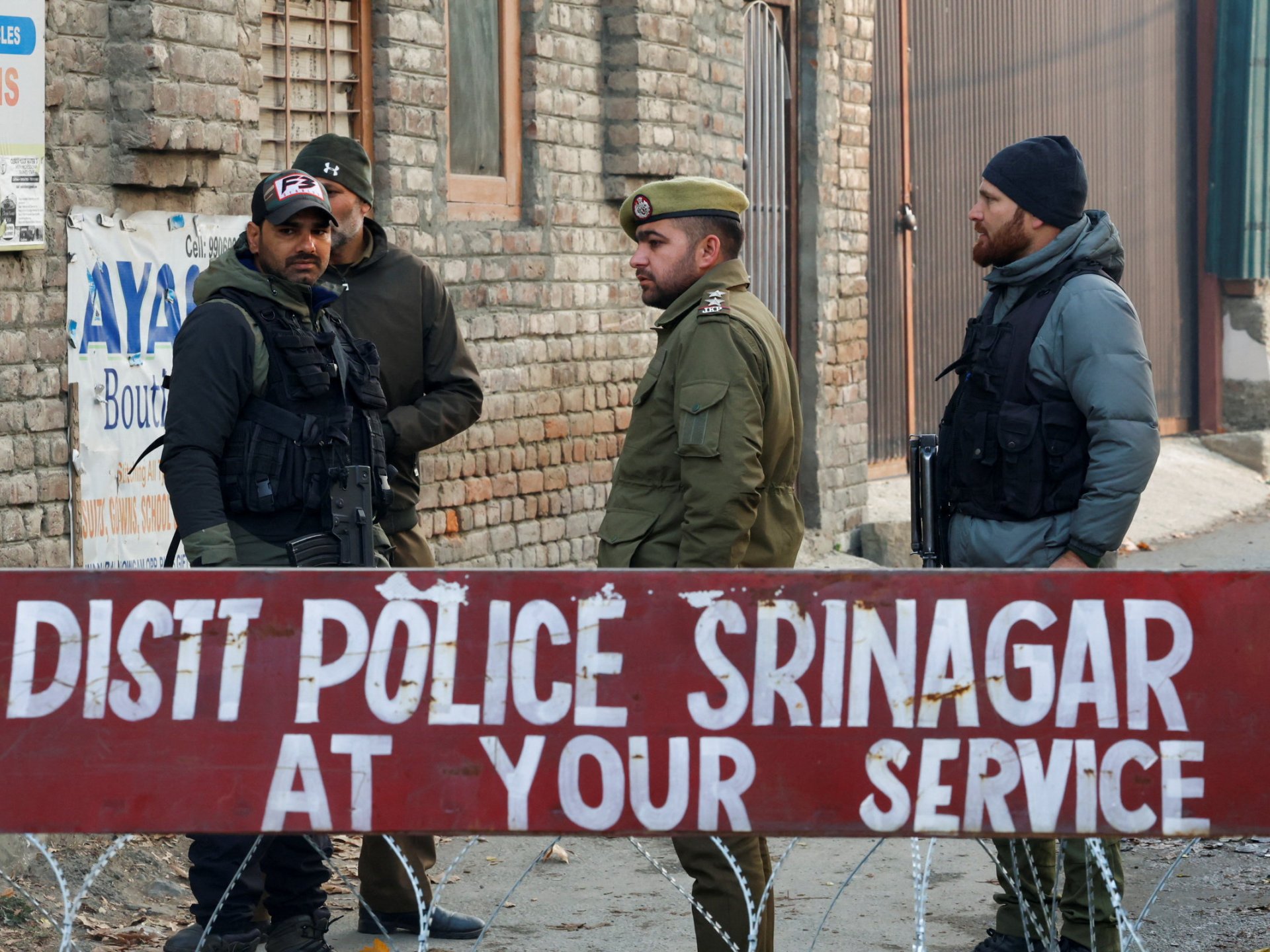
Multiple videos shared on social media by Indian media outlets and individual users showed policemen in riot gear gesturing to pedestrians or those driving vehicles to stop, and asking for their mobile devices. If the devices were locked, people were instructed to unlock them as officers shuffled through them.

Police said they have taken action against more than 100 people across the region since December 29 for violating the ban orders, adding that “security proceedings” were initiated against the “violators”. Those who were initially “identified” for violations were let go only after their “antecedents” were verified to confirm they had no connections with a “terrorist”, the term the government uses for Kashmiri rebels.
“Genuine users were released after detailed device analysis with a strict warning to refrain from VPN usage in the future,” a statement issued by the police said on January 2.
An estimated 20 percent of India’s 800 million internet users use VPNs. Surfshark, a cybersecurity company based in Amsterdam, estimates that India has the world’s largest number of VPN users, with a market size worth $17bn.
Frequent disruptions
Internet restrictions in Indian-administered Kashmir are not new.
Of the 901 internet shutdowns the Indian government has periodically imposed across the country, Kashmir accounts for nearly 50 percent of them, according to a monitor which started recording the blackouts in 2012. However, the intensity of such blackouts in the region has come down in the last few years.
When the Indian subcontinent won its independence from British rule in 1947, the Himalayan region of Kashmir was divided between India and Pakistan, though the nuclear-armed neighbours claim it in full and have fought three wars over it. China also controls a sliver of Kashmir’s land.
In the late 1980s, an armed rebellion against New Delhi’s rule erupted to seek independence for Kashmir or merge it with Pakistan. In response, India deployed nearly a million Indian soldiers there and gave them extraordinary powers to control the region. The conflict has so far claimed tens of thousands of lives, most of them civilians.
Advertisement
India further tightened its grip over Kashmir in 2019 when Prime Minister Narendra Modi’s right-wing government scrapped Article 370 of the Indian Constitution, legislation that granted a special status to the region by not allowing outsiders to get government jobs or buy properties there. The government also divided the semiautonomous region into two territories – Jammu and Kashmir, and Ladakh – and brought them under New Delhi’s direct rule.
Kashmir residents say the VPN ban is another addition to an ever-expanding list of restrictions on civic freedoms in the restive region.
A 32-year-old Kashmiri journalist told Al Jazeera he often relied on VPNs for work, but fears he will no longer be able to do so under the new restrictions.
“It is common for journalists in conflict zones to use VPNs for safety, especially when working on investigative stories,” said the journalist who requested anonymity over fears of reprisal from the authorities. “Now, that layer of protection is gone.”
Mir Umair, a 24-year-old businessman in Srinagar, said the VPN ban has cut his access to Bayyinah TV, an online platform of Quranic studies run by an Islamic preacher based in the United States.
“There’s nothing political in his speeches. Just religion. He has never talked about Kashmir except once when he narrated an episode of meeting a Kashmiri pilgrim during Hajj,” Umair said, adding that Khan’s channel was banned last year in May following the four-day India-Pakistan military clashes.
“I used to access his channel via VPNs,” he said.
Ahmad, a local lawyer who gave only his last name, fearing retribution from the authorities, told Al Jazeera the VPN ban could be unlawful.
“The legality of the order is doubtful as it is supposed to comply with India’s IT Rules that do not stipulate a blanket ban on VPNs,” he said. “One single executive order should not be able to sanction a ban as sweeping as this.”
Al Jazeera reached out to police and government authorities in Kashmir for their statements on the VPN ban, but they did not respond.
‘Unconstitutional policing mechanisms’
Last week, David Peterson, who heads the Geneva-based ProtonVPN company, invited a torrent of abuse from Indian users on X after he posted guidelines on tapping into his application’s “discreet icon” feature to evade the government ban.
“For additional context, Jammu and Kashmir [has] historically been subject to internet restrictions, bans and outages around this time of year to disrupt protests around the Republic Day [January 26] and the anniversaries of the Gawkadal and Handwara massacres,” he wrote, referring to the killings of civilians by Indian forces during the height of Kashmir’s armed rebellion in the early 1990s.
When an Indian X user accused him of facilitating “terrorism” in Kashmir, Peterson referred to the use of disguised apps by journalists working in dangerous environments. “[Like] in countries such as Iran, China, Russia, Myanmar, etc”, he replied.
In September last year, media watchdog Reporters Without Borders (RSF) described Indian-administered Kashmir as an “information black hole” out of which reliable news rarely emerges.
Advertisement
Srinivas Kodali, a digital rights activist and researcher, told Al Jazeera merely having a VPN installed on phones does not amount to a criminal offence.
“People from diverse professions use VPNs for legitimate reasons. This blanket ban is uncalled for,” Kodali told Al Jazeera, adding that the act of stopping people and forcing them to unlock their phones was a “gross violation” of their fundamental rights.
“But in Kashmir’s case, we have continuously seen the state pushing all sorts of unconstitutional policing mechanisms. It is just one more step in that direction.”
Furqan*, another Kashmiri journalist, works remotely for an international media house based in the southern city of Bengaluru. He edits videos on major global events for his organisation and requires access to a bigger repository of online material than he can “legally” scour on the internet.
“India is one of the foremost countries to ban stuff on the internet. Just look at the rate at which the X handles are withheld in India, especially of critics and dissenters. To know who is writing what, a journalist will have to access VPNs,” he told Al Jazeera.
Furqan insists that, as a journalist, he has the right to be discreet about his work, especially when he is dealing with sensitive information.
“Now this ban will hang like a sword on our thoughts,” he says. “Sometimes I am supposed to access the dashboard of the company. And because I am working remotely, it has to happen through a secure medium. So I use VPN. But in the damned region such as ours, even this mundane thing will now be deemed as a criminal activity.”
Furqan says the VPN ban adds to the “psychological pressure” on the Kashmiris. “It feels like we are on trial for our thoughts,” he told Al Jazeera. “A Kashmiri is risking so much even when he does something as basic as accessing a VPN.”
*Names changed to protect the identity of people over fears of retaliatory action by the government.
Related News

Trump says he wants to free up Venezuelan oil flow. What was blocking it?

Five key takeaways from Trump-Netanyahu meeting in Florida

Maduro to appear in New York court: What to expect